
You can launch a one-person Startup Studio — here’s how.
As a Startup Studio expert, this is my Micro-Studio blueprint.

I work with emerging Studios on getting from concept to launch.
There’s a lot that goes into bringing a Venture Studio to life.
- Develop the business model and portfolio design
- Nail a niche and differentiate positioning
- Document the innovation playbook (how to get from idea to launch)
- Build an A-list team of in-house teams of innovators, developers, designers, marketers, recruiters, and back-office support
- Bring on experienced executives like a fund manager and CTO
- Conduct content marketing so people know you exist
- Craft an EIR recruiting plan and engage with good-fit founders
- Network with investors and raise a fund
- The list goes on and on and on
Why is it so hard to build a Startup Studio? Because the ambitions of these Studios are to get big, really big.
The companies these Studios build are meant to scale. Some of the world's most interesting startups have come from Studios including Dollar Shave Club, Hims, Snowflake, Bitly, AirCall, and Rover to name just a few.
But let me let you in on something: it doesn’t have to be that complicated.
Studios are just companies that build companies.
If I establish a company and start building multiple products under that brand, I could stand up a Startup Studio tomorrow.
And you can too.
Now, clearly, there’s a difference between the formal Studio model and this indie hacker model, but that’s simply because the ambition is different. On one side of the spectrum, the goal is to build companies that are venture scale and can sell for millions, on the other side the goal is to build products that can generate cash flow and sell for a few thousand dollars.
Neither is better than the other, they’re just different.
Thousands of indie hackers around the world are running Micro-Studios and don’t even know it. They’re not doing it wrong, they just haven’t formalized their processes like a Studio would.
Key Studio Rules
Studio-born startups launch faster and fail less frequently than traditional startups because Studios follow rules when venture building.
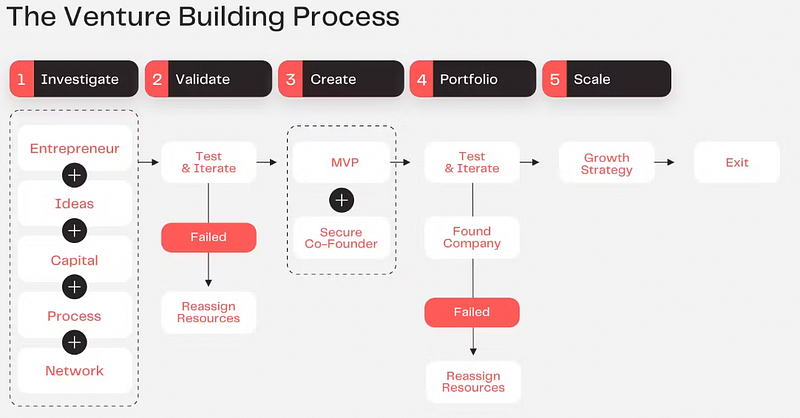
- Studios have an innovation playbook that gets refined over time to make it faster, cheaper, and easier to validate and launch new ideas
- Studios are disciplined in following “stage gate” criteria — meaning they go through a rigorous ideation process before moving on to validation. They don’t start building an MVP until validation criteria are met.
- Most of the time, ideas are killed as the startup advances through these stages. Because of the strict evaluation criteria in each phase, it often becomes clear that the idea isn’t viable. They kill it and move on to the next one. This process ensures that little time is wasted on ideas that are destined to fail.
Startup Studios follow these rules and often win the game. Indie hackers don’t typically structure their innovation processes this way and thus waste too much time on something that no one wants or needs.
If you‘re an innovator with lots of ideas, establishing a one-person “Micro Studio” is a fantastic path.
Here’s the blueprint 👇
Choose a Niche
Studios specialize to make the resources and playbooks valuable. Big Studios choose big niches, like FinTech, HealthTech, and BioTech.
Micro-Studios need to choose micro niches.
The following screenshot from the “categories” section of ProductHunt will give you a good place to start. Other places to find inspiration for your niche are Aquire.com and IndieHackers.com.
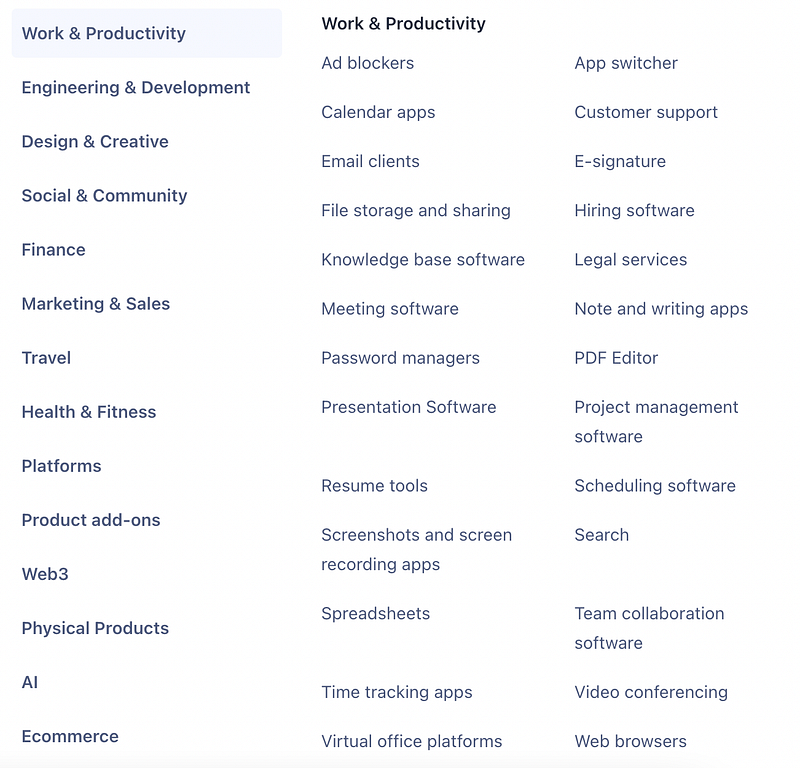
Focus on finding a niche you’re passionate about and one where you can leverage no-code tools to build + test quickly.
Big Studios spend ~4 months across the ideation and validation phases and another ~6 months building the product. Your timeline will be shorter.
Spend 2 weeks on ideation, 4 weeks on validation, and 6 weeks on MVP build.
Each product should take 3 months or less to launch.
Establish One Brand
Do you run it as a freelancer or you have setup the company?
This question comes up a lot.
My answer: you don’t need to set up an LLC until you’re making $1k+ MRR.
You do however want to establish a brand. In my experience, this helps you from becoming overwhelmed. You’re multiple products building under one umbrella.
When one of those products hits $1k MRR, establish an LLC for it. Better safe than sorry when it comes to taxes and if you ever want to sell it, you’re going to need an independent entity.
Avoid Shiny Object Syndrome
Frustration comes from competing priorities. The solution to this is working on one thing at a time.
Yes, you’re building multiple products — but one at a time. You’re a single person responsible for everything from validation to MVP development, don’t try to do this with multiple ideas at a time.
I like this hack from a contributor on IndieHacker.com:
I can write down the ideas, but can’t work on them. It’s almost like a reward for finishing my current project to get to work on the new, exciting project. — pstorm

Partner Up
You very likely have a vertical skillset. Maybe you’re a fantastic marketer — pushing products out into the market is your superpower. Or perhaps you’re great with design — you can stand up beautiful landing pages in minutes. The problem is, great designers aren’t often great marketers and brilliant developers are often bad at validation activities like talking to potential customers.
My advice is to find some partners and help each other.
There are great communities of founders and innovators out there — Indie Hackers being one of them, YC Co-founder match being another, Beta List being yet another, and the thousands of Slack groups, Skool communities, and Discord servers that are full of entrepreneurial folks.
Find the people to fill the gaps.
Work together with them to share services — I like to trade skills, myself. I know I’m good at marketing but I’m not good with design. So, I’ll help with the validation and GTM of a cool idea if they help me with design.
Big Studios have in-house teams for these shared services.
You need to build a tribe and make your own collective.
Get Started
To recap, building a Micro-Studio is possible. The hard part is executing but that’s what Indie Hackers do best.
- Develop a lightweight innovation playbook and refine over time.
- Build a startup studio focused on a single vertical (niche).
- Establish one brand to serve as the umbrella for your products.
- Don’t work on one project until you’ve completed or killed the last.
- Seek help from other Indie Hackers with the skills you lack.
The most important thing is to get started. Don’t spend too much time planning and thinking. One weekend is all you need.
If you want to learn more about Startup Studios, I write detailed breakdowns and insights every day on LinkedIn.
I also publish a Startup Studio newsletter every Friday.
Then there’s this blog with hundreds of articles on Startup Studio models. Here are a few that you might like:


