
You Can Be at Peace with Your Parents
Even if they don’t support any of your choices.
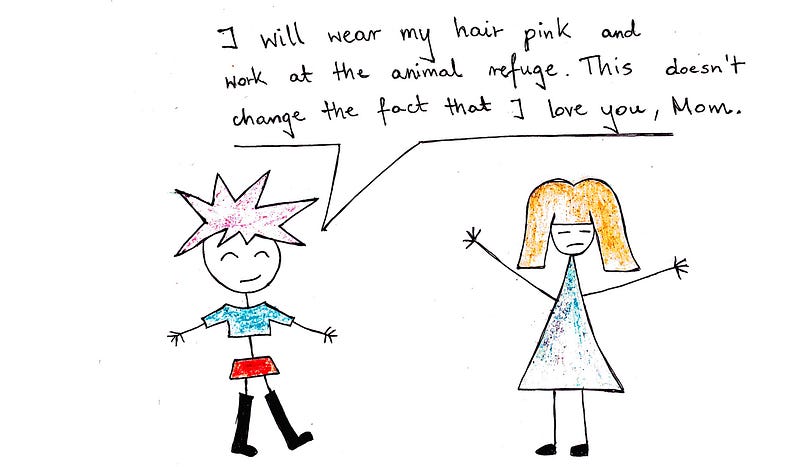
When you finish school and start figuring out what the hell you’re supposed to be doing on this planet — your whole world shakes. Suddenly, you’re forced to make choices that you don’t feel prepared to make at all.
The post-grad confusion doesn’t only happen because of too many possibilities. You know you can figure your way out of them, after all. The bigger problem may be that the people who used to support you all your life suddenly don’t get you.
They think that your “search for your path” is just a way of escaping responsibility.
This usually happens with parents, when their grown children start making first independent choices at they step into adulthood. The upheaval begins when parents openly disprove those choices.
Let’s get this off the table first.
After college, I finally discovered how important it was to follow my heart — rather than what I’ve been told. I was finally ready to do whatever it took to determine my authentic calling. My parents, however, didn’t understand that.
They insisted that I should have figured it out already. They insisted I stopped “searching” and started “living a normal life.” They got angry, sad, disappointed or anxious because of my choices. They tried to make me apply for specific jobs, so I could finally “settle.”
Many times I was tempted to say or do anything just to comfort them — and myself. To soothe the frustration on both sides. To put out the burning conflict in our relationship and finally stop discussing my future.
But I couldn’t take a job my parents suggested just to please them. After four years of ups and downs in our relationship, I can finally own this simple truth:
My life is mine — not my parents’.
No matter how many amazing things they did, are doing and will do for me — I will be the one to bear the consequences of my choices. No matter how much they love me — they don’t always know what’s best for me.
For the longest time, I couldn’t articulate that while remaining loving and respectful towards my parents at the same time. I was caught up in drama. I felt angry. I thought I had to choose between following my own path and being at peace with my parents.
In hindsight, I can see that this was nonsense.
The fact that they didn’t understand my choices felt so uncomfortable that I thought something was wrong with all of us. That this conflict wasn’t supposed to be happening. That one side of the conflict had to “win,” while the other “loses.”
Today, I see it differently.
It was a completely natural experience we needed to go through together. What I saw as needless drama was actually a necessary rite of passage.
The young adults’ soul-searching is a rite of passage.
The world looks different now than it did 40, 30 or even 20 years ago. Our personal and professional lives are defined by fluidity. Human behaviour naturally adapts to match this.
We are changing our ways of communication, core beliefs, work routines and leisure activities. On a bigger scale, the default human life cycle is also not the same as it used to be.
Our life is no longer divided into four basic phases: childhood, adolescence, adulthood and old age. As David Brooks points out in his essay, it is now comprised of at least six of them: childhood, adolescence, odyssey, adulthood, active retirement and old age.
The one you’re concerned with is the odyssey. Typically, it starts after you’ve completed the plan your parents devised for you (formal education) and you’re just dipping your toe in how it feels to live on your own terms.
I see the odyssey years as just one long rite of passage. The transition from the young and careless, into the adult and responsible version of you. And yes, this transition is messy. As society doesn’t currently offer any “official” framework to go through it, you’re bound to figure this out on your own.
Two great anthropologists, Victor Turner and Arnold van Gennep, propose that any rite of passage consists of three stages.
Because you’re transiting from one social group (youth) to another (adult), the first stage is to step away from your familiar environment — i.e. separate yourself from what you know. After that, you enter the second, “liminal” stage in which you don’t hold to your old identity anymore — but you also haven’t established the new one yet.
This is a fancy way of saying that you feel lost.
Finally, as the rite of passage is coming to a closure, you start incorporating yourself back into the society — but with an updated identity. That’s the third stage.
By the end of your odyssey, you discover so much about yourself that you’re able to re-enter society on your own terms.
Now, how does the conflict with your parents fit into these events?
Simple. Going through your odyssey means you’re finally growing up. You’re clearer than ever on the values you want to direct your life by. You’re also questioning the way your family raised you to live — for the sake of finding your own authentic way.
If your way turns out dramatically different from theirs, this obviously causes pain to everyone involved. This is how conflict is born.
But does it mean that you can’t be at peace with your parents?
Absolutely not.
The point is to cease looking at this conflict as a “bad” thing, or a sign that you’re doing something “wrong.” You’re not. What’s manifesting is a perfectly natural and necessary part of the process. It’s actually a sign that everything’s unfolding as required.
To come to terms with it, all you need is a shift in your mindset.
You are only seeing a part of the picture.
When I graduated, I started travelling immediately. During that time, I took on various jobs, from social work to cleaning and waitressing.
My parents were far from amazed.
They had hoped me to just finish college, maybe take a few months off to recalibrate — then dive straight into a stable, fairly paid, intellectual job.
But that was not at all what I did.
Instead, I moved to the UK and launched a theatre project with my friends. It collapsed after a few months. I started working as a carer for disabled people. Then, I moved to the French Alps to wait tables and clean rooms at a mountain lodge. After that, I became jobless for half a year — because, hell, I had enough savings to live on.
Today, I see many things that I could have done better. But I also know that I was doing my best at the time.
Being born into a middle-class family and having received an excellent education, I was — as Niklas Göke put it — “fighting to thrive, not survive.” My parents, however, didn’t see it this way.
What they saw was a mountain of missed opportunities. What they felt was fear about my future and disappointment that I was putting all the life advantages they granted me to waste. What they thought was probably just that I’d gone crazy.
But while they failed to understand my perspective — I also failed to understand theirs. The funny thing is that, at the time, I thought I knew just what they meant. In reality, I was too clouded with my emotions to even really listen to them.
And that was a big part of my problem.
I was so focused on getting them to approve my decisions that I couldn’t see the bigger picture. Because I wanted a specific outcome out of our conversations (make. them. understand.), I failed to see other things that were going on.
I think we all do this to some extent.
We’re so caught up in our own story, that we forget we’re only seeing the world from one perspective. We rarely take the effort to really put ourselves in the shoes of the other person.
I wish I did it more often back in the most difficult days with my parents. And if I could give my younger self a handful of tips to open her eyes a little? They would be these:
- Your parents have very real feelings, just as you do. Their feelings are not more or less important than yours — but they’re equally real. Just keep that in the back of your head before you say something hurtful.
- They’re treating you like a child because this is the role you’re playing. You may think of yourself as grown-up and independent. But at the same time, by explaining yourself to them and seeking approval, you are signalling that you’re still not your own person. Their protective attitude is a natural response to that.
- What you say is not what they’re hearing — and vice versa. You have to remember that all the information you give them about your life is selective. They have no other choice but to fill in the gaps in your story with their own details. And you’re doing the same with what they say. There’s no way around it. This is how humans communicate. Just keep this in mind next time you feel like you understand them — but they fail to understand you.
- If you want more peaceful interactions, you have to listen to your parents. Are you really listening? Or just using the time when they speak to prepare your next argument?
Simply start noticing these things as they arise in your interactions. Is there something important you may have been missing? How can you make yourself see beyond your narrow perspective of being the “misunderstood child”?
Once you start asking yourself such questions and observing the answers, one thing becomes crystal clear:
You don’t have the power to change your parents.
If you want to feel more at peace with them, the only way is to adjust yourself.
Don’t try to change your parents — adjust your mindset instead.
The more attention I paid to what was going on between me and my parents, the more our interactions shifted.
First, we stopped yelling at each other and switched to heated, but respectful discussions. Over time, we all started sharing what bothered us in a more peaceful and gentle way.
I realized that the more I listened — the more I was also listened to. The more confident I felt about my choices — the more my parents responded by respecting them.
Because my mindset and the way I engaged with my parents were shifting — our whole relationship followed suit. By bringing a new attitude to our interactions, I created conditions for a different kind of conversation.
Seth Godin recently wrote on his blog:
“You can’t make people change. But you can create an environment where they choose to.”
That’s a powerful statement, once you realize how true it is. Changing other people by telling them how they should behave never works. You only have agency over your own attitudes and actions.
By changing yourself, you also create a new environment for those around you. And when the environment is different, people are bound to start acting differently, too.
If you want to transform your relationships, the best thing you can do is to change your own attitude. With that, you invite others to follow along.
- Want to get people to listen to you? Start speaking quietly and use fewer words.
- Want others to respect you? Put yourself first in your own life and treat yourself as worthy of respect.
- Want people to trust you? Listen to them attentively and without judgment.
Do you see what I mean? If you want to experience more peace with your parents, you cannot delegate the responsibility for that peace to them. This way, you only disempower yourself.
You need to look for ways of adjusting your mindset that will cause your experience with parents to shift.
“It is far more useful to be aware of a single shortcoming in ourselves than it is to be aware of a thousand shortcomings in someone else. For when the fault is our own, we are in a position to correct it.” — Dalai Lama
This is what I want you to take away.
So how can you shift your mindset to invite more peace in the relationship with your parents? Here are a few things to remember:
- Accept that this experience is hard. The odyssey period is a relatively new phenomenon and both you and your parents may have trouble navigating it. That’s natural. Remind yourself that just because it feels hard, it doesn’t mean it’s wrong.
- Treat your feelings as valid. Your internal experience and your emotions count. Accept them as valid and necessary — they are already happening. Your feelings are probably teaching you something important. Even if the lesson is not clear now, it will become clearer from hindsight.
- Remember where your parents are coming from. It’s sometimes easy to forget that the force driving your parents’ actions is their love to you. They may not be doing exactly what you’d wish them to do. But they’re doing the best they can with what they have — just as you are.
- Zoom out and gain perspective. What you’re experiencing now is not going to last forever. Maybe you’re making it a bigger deal than it has to be? After all, this is just one stage of your life. A time will come when you’ll look back at today’s events and smile to yourself.
- Forgive yourself and your parents. You don’t have to cling to what happened in the past interactions with your parents. What any of you said cannot be unsaid — and blaming anyone won’t change that. The only way to move forward is to give yourself (and them) a fresh start each time you come together to connect. The only way to new possibilities leads through forgiveness.
If you wholeheartedly commit to shifting your attitude, your relationship with parents is bound to shift, too.
If you make a continuous effort to transform yourself, they will have no other choice but to follow suit.
On the way, you may also run into an important lesson or two. I just hope you keep your eyes and mind open enough not to miss it.


