
You Can and Should Travel to Cuba
This beautiful island provided lessons in politics, culture, and humanity
We were targeted because we were American, white, and English-speaking.
That’s right. As soon as the flight attendant saw us coming down the ramp, she said “Can you sit in the emergency exit row?” We said yeah, sure.
We were one of only a few passengers on this flight from Florida to Havana who met the above description, and apparently, you need to speak fluent English to sit in the emergency exit rows. Before the plane even started to taxi, we got our first lesson in how different life is for Cubans than it is for Americans.
As we stowed our small backpacks under the seats, we watched everyone else loading huge, and extremely heavy suitcases into the overhead compartments. The flight attendants were getting visibly annoyed when it became clear that everyone on this flight was carrying the maximum amount of luggage, and bin space was dwindling quickly.
Then a member of the ground crew came aboard. He spoke about the same amount of Spanish that we did, which I often describe as survival level, but it was more effective than the really loud English that had been attempted by the crew so far.
He was a self-described loud New Yorker, and he immediately took over the somewhat chaotic scene. His name tag said Carl. I took note of it because he was a fantastic character study being both brash and genuinely respectful to the passengers who needed to cram their bags on board somewhere. He also took on the role of educating the crew, who weren’t the regulars on this flight to Havana.
“We do this three times a day,” Carl explained. “These bags are full of baby formula, medicine, and canned food.”
“Every American should spend three days in Cuba to see how they live.”
We were about to find out for ourselves just how right Carl was. Life in Cuba means living with just 6–8 hours of electricity on most days. Cubans in Havana wait in long lines to enter mostly empty stores to purchase the sparse food or supplies that exist there.
By some calculations, Cubans are currently experiencing inflation around 500 percent. This is due to several factors, including those that are affecting the rest of the post-Covid world. But, Cubans have been hit particularly hard due to the historically long trade embargo imposed by the US government and restrictions on remittances that family members can send to those in Cuba.
After a brief easing of relations with Cuba in the Obama years, sending money to or doing business with Cubans was restricted again in 2019. That situation hasn’t actually improved for everyday Cubans even with the few policy adjustments from the Biden administration. (You can take a deeper dive into this if you’d care to read the 42-page “Cuba: U.S. Restrictions on Travel and Remittances” published by Congressional Research Service in December 2022.)
What does this mean for the US traveler in Cuba?
It means, it’s definitely a more difficult place to travel to than the other Caribbean destinations that are so easy for us to reach. It means US credit or debit cards won’t work in Cuba, so your transactions are all cash based. It means you can not spend money in any of the government-owned businesses, such as the majority of hotels or resorts on the island.
For us, it also meant that we had the opportunity to directly support the Cubans we met while there. Casa particulars are the accommodations hosted by individual Cubans, who are incredibly eager to share their homes and their beautiful country with tourists. These accommodations that can be found on vacation rental sites are also a lifeline for the hosts, who use the dollars to buy basic necessities for their families. In turn, we shared not only our cash, but chocolates, nuts, and candies that simply can’t be found in Cuba.
Renting a room from individuals, who hustle to make a few extra bucks from the lagging number or tourists, also gave us the opportunity to learn about their lives.
Blanca moved with her young son and mother from the countryside to Havana several years ago. She works for Manuel, the owner of several apartments in a majestic yet crumbling building in Old Havana. I asked her if it was a “good job”, and she said it was just okay but significantly better than the income she could get as a teacher or even a healthcare worker.
Cubans gained somewhat reliable internet access about eight years ago. That connection to the rest of the world has allowed hosts like Yameli, who we stayed within the western town of Vinales, to turn her farm into an Airbnb property. She now employs several other women who help clean the rental units and cook amazing meals for their guests. By the way, those meals cost less than $5 US.
Roberto is a teacher at the university in Havana, but he also has to work as a rental property manager to make ends meet. Though he has significant concerns about the economic and political future of his country, he wants to stay rather than follow his many friends who have left the country in hopes of a better future elsewhere.
We heard this over and over, that working a government job simply doesn’t earn enough income to support a family or even an individual. Everybody needs a side hustle just to get by.
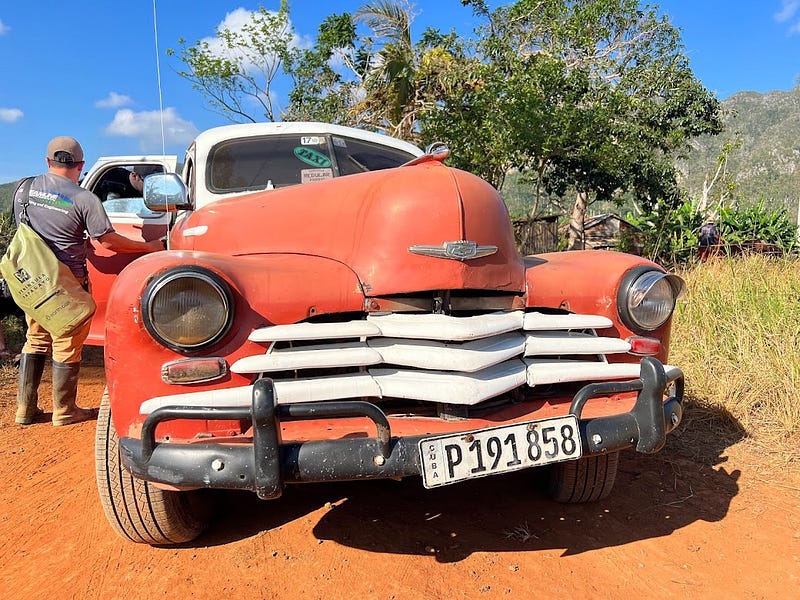
Among the struggles, the deteriorating architecture, and the iconic American cars from the mid-twentieth century, Havana has an electric pulse running through it. There is, of course, the salsa music, the nightlife, and the amazing coffee and rum. But much of the energy comes from the Cubans who are straining within the confines of an authoritarian government to make changes to a system that hasn’t fulfilled its promise of freedom and success for its people.
Those currents run just underneath the bustle of everyday life in Havana and out in the countryside as well. Cubans who repeatedly spoke to us about the conflicts between our two countries and their disappointment in their own leadership would invariably say “It’s not the people, it’s the governments.”
They are of course right. Changes to US policies that would allow remittances to Cubans and business transactions between the two countries would improve the lives of Cubans significantly. Changes from the Cuban government that would permit its people a voice in the growth and modernization of the country without fear of imprisonment would give hope to those who want to see their nation and people succeed.
Americans going to Cuba must declare a specific purpose for their travel. Ours was the support of the Cuban people. People to people support through tourism is essential to Cubans’ daily survival right now. When Carl, our tough love airline employee in Florida, said “This is a humanitarian flight,” he was spot on. He was also right in his claim that everyone should visit Cuba, not only to see the difficult living conditions, but also to meet the incredible people rising above them.
While travel to the island is a rewarding way to economically support the Cuban people, the following organizations are also dedicated to improving the lives of Cubans.