
You Aren’t Ready For Polyamory
If you aren’t willing to communicate on a very high level and to be responsible for your own emotions
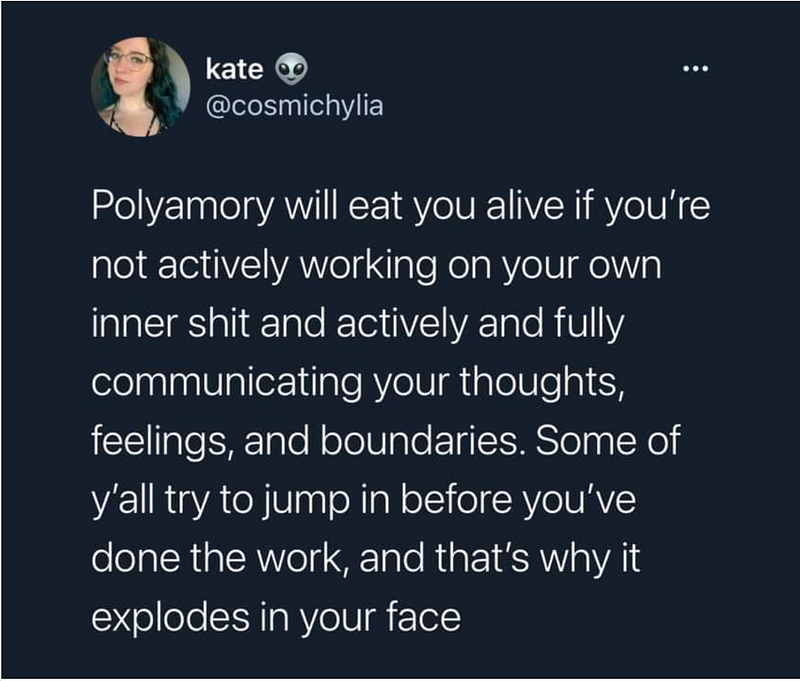
As Thomas H. Brand recently pointed out in his excellent story, 7 Questions To Ask Yourself Before You Begin Polyamory, “there are a lot of assumptions bundled up with modern relationships that we don’t even realise are influencing us.” In other words, most people rely heavily on the structure of monogamy and the expectations that go along with that, without even realizing that it’s what they are doing. Because of this, there are so many things they’ve never really discussed with their partner that they would need to when changing relationship styles.
If you are in a happy and healthy monogamous relationship, you may think that you and your partner communicate quite well, but almost certainly, it is not nearly the level of communication that is needed to have a successful polyamorous relationship. My husband James and I discovered this for ourselves when we decided to open up our marriage about 6 years ago.
We thought we had a pretty egalitarian marriage; we thought we were quite skilled at conveying our thoughts and expectations to each other. Pretty quickly, we learned, that wasn’t actually the case. We were simply used to relying on the largely unspoken rules of monogamous marriage and when we didn’t have those to guide us any longer, we had to really up our game. Needless to say, this created some initial bumps in the road, although fortunately, we got through them and came out better on the other side because now we have a much closer and even more authentic relationship.
Since then I kind of half-jokingly like to say, “The best thing about ethical non-monogamy is that there are no set rules, but it’s also the worst thing as well.” This is because it’s one of the hardest aspects. Without an inherent structure, there is no road map, which means that you and your partners have to/get to co-create one together. In order to be able to do this, you’ve all got to be doing the work to be self-reflective, self-responsible, and clear about what you want and expect about nearly every aspect of the relationship. Needless to say, this can be a lot of work.
When James and I were monogamous, it went without saying that we wouldn’t have sex with anyone else besides each other. Although we’d never talked about it, I think our mutual assumption was also that neither of us would engage in any sort of intimate relationship with anyone else, but the definition of what constituted an intimate relationship was never discussed.
In the conversations that we had after deciding to open up but before we ever got together with anyone else, James told me about a former co-worker that he had been really drawn to, and that she had felt the same. Nothing inappropriate was ever said or done, and they never communicated outside of work, but nonetheless, an intimate connection was there. It was a strong enough connection, that under different circumstances, it might well have turned into something meaningful.
Did that violate our marriage vows? Probably not, but it’s also not something that we’d ever remotely considered discussing under the auspices of monogamy and so it was an aspect of James’ life that he just kept hidden from me. I think there’s probably a lot of that kind of don’t ask, don’t tell in most monogamous relationships because being somewhat territorial is considered appropriate, and jealousy is expected. Most monogamous couples aren’t in the habit of sharing their crushes or attractions with their partner for that reason.
But in order to successfully navigate any sort of ethical non-monogamy (ENM), this is exactly the sort of thing that would probably need to be discussed (although some partners might agree that it isn’t). I don’t expect James to tell me about every single person that he finds attractive, but I do expect him to tell me about anyone that he’s developing a connection with, no matter the depth of it. That way, we’re both on the same page about where he is or where I am, and how that might potentially intersect with our relationship.
Early on, we tried to come up with rules for every contingency, but what we learned the hard way is that this can also backfire. When multiple people are involved, there are too many moving parts to be able to foresee every single contingency. What we also discovered is that fences don’t make for healthy relationships — that was a hold-over of monogamy-oriented thinking. Now we have some basic agreements, and the rest is built on trust and good communication. Trying to control every aspect of our interactions with other people isn’t going to work, and we don’t need to do that in order to feel secure within our relationship.
Unless your partner is violating agreements that you’ve made together, jealousy is essentially your issue, and not your partner’s. Jealousy is typically about one’s own insecurities, and that’s not something that is the other person’s job to manage, but it’s also a great thing to have a conversation about together just to be transparent and supportive of each other. This isn’t always easy or fun, but being willing to have difficult conversations is one of the hallmarks of ENM success.
A few weeks back James and I got into a discussion about something that had happened in our early days of polyamory where we were still learning the ropes and making a fair number of mistakes. He and I have an agreement that we only see other people together. This isn’t necessarily typical for polyamory, but then again, it doesn’t have to be, because we get to make our own relationship parameters.
Although we only get together with others as a couple, there have been many instances where I am the one who is doing most of the communication with a partner or potential partner, and that is totally fine with him. In one such case, I’d been flirting with this man for several weeks and we were making plans for a date. I ended up sending him a picture of me in a lacy bra, something that I thought nothing of because I’d sent similar pictures to other people before that with James’ knowledge and approval.
When James came home and found about it, he was furious. He felt like I should have told him beforehand that I was going to do that. My perspective was that it happened on the spur of the moment, and he wasn’t there to tell. Besides, I didn’t think it was a big deal since we’d agreed in the past to do that with other people and after all, it’s my body to do with as I please within our agreed-upon parameters.
If we’d still been monogamous that would have been a different story, but we weren’t any longer and I resented him trying to control things within the boundaries of what I thought we’d already agreed to. James was still dealing with monogamy-oriented ways of thinking about me in relationship to him, and he felt left out and in some ways, made a fool of. We hadn’t talked about that incident for years and years, but when it came up again the other day, we sat down and really finished hashing it out.
I listened to him about why that was hard for him and validated that at that time, he was still learning to no longer view me as someone whom he kind of owned. He listened to me about how I felt surprised that he would react that way, and how unfair I felt it was for him to be angry in that situation. Tensions got a little bit high for us both as we recalled the difficult emotions that we’d felt at the time, but we also really listened to each other and were vulnerable with each other. By the time we were done, we’d cleaned it all up and felt even closer to each other for having had that conversation.
These days we don’t wait years to thoroughly talk about things like that, and there are fewer misunderstandings or miscommunications in the first place, but they do still arise from time to time, and that’s really OK with me. As good of a relationship that we had before, I love the way that being able to talk about absolutely anything and everything has brought us even closer together. There are no longer any secrets, no matter how minor, and we both have to do the work of becoming more self-aware so that we can talk about what is really going on for us.
We both get to (and have to) keep co-creating our relationship by being honest and transparent about every aspect of it. Can monogamous people do that too? Of course, although I think that it’s probably pretty rare, based on my own experience and from what I see about how most couples relate to each other.
But in any case, if you are even considering polyamory or any form of ethical non-monogamy, just be forewarned that the best way to have it be successful is to do the work that it takes to understand what is really going on for you as far as your own desires, fears, and insecurities, and then to routinely have honest discussions about those with anyone who might be impacted.
This takes time, effort, and a high degree of vulnerability, but the pay-off is that it also leads to happier, more deeply connected relationships. You can’t just rely on parameters that were created by other people; you have to create your own and then keep reassessing them for viability. In many ways, monogamy is a lot simpler. There’s only one other person to consider and you pretty much know what the rules are.
Polyamory can be very rewarding, however. James and I have never been happier in our relationship. We talk more about all kinds of things, not even related to other people. We make fewer assumptions and are better able to identify what’s taking place for us when we feel activated. Better learning these skills and being forced to use them regularly has led to enjoyable, successful polyamory for us. I would definitely recommend never embarking on ENM if you are not willing and ready to do the same.
© Copyright Elle Beau 2021 Elle Beau writes on Medium about sex, life, relationships, society, anthropology, spirituality, and love. If this story is appearing anywhere other than Medium.com, it appears without my consent and has been stolen.