You Are The Product
6 commitments every content creator should make to save human civilization
The new Netflix documentary “The Social Dilemma” is the scariest movie that I’ve ever seen. It’s not horror movie scary. It’s end of the world scary.
In it, key makers in Silicon Valley pause to reflect on their baby Frankenstein, concluding that the singularity (what’s that?) was the wrong landmark of which to be wary when considering the dangers of artificial intelligence (AI). Rather, Tristan Harris, founder of the Center for Humane Technology argues that the dominion of AI is already here, and that thanks to our cell phone addiction, we’ve functionally handed ourselves over to our super commuters.
I watched “The Social Dilemma” the first time alone, but I watched it the second time with my 10 and 13-year-old, the former a boy, whose media of choice is Youtube, and the later, a girl, who loves Tiktok. They are good and brilliant little people; if we don’t destroy the world by the time they take over, we’ll all be okay.
As we watched, we discussed “sticky content” and “the algorithm,” and I kept my dirty secret.
Medium.
I am a writer on a social media platform. It’s a part of how I make my living. I am a content creator. If I’m any good, then an AI algorithm uses my words to glue my readers to their screens.
I’m a part of the problem. Not the solution.
You will tell me that Medium is different because it’s ad free, and it is advertisers’ greed that drives the runaway train depicted in “The Social Dilemma.” But, I’m not so sure. The film demonstrates that social media is the lever used to heave the boulder of civilization over the metaphoric cliff. It’s a megaphone, not a hammer, and as such, it’s only part of the problem.
The problem begins with content creators. Like me. And you.
Free feed-based Social platforms are driven by learning algorithms so complex they can only be categorized as AI (artificial intelligence). One need look no further than Facebook CEO Mark Zuckerberg’s testimony before the US Congress in 2018 which touched on alleged Russian interference in the 2016 US presidential race for colloquial consensus on that fact. There, Congress asked Zuckerburg how Facebook plans to combat the disinformation campaigns waged by powerful and foreign entities, which likely impacted the outcome of the 2016 elections.
“We need to rely on and build sophisticated AI tools that can help us flag certain content, and we are getting good in certain areas.” he replied.
AI is the problem. AI is the solution.
The algorithms that power our social media feeds are ingenious because they are programmed to learn our ins and outs, drawing on unimaginable quantities of data to do so. Once it does, it becomes an advertiser’s dream, having a near-perfect ability to match product and target market. Entertained and engaged consumers, we willingly give minutes and hours to our screens, rather than our jobs, our relationships, our lives…
When discussing the dominance of algorithms to animate our lives, Christopher Steiner, author of Automate This: How Algorithms Came to Rule Our World explains “We’re already halfway towards a world where algorithms run nearly everything. As their power intensifies, wealth will concentrate towards them. They will ensure the 1%-99% divide gets larger.” We’re seeing this dynamic intensify during the pandemic, as we become even more digital and the uber-rich become even wealthier.
Dr. Shoshana Zuboff, author of The Age of Surveillance Capitalism puts the situation in these chilling terms in the film:
“This is a new kind of marketplace now. It’s a marketplace that never existed before. And it’s a marketplace that trades exclusively in “human futures”. Just like there are markets that trade in pork belly futures or oil futures. We now have markets that trade in human futures at scale. And those markets have produced the trillions of dollars that have made the internet companies the richest companies in the history of humanity.”
We content creators have a major role to play in the machine that is algorithm-driven AI via Social Media. After all, the algorithm does not create the content used to hook users, it simply matches the content we produce with those users who are looking for us. What is more, platforms like Youtube and Medium, which offer creators a share of revenue are especially challenging, as we creators are driven by the potential for profit, even if alongside other motivations like sharing our voice or making the world a better place.
Social Media platforms are visual interfaces that serve up content in a manner that forces creators to compete for user’s attention. Users scroll and swipe, making split-second decisions about where to click. As such, sex sells, as does violence and gossip, those stimuli processed by the lightning-fast reptilian brain. As the groundbreaking 2018 MIT study demonstrated, fake news spread across Twitter six times faster than factual stories. The truth is boring. Social media likes the salacious.
It’s Up To Us
Content creators, alongside technologists, hold the future of human civilization in our hands. As the folks at the Center for Humane Technology
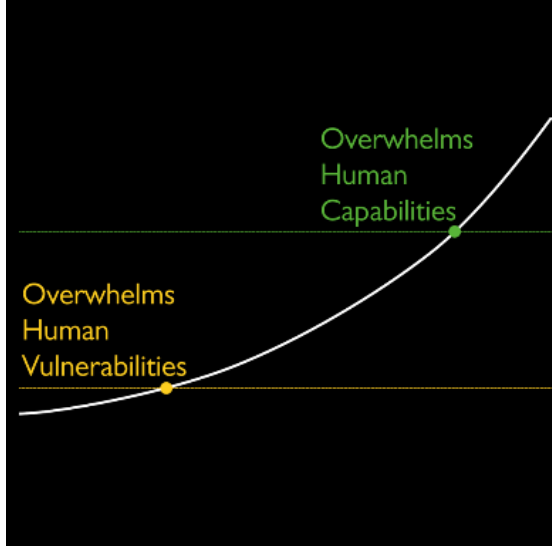
explain, the AI algorithms that drive social media have already captured so much of our attention that they’ve overwhelmed human vulnerabilities, unleashing wave after wave of the very ugliest in us on our public spaces, with people taking up arms in defense of causes they became hooked on through social media. To counteract this, the Center for Humane Technology calls upon technologists and content creators alike to commit to these six principles, to save human civilization.
Six Principles to Realign Technology with Humanity
- Obsess over values, instead of obsessing over engagement metrics
- Strengthen existing brilliance, instead of assuming more technology is always the answer
- Make the invisible visceral, by internalizing the pain your users experience, as if it were your own
- Encourage wise choices, instead of assuming more choice is always better
- Nurture Mindfulness, instead of vying for attention
- Bind growth with responsibility, instead of simply maximizing growth
Read more at Center for Humane Technology, #Principles
Initially designed for technologists, we content creators too need a code of ethics, which calls us to hold humanity in mind, even as we pursue the goal of one more viral story. Our health and our societies depend on it.
More from Sarene B. Arias on Illumination