
You Are Not Your Thoughts
A guide to finding your true self beneath your chaotic mind.

Eckhart Tolle is a spiritual teacher and author of The Power of Now, widely regarded as one of the most influential spiritual books of our time. At the age of 29, he experienced a profound inner transformation that radically changed the course of his life.
One night, not long after his 29th birthday, he woke up in the early hours with a feeling of absolute dread. He had previously battled with anxiety and suicidal depression, but it was more intense than ever before, and he began to question his reason for living. As he played with the idea of suicide, the same thought kept repeating itself in his mind:
“I cannot live with myself any longer.”
He suddenly became aware of what a peculiar thought this was. “Am I one or two? If I cannot live with myself, there must be two of me: the ‘I’ and the ‘self’… maybe only one of them is real.”
He was so stunned by this bizarre realization that his mind stopped. He was fully conscious, but there were no more thoughts. He was then drawn into what seemed like a vortex of energy and could feel himself being sucked in. Suddenly, there was no more fear, and he let himself fall into the void.
Upon waking the following day, the world seemed very different. Although he recognized the room, he had never truly seen it. Everything looked fresh and alive as if it had just come into existence. He knew something profound had occurred, but didn’t understand what it was. It wasn’t until several years later that he realized what had happened. The intense suffering of that night had forced a split in his consciousness. His deeply fearful ‘self’ fell away, and all that was left was the ever-present ‘I’.
The ‘I’ and the ‘self’
Are you your thoughts? Are you your feelings? Are you your body, or bodily sensations?
No. You are none of these. How can you be if they are always changing?
Do you feel different now than you did last week? Have you different thoughts today than when you were in school? Do you look different now than you did 10 years ago?
Of course, you do, but the same person is still looking in the mirror, the same person is thinking those thoughts, and the same person is feeling those feelings.
Your thoughts, feelings and body make up your ‘self-concept’, but this is not who you truly are. You are the observer, the ever-present ‘I’, the one who observes the ‘self’.
Self-Observation
If I asked you to focus on your body or bodily sensations, it’s likely that you ’d focus on a specific area, such as your breath, pulse, or chest.
If I asked you what you were thinking, you can observe this too. You might be planning for the week ahead, or worrying about money, but it’s possible to take a step back and observe these thoughts.
It’s the same for feelings. If I asked you how you feel, you could take a step back and observe how you feel.
The point is, you can take an observer’s perspective of your thoughts, feelings and bodily sensations.
The floating clouds metaphor describes this best:
Imagine your thoughts, feelings or bodily sensations as clouds floating through the sky. Sometimes they’re dark and angry, sometimes they’re light and calm. But you are not the clouds. You are the blue sky who observes the clouds, without engaging. You simply observe them until they pass, and they will pass. Everything passes, good and bad. Be the blue sky. Be the observer.
Why is this important?
Many people are anxious and overwhelmed without realizing why. But it doesn’t have to be this way. Next time you feel agitated or uneasy, take a few minutes to mindfully observe your thoughts, feelings and bodily sensations.
If you feel anxious, don’t engage. Just observe the feelings and let them pass. When you have uncomfortable thoughts, don’t let them define you - let them pass. If you have uncomfortable bodily sensations, accept them as they are, and let them pass. Don’t engage. Be the observer.
If you practice this regularly, you will create a sense of detachment when challenging situations arise. You will still feel it in your body, but there will be a space, and instead of feeling stressed or overwhelmed, you will be able to respond in a rational manner.
All You Need to Know
You are not your thoughts, feelings or physical body. This is your self-concept, which is simply who you think you are.
When I suffered from anxiety many years ago, I used to call it ‘my anxiety’. I felt anxious all the time. This was my self-concept. I turned to drugs to cope with ‘my anxiety’. I looked like and thought of myself as an addict. These were the thinking and physical aspects of my self-concept.
As far as I was concerned, I was an unhealthy looking anxious addict. And yes, this was a fairly accurate description, but it was not my true self, not who I really was.
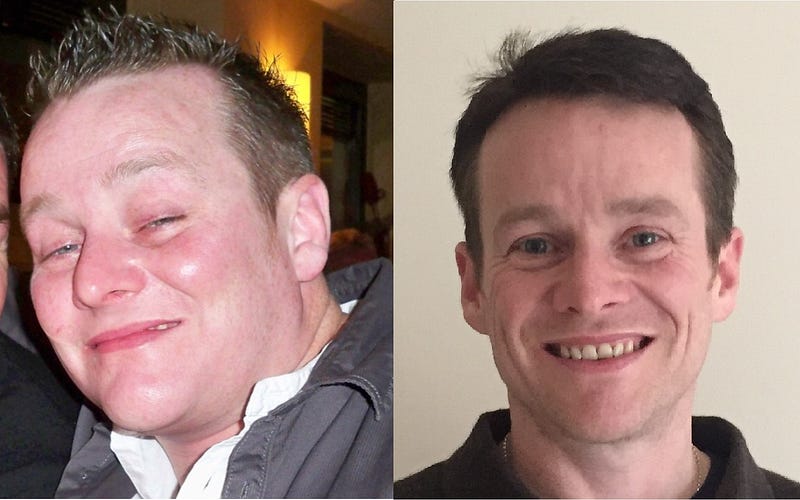
That’s me above on left in 2011, an anxious addict. The picture on the right is how I look today. I don’t suffer from anxiety anymore, and I don’t think of myself as an addict, so how could that have been who I truly was.
I certainly don’t have Eckhart Tolle’s peace of mind, but when difficult situations arise, there is a space, and I respond in a rational manner.
This is the power of self-observation.
What would you do if you had a second chance at life?
Having escaped from the depths of heroin addiction, I decided to devour every second of it. Then I decided to write a book about it. Bonus Time: A true story of surviving the worst and discovering the magic of every moment. You can pre-book here.
Mind Cafe in Your Inbox
Want to stay up to date with our top-performing posts each week? Sign up for email updates by following this link.


