
You Are A Social Media Addict (You Just Don’t Know It)
This addiction is more dangerous than a nuclear bomb
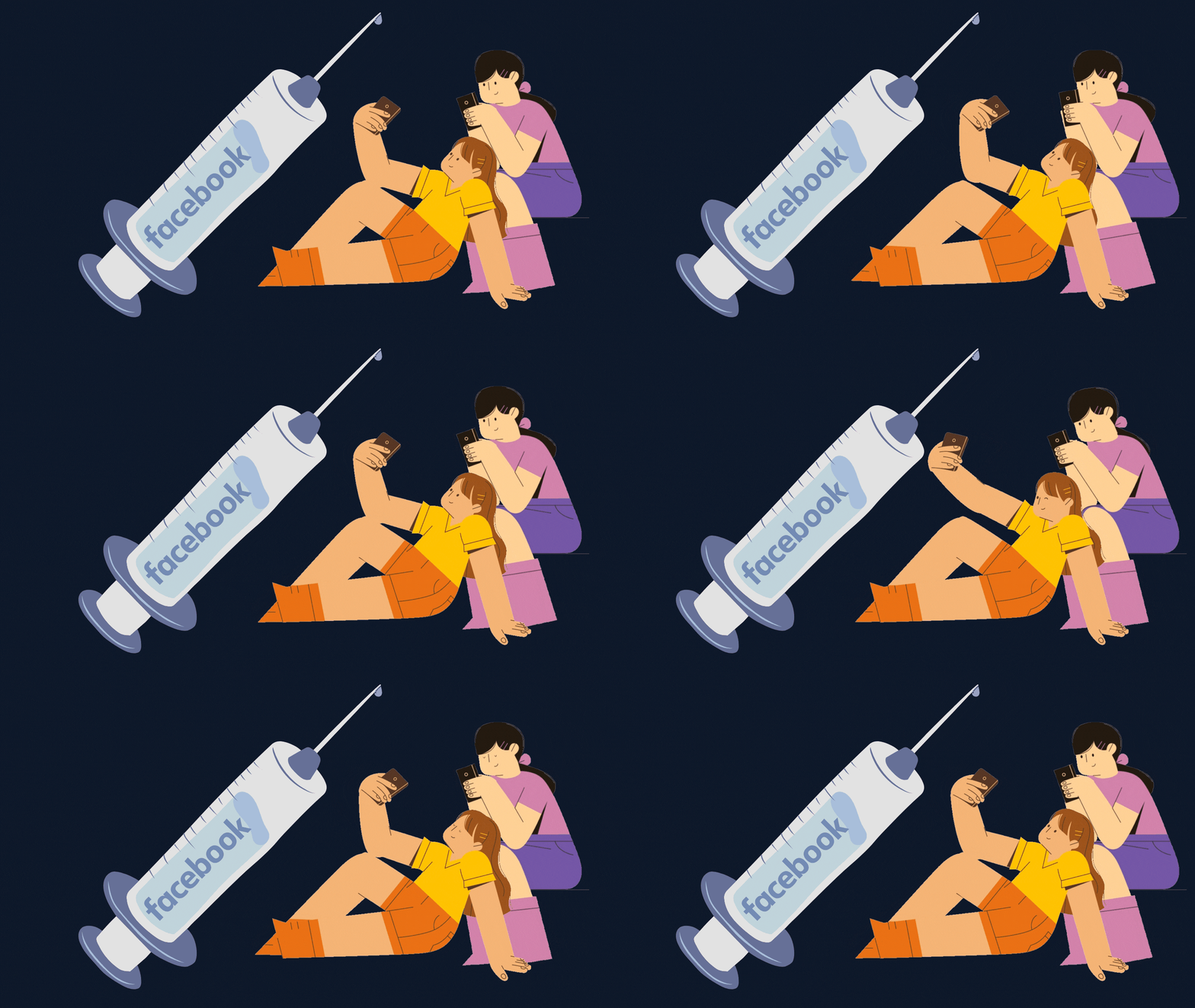
A lot of people think Google’s just a search box, and Facebook’s a place to see what my friends are doing. What they don’t realize is — there’s entire teams of engineers whose job is to use your psychology against you. — Tristan Harris, Former Google Design Ethicist
I must admit that I was a social media addict during my university days, back in 2012. I was young (still I am) and desperate to look cool in others’ eyes. I used to update my status several times a day and frequently posted cool photos with friends adding funny captions. And I was always available on messenger. My message indicator was green 24/7.
To make the situation worse, at that time, I liked a girl who lived in another city. So, we chatted the whole time using social media platforms basically, Facebook and WhatsApp.
At that time, I didn’t know that I was a social media addict. But now, when I look back at that time, I see a boy obsessed with social media to show the perfect version of himself to others. And now, I pity that boy for sure.
This story is not all about me. Now with the invasion of social media platforms like Facebook, Twitter, WhatsApp, Instagram, and many more — everyone has become the victim. But sadly, we don’t acknowledge this addiction. Because when we start to admit it, we will feel the guilt. And no one wants to be guilty.
I think it’s time for all of us to acknowledge that this addiction is real, and it’s ruining the life of an entire generation, making them dumb, self-obsessed, and unhappy.
So, if we want to live a happy and peaceful life, we must acknowledge the fact that something is going wrong with social media.
Am I a Social Media Addict?
In this super-connected world, it’s quite hard to find out a man on the internet without a Facebook or a Twitter account. And it’s okay to have both if you can control them. But can you?
All social media platforms are addictive, and it’s not entirely our fault that we get addicted after a few days of using any of them. The creators and inventors made it that way, by design.
But yes, we can identify who is in control by asking a few simple questions like the following.
➰Do I spend a lot of time thinking and planning what to post next on social media? ➰Do I feel the urge to use the platforms more and more? ➰Do I become anxious when I cannot access them? ➰Do I check my phone immediately when I hear a notification sound? ➰Am I checking over and over again how many likes and reactions my posts are getting? ➰Is social media the last thing I check before bed and the first thing after I wake up in the morning? ➰Do I feel comfortable at social media communication rather than a direct conversation? ➰Do I take too many selfies and continuously use filters and edit them before posting on social media? ➰Do I feel low when my photos or status doesn’t get much appreciation? ➰ Am I losing my patience day by day and getting irritated by simple things? ➰ Can I finish a meeting or conversation without checking or looking at my phone-screen several times?
If your answer is yes for more than three questions, you can consider yourself a social media addict.
A Litmus Test for Social Media Addiction
If you think the above questions are funny, and you are not at all addicted to social media. It’s wonderful. But to be 100% sure — let’s prove it. This is what I call the litmus-test to find out whether you are a social media addict or not.
It’s an easy test. Just deactivate your social media accounts(all of them) for just two weeks and see whether you can function properly without confronting any psychological issues.
If you don’t feel anxious — if you don’t feel the strong urge to re-activate the accounts — if you don’t miss the platforms too much and can function and behave well with others engaging in real conversation, you may consider yourself a non-addict.
But if it goes the other way around and you feel something is missing in your life — if you experience the obvious FOMO in every moment — and if you get upset that you are depriving of the excitement of life, my friend, I have bad news for you — you are definitely a social media addict.
You don’t need to be a great psychiatrist to find out your addictive behavior. A careful observation of your lifestyle will tell you everything you need to know about your social media addiction.
And as always, the first step towards betterment is to acknowledge that you have some issues with social media. Remember, there no shame to say — ‘I am a social media addict, but now, I need to improve my condition.’
What the Social Media Creators Say
I hope most of you have already seen ‘The Social Dilemma’ on Netflix. If not, I highly recommend you see that brilliant, thought-provoking documentary on how social media has taken control of your life and how it is altering your behavior and thought-patterns for their and their stakeholders’ benefit.
Let’s see a few comments from the creators and inventors in this field and learn what they’ve realized over the years, developing and working with this life-changing technology.
Sean Parker, former Facebook President
It literally changes your relationships with society, with each other, and it probably interferes with productivity in weird ways. God only knows what it is doing to our children’s brains.
You know, if the thought process that went into building these applications, Facebook being the first of them to really understand it, that thought process was all about how do we consume as much of your time and conscious attention as possible. That means we need to, sort of, give you a little dopamine hit every once in a while — because someone liked or commented on a photo or a post or a whatever, and that’s going to contribute more content, and that’s going to get, you know, more likes and comments.
So it’s a social-validation feedback loop that, I mean, it’s exactly that kind of thing that a hacker like myself would come up with. Because you are exploiting a vulnerability in human psychology and I think we the inventors, creators, you know, it’s me, it’s Mark, it’s Kevin Systrom in Instagram — it’s all of these people understood this consciously — and we did it anyway.
(Sean Parker, BBC interview)
Tristan Harris, former Google Design Ethicist
How much you paid for your Facebook account recently or your YouTube account. Zero. How are they worth more than a trillion dollars of market value? They monetize our attention. The way they get that attention is by influencing you and getting using just dark patterns or tricks to do it too.
The way to do it with children is they say how many likes or followers do you have. So they basically get children addicted to getting attention from other people. They use filters, likes, etc., beautification-filters that enhance your self-image. And after two decades in decline the mental health of teen girls, high depressive symptoms went up a hundred and seventy percent after the year 2010 with the rise of Instagram, etc.
(Tristan Harris, at Congressional Hearing, January 08, 2020)
Jaron Lanier, the Silicone Valley ‘computer philosopher’
The founders of the great Silicon Valley spying empires like Facebook have declared that they intentionally included addictive schemes in their designs. Now we have to say this is what I would call almost a stealthy addiction. It’s a statistical addiction.
What it says is — we will get the broad population to use the services a lot, will get them hooked through a scheme of rewards and punishment. And the rewards are when you’re retweeted, and the punishment is when you are treated badly by others online. And then within that, we will very gradually start to leverage that to change them.
So, it’s this very kind of stealthy manipulation of the population, so it’s not as dramatic as a heroin addict or a gambling addict, but it is the same principle.
When you watch the television, the television is not watching you. When you see the billboard, the billboard is not seeing you, and vast numbers of people see the same thing on television and see the same billboards. When you use these new designs, social media search, YouTube, — when you see these things — you’re being observed constantly and algorithms are taking that information and changing what you see next.
And, they’re searching and searching and searching, and they’re just blind robots, there’s no evil genius here until they find those patterns — those little tricks that get you and make you change your behavior.
(Jaron Lanier, on how social media ruins your life)
Chamath Palihapitiya, former Facebook Sr. Executive
It literally is a point now where I think we’ve created tools that are ripping apart the social fabric of how society works. That is truly where we are. And I would encourage all of you, as the future leaders of the world, to really internalize how important this is.
If you feed the beast, that beast will destroy you. If you push back on it, we have a chance to control it and rein it in. It is a point in time where people need a hard break from some of these tools and the things that you rely on.
The short term, dopamine-driven feedback loops that we’ve created are destroying how society works. No civil discourse, no cooperation, misinformation, mistruth, and it’s not an American problem — this is not about Russian ads. this is a global problem.
We’re in a bad state of affairs right now, in my opinion. It is eroding the core foundations of how people behave. By and between each other. And I don’t have a good solution. My solution is that I just don’t use these tools anymore. It’s created huge tension with my friends. Huge tensions in my social circles.
(Chamath Palihapitiya, Stanford Graduate School of Business, Nov. 2017)
There Is No Such Thing as a Free Account, You’re Selling Your Life
I know it’s hard to acknowledge, but it’s true. We are selling our life and making a few companies tons of money that we could ever imagine. The problem is — we are not seeing it as a problem.
We think it’s okay to spend a lot of our time on different social media platforms like Facebook, Twitter, Instagram, WhatsApp, and all. Especially the young generation thinks it’s cool to be super-active on these platforms. They are fascinated with the numbers of followers, likes, reactions, comments, and all. They don’t see the negative sides of comparing their lives with other people online. Thus, they are, in reality, ruining their life becoming a victim of social media.
A study published in the American Journal of Epidemiology that assessed 5,208 subjects found that overall, regular use of Facebook had a negative impact on an individual’s wellbeing.
An Independent article says, a study conducted by the University of Copenhagen found that many people suffer from “Facebook envy”, with those who abstained from using the popular site reporting that they felt more satisfied with their lives.
There is a clear link between social media use, negative mental health, and low self-esteem. According to Addiction Center, While social media platforms have their benefits, using them too frequently can make people feel increasingly unhappy and isolated.
When you think that social media platforms are free, and you can use them whenever you want — you become the victim. You are sabotaging your own life. You are harming yourself and your society as well. Just you don’t know it.
I want people to know that everything they are doing online is being watched, is being tracked, is being measured. Every single action you take is carefully monitored and recorded. Exactly what image you stop and look at. For how long you look at. Oh yes! seriously, for how long you look at. — Jeff Seibert, Former Executive, Twitter
I Kept My FB Account Deactivated for 08 Months
I did that because my newsfeed was flooding with what I don’t want to see — lots of ads, the tsunami of other people’s selfies, disturbing videos that people shared, and all.
So, I made my decision and deactivated my account that had almost two thousand so-called Friends. That was a tough decision indeed. The first few days were a little weird. Then, within a week, I regained the old habits that Facebook robbed me of.
I read numerous books, listened to instrumental songs, watched a hell lot of movies and series, wrote a few short stories, travel outside the city to see the real world, and most of all, I felt free from the strain of being connected all the time.
During that time, I decided that my social media life will be different from the previous one. Anyway, when I start writing online during the pandemic, I reactivated my account and then delete it.
I opened a fresh account and I controlled strictly what I like and post. Now, I use social media platforms like Twitter and Facebook only to share my online writings and get connected to other writer friends — nothing else.
To Conclude
Jaron Lanier says, if you can quit social media, but don’t, then you’re part of the problem. I think deleting social media is easy, but using it and not being an addict is tough — because these platforms are designed to be addictive.
Silicon Valley insiders have told the BBC that social media companies are deliberately addicting users to their products for financial gain.
But if we want to live a happy, peaceful, and balanced life, we must keep track of how much time we are spending on these platforms and how they are affecting our life. We must treat our addiction with deliberate efforts. And as I said earlier, acknowledging that we are addicted is the first step towards real change.
Otherwise, this social media bomb will destroy our entire generation, robbing our minds and attention in no time.
Thank you for reading.
If you are interested to balance your life by reconnecting to nature, the following article published in The Masterpiece will help you.
References:
- Association of Facebook Use With Compromised Well-Being: A Longitudinal Study
- Social Media Addiction, Addiction Center
- Six reasons why social media is a Bummer, The Guardian
- If you can quit social media, but don’t, then you’re part of the problem, Vox
- The Social Dilemma, Netflix


