
Machine Learning Art
You are a robot with no sense of time
ready to use app for reading the time from an analog Rolex

Analog clock hands indicate the time. The little hand denotes the hour, the long hand the minute, and the thinnest hand the seconds.
Robots have a hard time reading the time on an analog clock, but machine learning can now do it accurately by using a method that was hard to use before.
A NEW CULTURE is coming!
Computer vision has been able to read digital clocks’ times for a long time by just looking at the numbers on the screen. But analog clocks are much harder to read because of things like how their designs vary and how shadows and reflections can make the hands hard to see.
Analog Clock, It’s About Time Out in the Wild
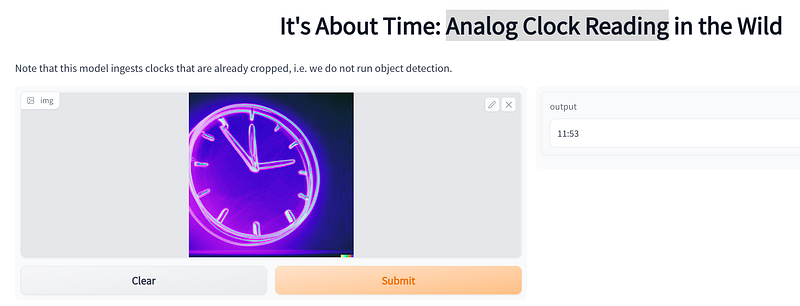
The new method allows us to read analog clocks in photos or videos taken in the real world. In particular, the authors bring the following to the table:
First, they make a scalable pipeline for making synthetic clocks, which reduces the need for labor-intensive annotations.
Second, they introduce a clock recognition architecture based on spatial transformer networks (STN), which is trained end-to-end for clock alignment and recognition. The researchers show that the model trained on the proposed synthetic dataset works well with real clocks, which is why they recommend a Sim2Real training regime.
Third, to close the gap between simulation and real data. They use the unique property of “time,” which is uniformity, to generate reliable pseudo-labels on real unlabeled clock videos and show that training on these videos gives even better results while still requiring no manual labeling.
Lastly, they introduce three benchmark datasets based on COCO, Open Images, and The Clock movie, with full annotations for a time that is accurate to the minute.
Project Page (scroll down)
It is the first time that analog clocks can be read successfully in unconstrained pictures according to the model, which achieves top-1 accuracy of 80.4%, 77.3%, and 79.0% on each dataset correspondingly.
Reading the time on an analog clock should develop into a regular phase in the processing of photos in the not-too-distant future, much like word recognition and object recognition are today.
I invite you to explore the concept of “AI art generators” by reading and learning from the many articles found on 🔵 MLearning.ai 🟠
- Check out my instagram with new material every week
- If you enjoyed this, follow me on Medium for more
- Want to collaborate? Let’s connect on LinkedIn
- https://linktr.ee/evartology
Data Scientists must think like an artist when finding a solution when creating a piece of code. Artists enjoy working on interesting problems, even if there is no obvious answer.
All our writers (members) receive the opportunity to be promoted on our social media, which increases the popularity of articles published on MLearning.ai
- Linkedin (25.5K+ ML-professionals)
- Twitter (5.2K+ followers)
- Instagram (2.2K + followers )
- Sketchfab * — individual vRooML!
- Youtube
- Apple Podcasts
- Substack
Keywords: computer vision, Artificial Intelligence, Machine Learning, AI art, art, wombo dream, digital art, Dalle 2, Imagen, wombo ai, Parti, text-to-image, diffusion models, generative art, wombo art, photographic quality, img by AI system, AI art generator, text to art generator, free ai art generator, 3D ai art, analog time,

Project Page:
Ready to use app:
Title: It's About Time: Analog Clock Reading in the WildThe Authors: Charig Yang, Weidi Xie, Andrew Zisserman;