avatarJuneta Tao

Summary

YOLOX is an improved anchor-free version of the YOLO object detection model that incorporates decoupled head, strong data augmentations, multiple positive matches, and the SimOTA label assignment strategy to enhance performance without the need for pre-trained weights.

Abstract

YOLOX is a significant evolution in the YOLO family of object detection models, moving away from the traditional anchor-based approach to an anchor-free design. It builds upon YOLOv3-SPP, utilizing the DarkNet53 backbone and an SPP layer, while introducing a decoupled head to address the conflicting objectives of regression and classification tasks. The model employs strong data augmentation techniques such as mosaic and mix-up, allowing it to be trained from scratch without reliance on pre-trained ImageNet weights. The anchor-free head simplifies the model by outputting four values per pixel, representing the offset to the top-left corner and the object's width and height. Additionally, YOLOX uses a 3x3 area for multiple positive matches during training and introduces simOTA, an efficient approximation of the OTA label assignment strategy, to reduce training time. The model is trained end-to-end with specific details, including a 300-epoch training schedule with a cosine learning rate schedule, and it outperforms YOLOv5 across various scales, particularly with the YOLOX-Tiny version, which surpasses other models of similar size.

Opinions

  • The YOLOX model is considered an advancement over previous YOLO versions, with a focus on eliminating the need for predefined anchor sizes that may limit detection performance.
  • The decoupled head is seen as a valuable addition that improves training convergence without significantly increasing inference time.
  • Strong data augmentations, including mosaic and mix-up, are highly regarded for their role in enabling effective training from scratch.
  • The shift to an anchor-free approach is believed to simplify the model and potentially improve detection accuracy by reducing the reliance on predefined anchor boxes.
  • The use of multiple positive matches within a 3x3 area during training is thought to enhance the model's ability to generalize across object scales and aspect ratios.
  • SimOTA is praised for providing a balance between computational efficiency and the benefits of the more complex OTA strategy, reducing training time while maintaining performance.
  • The end-to-end training approach, despite causing a notable performance drop, is still considered a step forward in simplifying the detection framework.
  • The YOLOX-Tiny model is highlighted for its exceptional performance relative to its size, making it suitable for deployment in resource-constrained environments.
  • The observation that mix-up augmentation benefits larger models but not the tiny model suggests that data augmentation strategies may need to be tailored to the model size and complexity.

YOLOX: Anchor Free YOLO

Most YOLO family, e.g. YOLOv3, YOLOv4, YOLOv5 and YOLOv7, are anchor based detectors. The performance are optimised for anchor based framework. However the predefined anchor size, as a strong prior, may limits the detection performance.

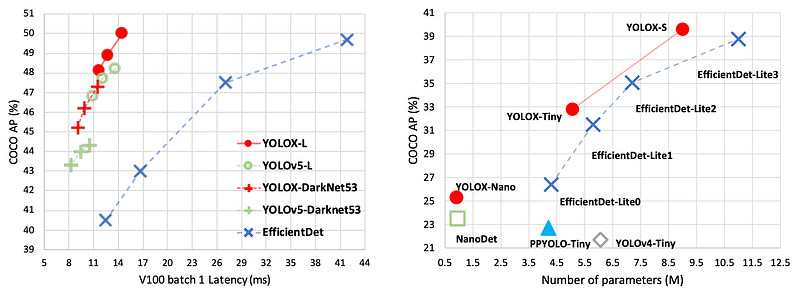
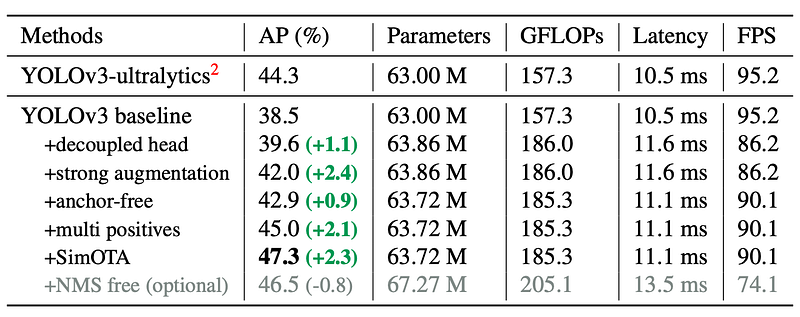
YOLOX is based on YOLOv3-SPP with DarkNet53 backbone and an SPP layer. Apart from make YOLO anchor free, it also applied decoupled head, mosaic/mix-up augmentation, multiple positive and simOTA to boost the performance.
from [1]

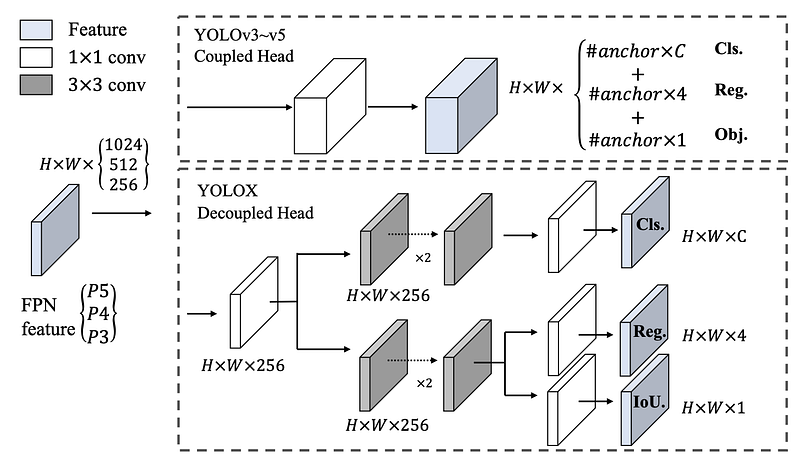
Decoupled head is proposed to resolve the conflicts between regression and classification tasks. YOLOX proposed a lite decoupled head which increase the inference time for only 1ms on Tesla V100. Decoupled head helps model to coverage faster during training.
from [1]

Strong augmentations: mosaic and mix-up are adopted. This strong augmentation eliminates the need of pre-trained weights with ImageNet. So all YOLOX models are trained from scratch.

Anchor free: Change the head to be anchor free make the model a lot simpler. The output for each pixel is four values, i.e. offset to top left corner and object width/height.

Multiple Positives: Use 3x3 area to allow multiple positive matches during training

SimOTA: OTA[2] is an advance label assignment strategy, that use optimal transport concept to assign labels. Using original OTA, the training time is increased 25%, so simOTA is proposed to use top k best predictions to obtain approximation. The simOTA is summarised as

  • calculate the gt-prediction pair cost c_ij based on the classification and regression loss
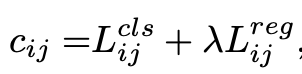
  • for each ground truth box gt, k best predictions, that are closest and within the center region, are matched to gt
  • note: the k is decided dynamically based on the gt box

End-to-end training: Following [3], end-to-end training are introduced to eliminate NMS from detection framework. However the performance drop quite a bit.

Training details:

  • 300 epoch with 5 epoch warm up
  • scaled learning rate lr×BatchSize/64, lr=0.01, cosine schedule
  • SGD optimiser with momentum 0.9, weight decay 0.0005
from [1]

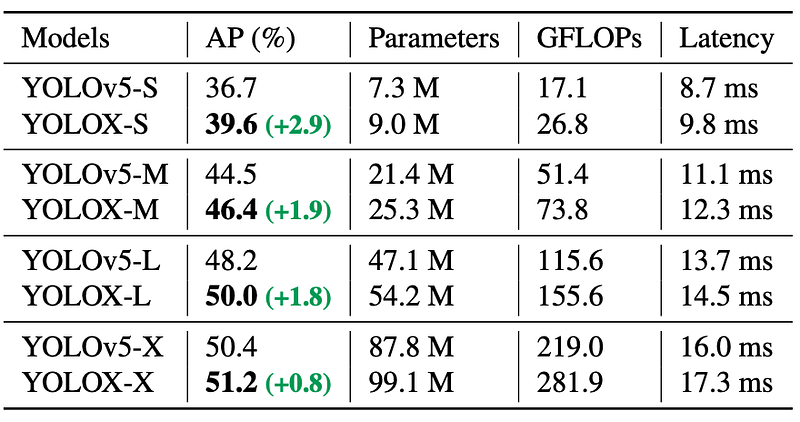
YOLOX vs YOLOv5: YOLOX outperforms YOLOv5 on all model scales with input resolution 640x640.
from [1]

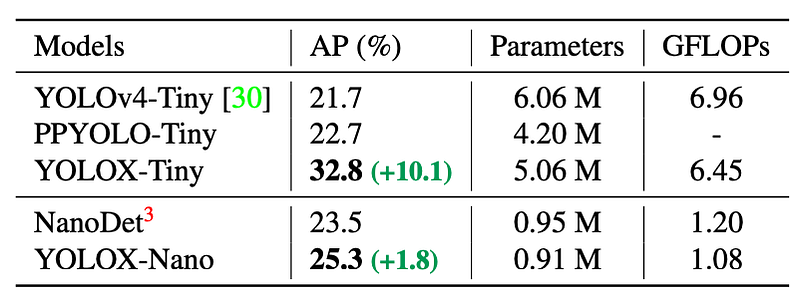
Tiny model: YOLOX-Tiny outperforms all other similar sized models.
from [1]

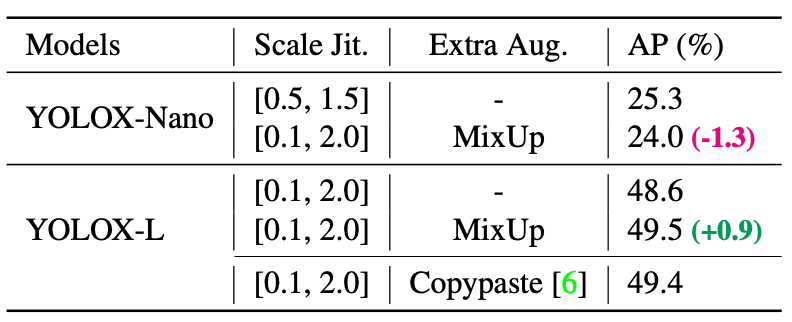
Interestingly, mix-up augmentation improve performance of large model but does not help with tiny model
from [1]
  1. Ge, Zheng, et al. “Yolox: Exceeding yolo series in 2021.” arXiv preprint arXiv:2107.08430 (2021).
  2. Ge, Zheng, et al. “Ota: Optimal transport assignment for object detection.” Proceedings of the IEEE/CVF Conference on Computer Vision and Pattern Recognition. 2021.
  3. Zhou, Qiang, et al. “Object detection made simpler by eliminating heuristic NMS.” arXiv preprint arXiv:2101.11782 (2021).
Yolo
Yolov3
Yolov5
Object Detection
Recommended from ReadMedium