
Yieldmax funds: why you should never chase high dividend yields
Why You-Tube is turning into Yieldmax-tube
It happened again today. I was happily walking my dog and wanted to listen to some finance video’s on Youtube. And after scrolling down once (while simultaneously trying to avoid running into a bush), there was the thumbnail I was hoping not to see. Yet another one, like a similar one I saw yesterday … and the day before.
It was another video of some ‘finfluencer’ praising the almighty god of the investing world: the Yieldmax Covered Call ETF’s. These are ETF’s that promise investors incredible returns, some up to 76% (TSLY) in one year. Investors from all over the world are investing their life savings and are going all-in on these new funds.
Wat are Yieldmax funds? Are they a new revolutionary way of investing ?
If you can almost recover all the money you invested initially in one year, then why is not everybody selling their investment portfolio’s, and buying these new funds? Let’s do a deep-dive of what Yieldmax funds are and their major flaw, which will inevitably lead to their downfall.
Yieldmax funds do a covered call option strategy on one underlying stock, for example Tesla. However, they have many funds that are based on another underlying stock, like Amazon, Google, Facebook, etc
They aim to provide monthly income (due to the high dividend yield), but not capital appreciation (in other words: that the price of the YM stock goes up and the investor makes a profit that way).
Their strategy is to use an option strategy and pay out the profits of those options to their shareholders. In theory, when talking about covered call funds, we cannot actually call them ‘dividends’, as they are not derived from any stock. The correct term is actually ‘distributions’, as they distribute apart of the option profit to a shareholder. Sounds great, yes? Let us look at the flaws of this strategy.
In order to execute this CC strategy for you, they ask a yearly 0.99% ‘active manager’ fee.
You invest in a strategy, nothing more
The first thing you have to realise with these super high yields funds, is that they basically hold … nothing. Well, they do hold cash and US treasury bills, mainly as collateral which is required by law. What you need to understand is that YM does not actually ‘buy’ the underlying stock of the fund. In short, you are investing in a strategy. A covered call strategy consisting of put and calls on stock they do not buy/own themselves. These are called ‘Synthetic’ covered calls. I will not go into the specifics of call options in this article. The only thing you need to know is that with covered calls, you are exposed to the entire downside of the option (your potential loss), while being limited to your upside (your potential profit). And that is exactly where there major flaw arises…
These funds are highly susceptible to what is called fund NAV erosion
Due to the very high distribution yields of these funds, YM needs to manage their covered calls extremely well. The better they position their options, the more profit they will make. And they do a good job, but every option enthusiast knows that nobody can be right ‘all’ of the time. Sometimes they will get it wrong, which is totally natural. The problem begins when a stock is so volatile (the stock price goes up and down all the time), that it almost becomes an educated betting game. However, the investors still expect their high monthly pay out/income. Consequently YM will have to pay that month’s distribution out of the available money in the fund (called the Net asset value of the fund), after which is goes down.
You could argue that if they do not get it wrong all the time, they also get it ‘right’ sometimes. Which is totally true, but unfortunately we cannot forget our earlier definition of a covered call: it LIMITS the upside. So, even when a stock performs great a particular month, YM CC strategy will not capture all the profit. The CC itself sets a limit to the profit it can make.
This is a real problem, as the NAV of a fund goes down when YM has to pay high distribution amounts, but at the same reason is unable to recover all that lost money, though the stock appreciation (remember: they do not hold the stock). Inevitably, the fund size will go down more and more, until the fund managers have to reduce the distributions considerably (or even worse: close the fund). YM even puts it in their prospectus:
There is no guarantee that the Fund’s investment strategy will be properly implemented, and an investor may lose some or all of its investment. (page 6 of YM 126 page long prospectus)
YM solution to potential NAV erosion
YM tries to negate this inevitable conclusion by 2 things:
- spend huge amounts of money on marketing. They need as many investors coming into the fund as possible. The more investors, the more the NAV of the fund will recover.
- They need the YM investors to reinvest their distributions back into the fund itself. That is the only way to prevent NAV erosion.
Conclusion: You-tube is turning into Yieldmax-tube
How do you realize the above 2 points, you ask? Exactly: social media.
The YM fund managers are turning up on every financial YT channel, even if it only as a few thousand subscribers. Every time their message is the same: you will make a lot of income (money) if you invest with us. The second thing that they will tell potential investors, is that you need to reinvest your distributions into the fund itself.
A lot of beginner investors will be drawn into the fund, with all these promises of high yields. However, what we have also see already is, that very few reinvest their monthly money back into the fund. They use it as ‘income’, in other words: to pay bills or drink latte frappe ice macchiato caramel sprinkled coffees with it.
On top of that, after 1 or 2 years, potential investors can see how much the funds are going down and realise straight away it is not a sustainable investment. Would you invest in a fund, if it has gone down more than 50% in less than 2 years?
This is why these funds will always go down in NAV. And why they will inevitable reduce their yields.
An example to make it real
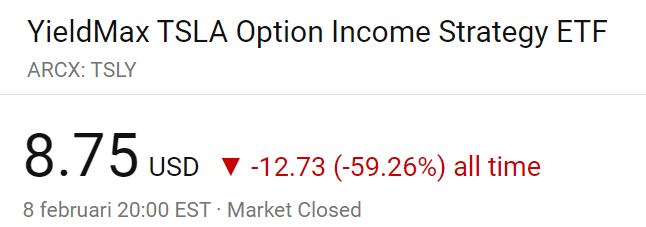
Let us say you invested 10 000$ in TSLY, the YM fund based on TESLA.
The fund was started 30th November 2022, wich makes it under 2 years old. If you had invested 10k at that time, your 10k would be worth only 4074$ today.
You can say: yes, but I will have received a lot of money in monthly distributions and that is true. However, most use it for other purposes, which should be the goal of any ‘income’ fund.
You cannot sell your TSLY shares, because then you do not get any money anymore, so you are captured in the fund. If YM then reduces (or even suspends) their monthly distributions, you are either stuck with ‘dead’ money (money that is not generating money) in your portfolio, unless you sell at a loss and reinvest what is left. The new low distributions will also not be enough to recover the fund NAV, so it will continue to go down anyway…
It is a very harsh lesson, that I hope some beginning investors will not make after this article.
disclaimer: this is my personal opinion, I am not a licensed financial advisor. This article is meant for entertainment and education purpose only.