
American Culture + Free Speech
Yes, Your Speech is Banned, But It’s Not Because You’re Conservative
The issue is hatred, not conservatism
What’s going on?
Although the song is over 50 years old, Marvin Gaye’s seminal classic, ‘What’s Going On’ has been on my mind all week. In 1971, Marvin Gaye asked, “What’s going on?” as a critique of what he and many others considered “a world in despair.”
Gaye had been inspired by social ills committed in the United States. Citing the 1965 Watts Riot as a turning point in his life and opposing America’s involvement in the war in Vietnam, Gaye is quoted as having asked himself, “With the world exploding around me, how am I supposed to keep singing love songs?”
The song, ‘What’s Going On’ and the album by the same name explore themes of racism, drug abuse, environmental degradation, poverty, unjust governmental policies, and the Vietnam War. Gaye depicts all of these social ills as being the product of hate. Gaye declares in the song that “only love can conquer hate.”
The common refrain throughout the song is:
You know we’ve got to find a way To bring some lovin’ here today
The closing refrain is:
Oh, you know we’ve got to find a way To bring some understanding here today
Fifty-three years after the release of ‘What’s Going On’ and forty years after Gaye’s tragic death, I find myself asking that same question, “What’s going on?” I also find myself convinced that if we’re serious about transforming “a world in despair” into a world of hope, that “we’ve got to find a way to bring some lovin’ [and understanding] here today.”
Why is hate embraced as a value worth protecting?
On Monday of this week, the Supreme Court held oral arguments in the cases of Moody v. NetChoice and NetChoice v. Paxton. In these two cases, the court will decide whether laws from Florida and Texas governing social media violate the First Amendment right of social media companies by compelling those companies to host hate speech, disinformation, and speech that incites violence, even when such speech violates user agreement rules.
The Florida and Texas laws were passed in 2021 after former President Donald Trump was banned from many mainstream social media platforms following the January 6 attack on the U.S. Capitol by Trump supporters.
The law in Texas prohibits social media platforms with more than 50 million active users from censoring “a user, a user’s expression, or a user’s ability to receive the expression of another person.” It would prevent online services from engaging in content moderation except in a few specific instances.
Florida seeks to limit large social media platforms with “annual gross revenues in excess of $100 million” and “at least 100 million monthly individual platform participants globally” from willfully de-platforming a political candidate.
Both laws are clearly in response to the banning and de-platforming of Donald J. Trump. While the underlying question that the Supreme Court must answer is whether or not the content moderation restrictions required by the Texas and Florida laws violate the First Amendment rights of large social media platforms, I’m much more interested in why the legislatures in Texas and Florida are adamant about embracing hate as a conservative value worth defending and protecting.
At the bill signing for the Texas law, Texas Republican Governor Greg Abbott declared, “Freedom of speech is under attack in Texas.” He went on to say, “It is now law that conservative viewpoints in Texas cannot be banned on social media.”
According to Abbott,
There is a dangerous movement by some social media companies to silence conservative ideas and values. This is wrong, and we will not allow it in Texas.
If social media companies are silencing the viewpoints, ideas, and values of certain people, they are not silencing them because the people are “conservatives.” They are silencing those viewpoints, ideas, and so-called “values” because they are dangerous and often incite violence. I fail to understand why so many conservative politicians proudly embrace hatred as a conservative viewpoint, idea, and value.
Trump was not banned from social media for being a conservative
While the Texas and Florida laws are in response to banning Donald Trump from social media platforms, Trump was not banned for being a conservative. He was banned for repeatedly engaging in hate speech, disinformation, and inciting violence.
By the beginning of 2021, more than 17 social media platforms had banned or restricted Trump. The reasons given by virtually all of the platforms were that their user agreements prohibit content that promotes disinformation, hate, or encourages, glorifies, incites, or calls for violence against groups of people or individuals.
Before winning the presidency in 2016, Trump used Twitter to amplify his racist campaign, asserting, falsely, that Barack Obama was not born in the USA. As president, he repeatedly shared racist videos on Twitter and Facebook attacking and inciting violence against Muslims and Black Lives Matter supporters, a clear violation of each platform’s policies against hate speech.
In 2020, both Facebook and Twitter removed posts shared by Trump mocking a so-called “racist baby.” The posts included deceptively doctored footage of two toddlers, one black, one white, running down a sidewalk with a fake CNN headline: “Terrified toddler runs from racist baby,” as the black toddler ran ahead of a white toddler. The fabricated CNN headline went on to say, “Racist baby probably a Trump voter.”
The video then displayed the words “WHAT ACTUALLY HAPPENED” and showed the original clip of two children running toward each other on a sidewalk before embracing.
“AMERICA IS NOT THE PROBLEM,” the video proclaimed. “FAKE NEWS IS.” While Trump’s posts accused CNN of manipulating a video in order to promote “fake news,” it was actually a Trump supporter who manipulated the original video and Trump who posted it. The manipulated video was viewed over 20 million times on Twitter and over 4 million times on Facebook by the time it was finally removed from each platform.
The banning of Trump from social media platforms has nothing to do with him being a conservative. He’s been banned by several social media platforms because of his promotion of hatred, a viewpoint that far too many conservatives have embraced as a “value” that needs to be defended.
A misunderstanding of “freedom of speech” and the First Amendment
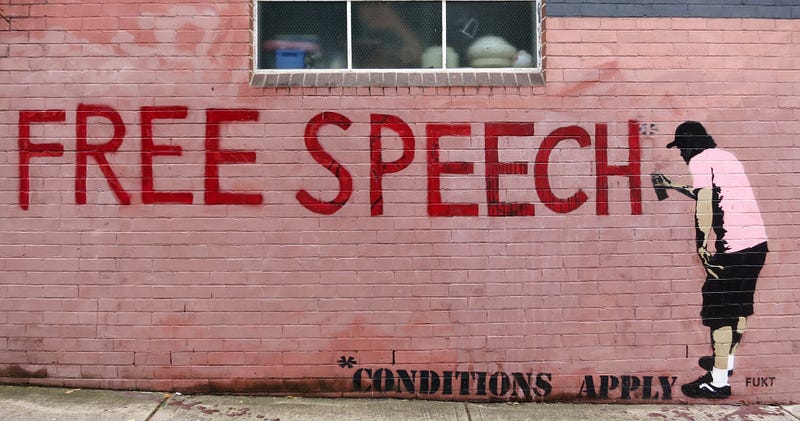
Supporters of the Texas and Florida laws say the laws protect the First Amendment rights of conservative users from censorship by what they imply are left-leaning tech companies. First of all, the First Amendment explicitly prohibits the government (not the private sector) from silencing speech. Secondly, freedom of speech is not freedom to say whatever you want to say wherever you want to say it.
As it relates to speech, the First Amendment states, “Congress shall make no law…abridging the freedom of speech, or of the press….” The prohibition applies to Congress, not social media companies.
During oral arguments, Chief Justice John G. Roberts Jr. and other justices pushed back against the claim that social media companies are violating the First Amendment by pointing out that social media companies are private entities not covered by the First Amendment. Chief Justice Roberts stated,
I wonder, since we’re talking about the First Amendment, whether our first concern should be with the state regulating what, you know, we have called the modern public square?
In other words, if there is a violation of the First Amendment, it may come from state governments making laws abridging the freedom of speech of social media companies.
Attorneys representing the social media platforms argued that the First Amendment does not require private social media platforms to allow all speech on their platforms. Instead, the First Amendment protects the editorial discretion of social media platforms by prohibiting the government from passing laws abridging their freedom of speech by forcing them to publish content against their will that promotes hatred, disinformation, or incites violence.
The attorneys for the social media platforms further asserted that without editorial discretion (which is a form of speech) — including the ability to block or remove content or users, prioritize certain posts over others, or include additional context —social media platforms will be overrun with misinformation, disinformation, extremism, and hate speech.
While the phrase “freedom of speech” is referenced in the First Amendment of the U.S. Constitution, it’s not explicitly defined. According to protection language found in the First Amendment, as well as many state and federal laws, freedom of speech is the right of a person to articulate opinions and ideas without interference or retaliation from the government.
Freedom of speech does not mean the freedom to say whatever you want, wherever you want. Freedom of speech does not mean people have a right to post whatever they want on social media platforms without interference or moderation.
While the government is prohibited from abridging free speech, non-governmental entities are not prohibited from abridging or moderating speech. Since the First Amendment limits only the government’s ability to abridge, control, exclude, or interfere with speech, the attempt of Texas and Florida state legislatures to restrict the content-moderation (which is a form of speech) of social media platforms seems like a blatant violation of the First Amendment.
Content moderation is illegal, but book bans and curriculum restrictions are fine
In response to the Supreme Court hearing oral arguments regarding the Texas and Florida laws limiting the right of social media platforms to engage in content moderation, Florida Governor Ron DeSantis, the same man who has sponsored some of the most draconian book bans and curriculum restrictions in the USA, stated,
Whatever the court decides, you know, we’re going to make sure that we’re doing everything we can to ensure that people have a right to speak in these public forums. We want more speech, not less speech.
When it comes to “content-moderation” of what DeSantis perceives as conservative views, he wants “more speech, not less speech.” However, when “speech” makes the demographic of constituents that DeSantis allegedly represents feel “guilty” or “uncomfortable,” it’s okay to ban and restrict that speech.
The other irony of DeSantis’ position is that the book bans and restrictive curriculum legislation that he has implemented reflect government interference and control of “free speech.” DeSantis accuses social media platforms of violating the First Amendment even though the First Amendment doesn’t apply to non-governmental entities, while his administration passes legislation and book-bans abridging free speech, which the First Amendment explicitly prohibits.
Similarly, while Texas Governor Greg Abbott celebrated the passage of the Texas law that prevents “conservative viewpoints in Texas [from being] banned on social media,” the Texas legislature passed a bill banning how teachers can talk about current events and systemic racism in the classroom. The so-called “Critical Race Theory” bill has been attacked by educators and historians who believe the state should not be controlling what can and cannot be said in classrooms.
According to Armando Alozo, a professor of history at Texas A&M University,
Once you start making prohibitions, and restricting the ability of the teacher to discuss — particularly things that, to many individuals and students and to their parents, may be controversial — I think that that’s getting into a dangerous area of censorship.
Chris Tomlinson is an author and columnist for the Houston Chronicle. He finds it hypocritical when he hears Governor Abbott talk about conservative voices being silenced.
According to Tomlinson,
Governor Abbott and Lieutenant Governor Dan Patrick oppressed my free speech when they canceled the book talk we had scheduled at the Bullock Museum just three hours before we were to take the stage.
Tomlinson co-wrote the book “Forget the Alamo.” The book examines the role of maintaining slavery in the state’s battle for independence. It also challenges what Tomlinson calls the “white supremacist” legend of the Alamo Defenders motivations.
You’re not banned because you’re conservative
The Texas and Florida laws regulating social media platforms seek to criminalize the efforts of social media platforms to engage in content moderation designed to prevent hate speech, disinformation, and the inciting of violence. The laws claim such content moderation violates the First Amendment because it censors conservative views and values and prohibits conservatives’ free speech.
Unless hatred is a specifically conservative value, content moderation and social media bans are not designed to censor conservatives. Donald Trump was not banned because he is a conservative. There are actually many conservatives who take offense at Trump being identified as a conservative. According to former Republican House Speaker Paul Ryan, Trump is not a conservative. Instead, Ryan sees Trump as “a populist, authoritarian narcissist.”
While Ryan could have done more to oppose Trump when he ran for the Republican nomination in 2016 and could have spoken out more during Trump’s four chaotic years in the White House that ended in the deadly January 6 attack on Congress, he is at least now willing to criticize Trump. Ryan recently praised Republicans Lynn Cheney and Adam Kinzinger for opposing Trump to the cost of their congressional careers.
While there are undoubtedly many conservatives who have tied their political futures and identity to Trump, associating Trump’s hateful (and often incendiary) speech and rhetoric with “conservative values” not only does a disservice to conservatism, it conceals the true problem of hatred.
While many people (myself included) feel the social media ban on Trump came far too late, Trump was rightfully banned in 2021 by several social media platforms. He was banned not because he was a conservative but because most of his posts promoted hatred, which should not be promoted and protected as a “value” of any kind (conservative or liberal).
As America prepares for the 2024 Presidential election, which takes place in eight months, I conclude with the words of Marvin Gaye:
You know we’ve got to find a way To bring some lovin’ here today…
Oh, you know we’ve got to find a way To bring some understanding here today
Thanks for reading. If you’d like to get my articles emailed to you directly, you can subscribe here. Learn more about Guy Nave here. See ALL of my Medium articles here. Follow me on Twitter: @guynave2.