Yes, You CAN be Good Without God!
In fact, you might even be better
We’ve all heard the story of the boy who cried wolf. We tell it to our kids because it conveys an important moral lesson: if you tell a lot of lies, you’ll get a reputation as a liar. Then, when you need people to take you seriously, they won’t.
But imagine someone trying to tell you that unless you believed there literally was a boy, who literally lied about seeing a wolf, and then literally got eaten by a wolf when his cries for help went unheeded, you couldn’t possibly appreciate the moral of the story. You’d think they were crazy, right?
But that’s precisely the position that religious people take with respect to their sacred texts. Instead of acknowledging that all of these texts, as well as much of the secular literature of the world, can help us better understand the human condition, we’re told that only this particular book can really make us moral, and only if we believe that the stories it relates actually happened.
Let’s take a step back and see if we can’t make some sense of this. We need to distinguish between (at least) three kinds of claims. The first kind of claim basically says that morality cannot exist without God. We’ll get to that one in a minute. The second claim says that you cannot be moral unless you believe in God. And the third says that you cannot be moral unless you believe in the truth of a specific religious tradition, its sacred texts, rituals, and conception of God.
The third of these is the easiest to dismiss. As we saw above, it’s the moral of the story that counts, not whether the story is true as a matter of fact. So as long as any given body of stories or other cultural artifacts successfully inculcates moral lessons, you can take your pick. People who are more concerned that others should believe as they do are, it seems to me, more invested in their particular faith tradition as a badge of tribal identity than as a route to morality.
What about the more enlightened religious person, the one who acknowledges that any given faith tradition can lead you to make moral choices, but insists that you must believe in some faith tradition to be moral? I think these individuals are getting cause and effect backwards. Are we moral because we believe in religion? Or do we create religions because we are moral?
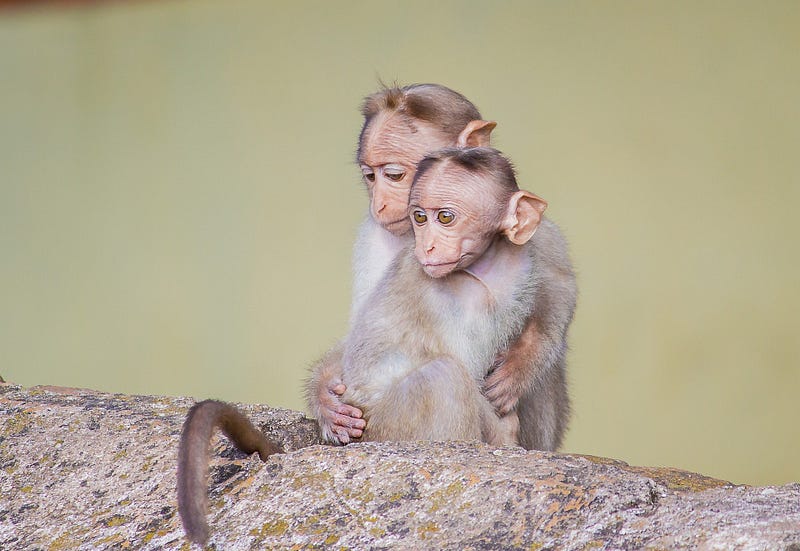
The fact of the matter is that not only humans but many social species exhibit moral behavior, including a sense of fairness and empathy for others. Humans and other social animals act altruistically and moralistically because being social animals requires a readiness to both cooperate with others and punish those who do not.
Moreover, the nature and manifestation of these moral instincts are so similar across species that at least one author has been led to conclude that animals’ moral instincts are not merely analogous to our own, but homologous. That means our moral instincts share a common ancestor in the deep past. We were moral before we were human. And since only humans have religion, it follows that we were moral before we were religious.
One of the functions of religion is to explain, elaborate, and codify our moral instincts. But the diversity of religious traditions is proof that this can be done in many different ways and still capture the essence of what makes us moral. Indeed, the catalog of human religions doesn’t come close to exhausting all the ways that human (and non-human) moral instincts can be thought about, systematized, or elaborated upon. You could approach the problem from a purely secular perspective, for example, and still arrive at a practical system of ethics, as many philosophers over the centuries have done. Belief in God, any God, just isn’t necessary.
“Ok,” you say, “but that doesn’t address the argument that morality — objective morality — needs a God to give it substance and structure. You might think you’re being moral, and that your moral beliefs have been arrived at by a natural or secular process, but in fact they were ordained by God, and you simply refuse to acknowledge their source.” I did say we’d get back to this question, so let’s have at it.
In fact the paragraphs above did address this point, if you were paying attention. Natural selection, which is responsible for the moral instincts of humans and other social animals, is a purely natural process. It doesn’t require the intervention of a God.
You could try to claim that God created evolution or God created the universe and set it in motion, and therefore is responsible for everything from the rules of morality to the laws of physics and more. But we investigate the laws of physics and other features of the natural world without reference to God all the time. Whether or not God got the ball rolling doesn’t change the fact that force equals mass times acceleration. Nor does it change anything we might say about morality based on our scientific and philosophical inquiries.
I think the tendency of theists to get stuck on this point is rooted in their attachment to an unreasonable definition of “objective.” In order for morality to be objective, they think, it must be somehow woven into the fabric of reality. Since God is presumably the only being capable of doing the weaving, God is deemed necessary for objective morality to exist, and the sense that morality is objective is taken to be evidence for the existence of God.
Of course, this reasoning is circular, but that’s just for starters. There is simply no need to suppose that something can only be objective if it is baked into the metaphysical structure of reality. The value of a dollar is objective. If you don’t think so, try this experiment: go to a car dealership and attempt to pay for a new car with a one dollar bill. Of course, money is a social construct, and if all humans disappeared tomorrow there would be no sense in talking about the value of a dollar. But that doesn’t make its value any less objective now.
I’m going to conclude this article by making one last point that is often overlooked by theists who claim that we need God to be good. There is a real danger to conceiving of morality as something baked into the structure of reality, rather than something that has evolved and continues to evolve.
If you take the former approach, you run two very real risks. The first is moral hubris, a sense that your moral beliefs are infallible because they are vouchsafed by God, and therefore you have nothing to learn from others, and indeed that others’ ideas about morality are positively dangerous.
Secondly, you risk developing a fatalistic attitude towards the suffering and injustice you see around you. If moral goodness is already baked into the world by God, then it’s not our responsibility to change the world. Indeed, you might even come to see any kind of social activism as not only futile but even harmful.
On the other hand, if you see morality as the product of evolution, you realize that as conscious agents we have a responsibility to determine the meaning and appropriate application of our moral instincts in new circumstances, many of which are very different from those in which we evolved. You acknowledge that morality can be a double-edged sword, and it’s up to us to make sure we do not use our moral instincts as an excuse to engage in tribalism and dehumanization of the Other.
Remember: morality evolved because we are finite, vulnerable beings. But by caring for each other we make ourselves stronger and wiser. An omnipotent, omniscient, and immortal being doesn’t need anyone to care about its health and happiness. It has no reason for preferring one state of the world over any other. Morality is about what matters to us and why, and that’s a condition to which no God can relate.


