
The Real Reason Women Prefer Tall Men
And no, evolutionary psychology does not have all the answers

Women on dating apps might swipe right on tall men, but they couldn't match the king of Prussia, Friedrich Wilhelm I's height obsession. In 1713, Wilhelm assembled an infantry of tall soldiers known as his Potsdam Giants.
To make the tall team, men had to be at least 6' 2." That height might not seem particularly giant, but the average male height at the time was 5' 5." (The average American male height today is 5' 9.”)
Wilhelm's recruitment process wasn't exactly a fairy tale adventure either. He would often kidnap tall men and force them into his army. Sometimes foreign leaders such as Tsar Peter the Great gifted Wilhelm tall men for his collection. Other times he tied men to a rack and stretched the soldier's leg bones. Many did not survive the mutilation.
And when kidnapping and torture didn't work, Wilhelm turned to breeding programs. In one of the first eugenics experiments, he recruited tall men and women to breed tall children and then paid the couple for their offspring. Eventually, Wilhelm amassed an army of 3200 giants.
Wilhelm’s comment to a French ambassador better illustrates his bromance with tall boys. He said, "The most beautiful girl or woman in the world would be a matter of indifference to me, but tall soldiers — they are my weakness."
His weakness certainly didn't make his military stronger. Most Potsdam Giants never saw a day of combat and were instead paraded around like circus ponies.
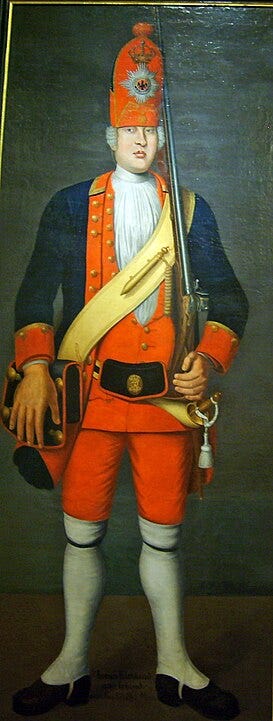
Between their height and the conspicuously tall red hats, they certainly would have been easy to pick off on a battlefield.
Of course, height also confers little advantage when a loaded musket can turn any man into a killing machine. Guns are a great leveler.
Wilhelm's son Frederick the Great, found this out the hard way. After his father's death, Frederick put the Potsdam Giants to work doing what military soldiers should do — combat. Unfortunately, the Potsdam Giants were demolished at the Battle of Jena-Auerstedt in 1806. Apparently, Wilhelm's tall soldiers were no match for the French army led by the legendary (and debatably) short General Napoleon Bonaparte.
Today's CEOs are Potsdam Giants.
Wilhelm's obsession with tall men might seem extreme, but society still associates height with leadership. In Malcolm Gladwell's best-selling book Blink, he examined the heights of the CEOs of Fortune's top 500 companies. He found approximately 30% of these CEOs would have met the height requirement for the Potsdam Giant army — above 6' 2." Considering that only 3.9% of American adult men match that height requirement, it's a staggering number of exceedingly tall CEOs.
Tall men also make more money. Gladwell found that even when researchers corrected for gender, age, and weight, an inch of height is worth $789 more a year in salary. And that compounds over a tall lifetime.
Americans vote tall too. Since 1789, taller presidential candidates have received roughly two-thirds more votes. In the Republican presidential showdown before the 2016 election, the most googled phrase during the debate was "How tall is Jeb Bush?" It should have been, "How will new Supreme Court nominees cut down women's rights?"
And yet height doesn't make a man a better soldier any more than it does a better CEO or President.
Forget tall men. Get a dog and a spear.
The just-so story from evolutionary psychologists is that height in a hunter-forager society conferred a competitive advantage when slaying a wild boar. Women preferred tall men because tall men didn't let their lady love starve.
This ties height preferences up with a pretty evolutionary bow, except for one problem. The entire hunter-forager story has recently come under attack.
Researchers have found that women in hunter-forager societies brought home the wooly mammoth bacon as often as men did. In other words, anthropologists found that with the right weapons — bows, arrows, knives, and nets — women killed small and big prey as much as they slaughtered berries.
This evolutionary psychology just-so story has another plot twist from our hero's unsung (and always adorable) sidekick.

Yes, dogs changed our hunter-forager story too.
One of the many theories for why Neanderthal went extinct, and Homo sapiens did not, was the latter had more efficient hunting practices. Neanderthals used ambush hunting to kill prey in close proximity. Homo sapiens didn't play that game.
Instead, Homo sapiens befriended the dog's early ancestors and used them as pursuit predators. These early dogs' keen sense of smell and ability to run long distances gave homo Sapiens a competitive advantage to track and hunt down prey. It's not the only reason homo Sapiens survived, but dogs helped.
Maybe single ladies should get a dog and not a tall man.
In the past, it was natural to equate height with strength. If I have to defend myself on the plains of a violent Savana, then the short kings might not be the best mate choice. But in today's modern world, more married women complain about an unmopped floor than attacks from Saber-toothed tigers.
Why do we conflate tallness with superiority?
Sociologists have framed it as a chicken vs. egg story. Since tall people are admired by society, tall children grow up more confident. More confidence equates with more authority and status. The same Halo Effect argument has been used to explain pretty privilege in women.
Unfortunately, the nurture vs. nature debate is hard to untangle because height is both highly heritable and subject to environmental influences. Simply put, societies with nutritional deficiencies do not grow as tall. And if you have tall parents, your odds of being tall increase. There's no straight line between height and genetic superiority.
Yet, we continue to focus on height as a sign of strength, intelligence, and health, even though height no longer offers an evolutionary advantage in modern society.
Height as a sign of health certainly doesn't fit neatly into the evolutionary debate. Research has found men over 6' 2" are at a higher risk for thromboembolism — the third leading cause of heart attack and stroke. It makes sense logistically. Taller people have longer leg veins, more surface area to cover, and increased gravitational pressure — all factors that could hinder blood flow.
Another study found that taller men's cancer risk increases by 4% for every two and a half inches of height a person has. Swipe left on that, ladies.
Yet researchers consistently find that women prefer tall men. The reasons they give are often lame ones — tall men make them feel more feminine, tall men are more athletic, or tall men can reach high shelves. Sure, if you don't own a ladder.
More interestingly, researchers examining non-westernized societies did not find a universal preference for tall men. For example, among the Datoga people of Tanzania, both men and women preferred a taller partner.
Scratch the surface, and this obsession with height feels more like an evolutionary holdout as ridiculous as a peacock's flashy plume. And much like the ostentatiously adorned Potsdam Giants, height is more style than substance.
You can't tell people whom to lust. Our culture has beat into our lizard brains that height is a sign of status and power. I won't untie that cultural knot by pointing out its faulty logic.
The human heart never beat to the tune of reason.
But one explanation for why women prefer tall men really sticks in my craw. Some psychologists have posited that when we look up to someone literally, we also look up to them metaphorically. Does that mean women don't want to be the object of admiration?
Instead, let's examine the women not enamored with male height. If we are to apply the same "I prefer to look up at someone" cod psychology, what does it say about women who prefer shorter men? Do we prefer a partner that doesn't give us both literal and metaphorical neck pain?
Perhaps the women who prefer shorter men are looking for a partner, not a savior.

Carlyn Beccia is an award-winning author and illustrator of 13 books. Subscribe to Conversations with Carlyn for free content every Wednesday, or become a paid subscriber to get the juicy stuff on Sundays.


