
Yes, Michelle Obama Can Have A Depression Too
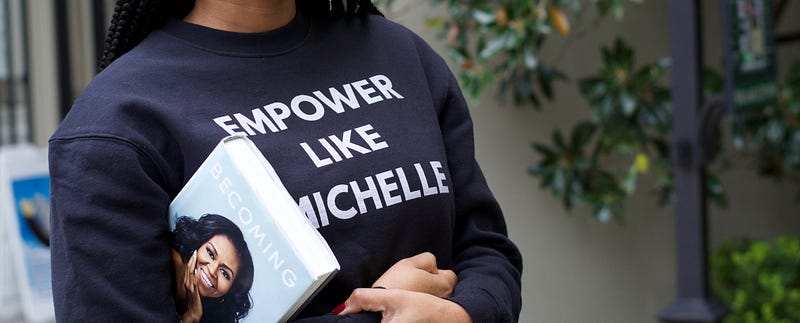
A few days ago, I wrote an article called: I Am Not An Angry Black Woman. I wrote the piece to show how often black women are categorized as either always super strong, angry, or aggressive.
I pleaded with the world to let black women be strong when they needed to be, angry when they needed to be, but most importantly, I asked the world to understand that we can also be vulnerable at times as well.
Michelle Obama coming out this week to speak about her low-grade depression speaks to my point. In her new Spotify podcast, she admits that she is having a hard time right now: “ These are not, they are not fulfilling times, spiritually,” she told journalist Michele Norris during The Michelle Obama Podcast.
“I know that I am dealing with some form of low-grade depression. Not just because of the quarantine, but because of the racial strife, and just seeing this administration, watching the hypocrisy of it, day in and day out, is dispiriting…I am waking up in the middle of the night because I’m worrying about something, or there’s a heaviness. I try to make sure I get a workout in, although there have been periods throughout this quarantine, I just have felt too low.”
Michelle Obama’s words spoke to me, I could feel her raw vulnerability, her pain, the heaviness on her chest, the hurt. This instantly connected me to her humanity like I hope it will for many an empathetic human being. She is made of flesh and blood, emotions, and feelings — she too has pain.
For me, the key message here is that Michelle Obama is not always the strong, invincible, almost the superhuman person she is often portrayed to be. She has her difficult times as well, just like you and me.
Michelle describes the reasons for her depression; a combination of quarantine, worsening race relations in the US, and the actions of the current administration.
Trust me, I don’t think she is the only one in the US or even around the world right now with a depression. White, black, brown people and all hues in between are suffering, having difficulty coming to terms with the world we live in.
Guess what? It’s normal. Some of us are isolated from our families, our routines have been disrupted — some of us have lost loved ones, our jobs, our houses. It is without a shadow of a doubt, a very tough year.
We certainly can’t ask everyone to tough it up and get on with it, so why should we ask Michelle Obama to?
The response to Michelle’s confession has stormed the internet. Everyone is going at it with their comments and judgment, even those without any medical training or experience to speak about depression. Everyone seems to have a doctorate in psychology. Really?
Donald Trump’s campaign manager Jennis Ellis said that Michelle Obama’s liberalism is to blame for her depression. She even goes so far as to suggest that Michelle should go to church to find happiness. The sheer lack of knowledge about depression and the insensitivity of the comment is unnerving.
I’ll pass on the increasing litany of derogatory, racist, and ludicrous comments I have read online about Michelle’s depression. As always, the most hurtful and demeaning comments have come from white supremacists cowering behind their computer screens; internet trolls that seem to exist only in the sordid back alleys of the virtual world. Suffice to say that they have been extremely cruel.
But for the rest of the world or should I say for the normal people in the world, Michelle is showing us vulnerability. She is making it ok for all of us to feel a little fragile right now.
Her confession helps remove the perception that black women are always strong. Even more importantly, it shows depression is a part of life and removes the social stigma that society attaches to depression. It helps trigger a much needed global dialogue around mental health and how we can raise awareness and educate in order to defeat this ancient foe.
According to the World Health Organisation, depression is an illness that affects more than 264 million people worldwide. The same organization predicts that the psychological effects of the pandemic are not yet fully apparent, and warned of a massive increase in mental conditions in the coming months all around the world.
Michelle admits that spending time with her loved ones has helped mitigate some of the nefarious effects of depression. Getting into a routine and adopting a proper diet and sleep patterns is key. Consulting your medical practitioner if you are feeling too sad or having suicidal thoughts is important. Don’t try and wait it out, depression is a disease that needs to be managed and treated.
Sylvain Saurel whose articles I recently discovered here on Medium speaks to the therapeutic effects of physical activity in keeping depression at bay. Take a look at his insightful articles on this important topic.
In conclusion, I would add that as human beings, we all have different facets to our personalities. We can be both strong and vulnerable, happy and unhappy, re-energized, and tired.
Locking up black women into a category of always been strong, angry, or aggressive is unfair. Let us all agree that to be human is to exist, to evolve through different moods, emotions, and states of being. What is most important is to always be true to oneself — to one’s values and to one’s humanity.
Thank you for reading my perspective.