
Yes, I Listen to Myself on YouTube. No, I am not a Self-Obsessed Narcissist.
I just want to express myself better.
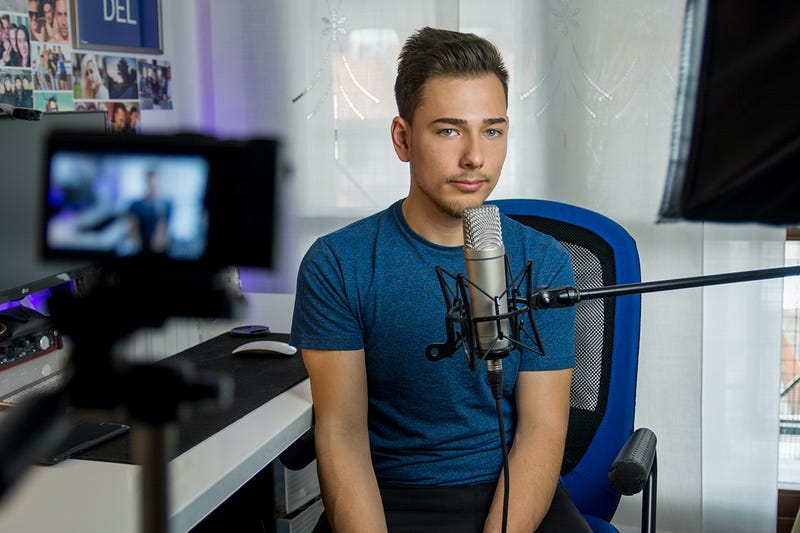
I see raising eyebrows and eyeballs on the floor whenever I tell others I listen to myself on YouTube.
My friends feel embarrassed for me. I know. I know what you are thinking also. In fact, your mind screams narcissist!
Agree, but hang on for a second. Don’t you think we need a way to review, reflect, so to become better at our craft?
Yes, I am obsessed with myself. But not because I want to get intoxicated by my deep, sexy, beautiful voice. The contrary is true. My voice sucks. For reasons unbeknownst to me, my ears find my voice jarring.
What. An. Irony.
I listen to myself on YouTube from time to time to take a pulse check on my ability to express my ideas, opinions, and perspectives. I know I have something to say. I want to find out if I am doing justice to them.
So, this is the verdict. No, I do not. And that is true 80% of the time.
Thus, I have to find out what went off-tangent. To do that, I must confront my ultimate source of embarrassment. Watching and listening to myself on YouTube.
Watching Myself on Raw YouTube Clips Exposes All Weaknesses
“It is an absolute human certainty that no one can know his own beauty or perceive a sense of his own worth until it has been reflected back to him in the mirror of another loving, caring human being.”
― John Joseph Powell, The Secret of Staying in Love
YouTube clips without post-edits have terrible views. The audience on YouTube is spoilt and demands better quality images, background music, cinematography, and heavy-duty punchlines in the introduction.
I am on YouTube because of my livestream program, but I am not yet a YouTuber. Many people associate a YouTuber with someone receiving a paycheck from YouTube. From that angle, I am, at best, a video content enthusiast.
I am happy with that. Because my goal is not to be a YouTuber. My ambition is to deliver a TED Talk. The problem? I am far off from that dream.
All TED Talk superstar speakers are captivating when they speak. There is no fanciful 30-slide PowerPoint presentation and post-recording edits. These speakers stand on the stage and then spread their ideas with their voice. That is it.
The best ones receive a standing ovation after 18 minutes. These superstars include Sir. Ken Robinson, Simon Sinek, Brene Brown, Susan Cain, Tim Urban, Kelly McGonigal, Dan Pink, and the list is long. Most importantly, I want to be one of them.
To be knighted as a TED Talk speaker, I have to work on the following:
- One clear idea worth spreading.
- Great storytelling.
- A clarity in articulation.
- Timeliness.
- Most importantly, being understood.
Author’s Note: Becoming a YouTuber is a worthy ambition. It is, so please do not get me wrong. I have a lot of respect for YouTubers crushing it with their top-notch, out-of-the-world videos. For me, my ambition is to deliver a TED Talk. Appearing on YouTube is a way to get there. Practice is necessary, isn’t it?Give Me a Hole to Jump Into… Grrrr!
“Everyone has embarrassing moments at work — it shows we’re all human. The best way to handle awkward moments is to gracefully move on, and, if possible, try to find humor in the situation.”
We are all humans, and I am a part-time ostrich. Whenever I cannot bear to watch myself on YouTube, I turn my head away from myself.
I listen to myself, and I fish for patterns to eliminate. These are patterns that help me lose the audience’s attention. Bad speech destroys brilliant ideas.
This is what I found out about myself:
- I repeat and then as if it is free.
- My pet phrase is… I think.
- I challenge convention, therefore I routinely start my articulation with that is not the way to think about it, and instead, we should…
- I conclude sentences abruptly and with impatience by using etc, etc, etc, or, blar, blar, blar.
- I am a natural at expressing myself… excessively. #Facepalm.
Because the YouTube videos are exposed to everyone who has a smartphone, I have stronger motivation to one-up my speaking prowess. I can live with embarrassment today, but I do not want to live with the same form of embarrassment 5 years from now.
Author’s Tip: If you have an important presentation, pitch scheduled for — Take my advice. Rehearse and prepare as if your life depends on it. No matter how good you think you are in public speaking, the first rehearsal will always sound (and feel) like crap.Of course, you do not have to do what I do. I am comfortable making a fool of myself in public. YouTube is, after all, a public domain, and you may feel uncomfortable exposing your weakness for others to see.
Author’s Recommendation: You can do your dry-runs using Zoom or Google Meet. These platforms have a recording function, and you can review your performance by replaying the MP4 source file.Summary
Confronting ourselves on YouTube is no easy feat.
This is especially so when our skins are thin. You may not have goals to be a YouTuber either. However, there will be instances where you need to perform public speaking.
We need to be prepared for it.
For me, I want to start preparing for the best speech of my life. Standing in the TED Talk stage inspires me to prepare meticulously, speak more, and articulate myself with precision.
That is the reason I continue to confront myself on YouTube.
Sigh. What an embarrassment. Facepalm.
As a content contributor, I write my observations from daily life and my business exposure. Because our life experience is the bedrock of our unique perspectives.


