
Yes, ‘Comedian Privilege’ Is A Thing
Chris Rock and Will Smith just proved it
When we witnessed “the slap heard ’round the world” where Will Smith smacked Chris Rock, it set off a chain reaction of social commentary. At what level of severity was Smith’s behavior? How do we measure the magnitude of disrespect Rock had aimed at Jada Pinkett Smith?
I’ll weigh in more extensively, in a future piece of mine, regarding my deeper assessment of both Smith’s and Rock’s conduct. But first, I want to explore another angle of this whole ugly incident.
Are comedians being unduly persecuted for questionable humor? Is there a certain level of responsibility that comedians have, as human beings, even when they’re trying to spread the joy of laughter?
Iconism is the term I use to refer to what is essentially “celebrity privilege.” It refers to unearned privilege and advantages bestowed upon specific people due to their celebrity status. Or, alternately, how noncelebrities (anyone without a significant public profile) are unfairly held to higher standards than celebrities are.
A subset of “celebrity privilege” could loosely be identified as “comedian privilege.” It would be where, under the pretense of communicating through comedy, we tend to be more permissive of what comedians say and do than we’d be if it was a “regular person” saying or doing those exact same things.
Much of the prevailing narrative has painted Chris Rock as the “hero” and/or the “victim” with respect to Will Smith’s behavior.
I agree that Rock is a “victim” in terms of the premise that Smith should never have hit him.
I disagree that comedians should be likened to essential workers who categorically have more pristine ethics, value, utility, or morals than the rest of us do.
“Oh, they were just trying to be funny” is never a valid excuse.
There’s a common theory that Donald Trump decided to run for the presidency after being roasted by then-President Barack Obama at the 2011 White House Correspondents’ Association Dinner. Now, I’d be the last person to argue that Trump’s ensuing egomania was in any way an appropriate response to Obama’s barbs. And Trump was definitely culpable for peddling the conspiracy theories that boosted his political rise.
But if Obama had never made that crack, in the first place…could we have ultimately been spared from the bloviating Noise Machine that has become Trumpism?
On the March 29 episode of CBS’s The Talk, as their panel discussed the Smith/Rock altercation, cohost Jerry O’Connell expressed bewilderment at Smith’s surprise that Rock would “go there.” From O’Connell’s perspective, he’d always assumed that the whole purpose of awards shows was to roast the people whom we’re celebrating.
At another point, Talk co-host Sheryl Underwood vocalized the same pearl-clutching we’d heard from so many other prominent Hollywood comedians — they were now terrified of performing onstage in front of live audiences, due to the risk that they might be assaulted in a manner similar to (or worse than) how Smith accosted Rock.
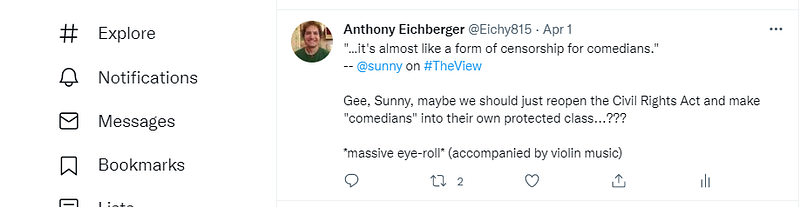
Three days later, on ABC’s The View, when talking with guest Stephen Merchant, cohost Sunny Hostin stated, in regard to the chilling effect this could have on comedians’ artistic freedom:
“…it’s almost like a form of censorship for comedians.”
Hostin regularly spouts a lot of ridiculous stuff…but that little gem made me want to scream through the TV at her disingenuity more than anything she has said in a long time.
And I proceeded to call her out, via Twitter. Not that I find it very likely she even read my comment…
Of course, Hostin’s embrace of “Rules for thee, but not for me” is emblematic of her pro-establishment narcissism. She has a long history of defending neoliberal elitism and sectarian sentiments, while centering HERSELF amidst the discourse. Hostin’s affection for cohost Joy Behar (the last person with clean hands) and their other Hollywood comedian friends took precedence over intellectual honesty, here.
By contrast, O’Connell’s cluelessness seemed to me that it was more a case of innocent naivete on his part.
I don’t think we should hold comedians to a higher standard than everyone else. But, by that same token, we shouldn’t lower the bar for them just because they’re trying to be “funny.”
With that in mind, I invite you to check out the following five op-ed pieces by other Medium writers, regarding such controversies:
In “White Supremacy, Inc.,” Judson Vereen takes aim at Jon Stewart for trivializing racial discourse with hyperwoke “humor”…
In “Is Abuse Ever Funny?,” Alex Mell-Taylor questions why we should excuse the tendency of Dave Chappelle and other comedians to dumb down other people’s trauma…
In “Finally, A Comedian Actually Got Canceled,” Jude Ellison S. Doyle challenges the notion that the Smith/Rock fiasco actually gives comedians a legitimate reason to fear for their safety…
In “From Will’s ‘Ridiculous Ego’ To The Bystander Effect — The Psychology Behind That ‘Oscars Slap’,” Kat Morris voices doubt that Smith’s actions will actually force celebrities and comedians to reevaluate their (lack of) scruples…
And, in “He Got In One Little Fight,” Steve QJ exposes the entire culture of cruelty that fed into the Smith/Rock escalation, in the first place…
Comedians shouldn’t receive disproportionately-high punishments when they offend audiences. However, they also shouldn’t be given carte blanche to do or say whatever they want just because they’re viewed as “funny” by their echo chambers of devoted fans.
So, comedians, here’s my message to you: yes, keep experimenting with your humor. Delve into how you can push the envelope. But, if someone tries to engage you by pointing out how your material has dredged up trauma or indignation for them, be willing to listen and ask questions. Use that feedback to hone and improve your own comedic setlists.
Take a page from the politically-correct virtue-signalers whom so many of you, paradoxically, appear to worship…
“Be better”
“Do better”
“Check your privilege”
…your celebrity/comedian privilege!


