
Yentl: A Trans Man Studying Talmud is Distracted by Gay Thoughts
Yentl (1983, dir. Barbra Streisand) and Yentl the Yeshiva Boy by Isaac Bashevis Singer.
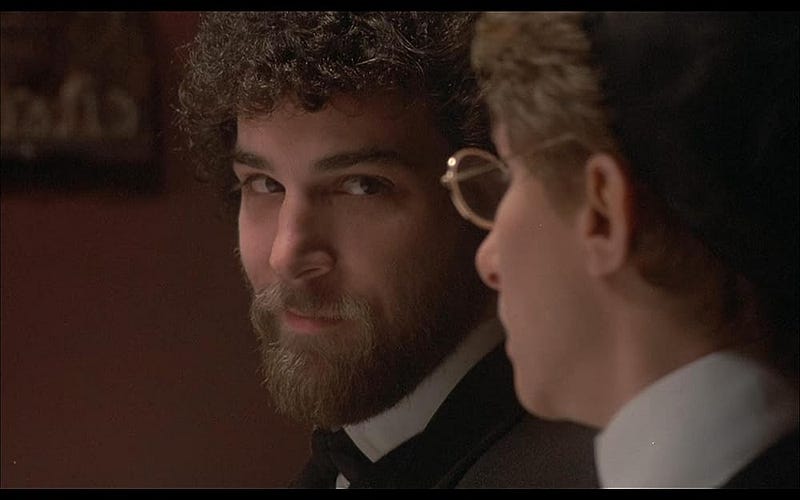
It’s a sad thing, hearing cisgender people talk about Yentl — especially the short story — and think they understand it, that they’re getting everything from it, while at the same time, they can’t conceive that transgender people even exist.
It’s a strangely joyful short story to read as a trans man, as sad and complex as it is, and the film has a similar bittersweet warmth to it.
“Yentl — you have the soul of a man.”
“So why was I born a woman?”
“Even Heaven makes mistakes.”
From Yentl the Yeshiva Boy, by Isaac Bashevis Singer
At the beginning of Yentl (1983), we see Barbra Streisand as the titular Yentl walking around in Yanev, ostensibly to buy groceries — including a fish — for dinner. She’s bored and distracted as the other women discuss how to study a fresh fish or how to distinguish between the different types — the bookseller is coming through town, calling out that he has novels and picture books for women and sacred books for men.
Yentl approaches the bookseller and surreptitiously takes one book from the men’s shelf, a book exploring the mysticism of creation and the similar mysticism of language that was being discussed by some yeshiva students a moment ago, and the bookseller interrupts her — “You’re in the wrong place, Miss. Books for women are over there.”
He tells her it’s the Law that women can’t study such books; she retorts, “Where is it written?”; he says, “Never mind where: it’s a Law.”
She says the book is for her father, Reb Mendel, and the bookseller finally relents, whereupon she goes home and reads the book herself.
Mendel is a widower, and although he scolds Yentl gently for not being an adept cook and tells her that studying is for men and not for women, he studies with her anyway and teaches her — it makes Yentl the subject of gossip in town, with one of Reb Mendel’s students remarking that his father says a woman who studies Talmud is a demon — it doesn’t help that Yentl is unmarried.
From the short story:
But Yentl didn’t want to get married. Inside her, a voice repeated over and over: “No!” What becomes of a girl when the wedding’s over? Right away she starts bearing and rearing. And her mother-in-law lords it over her. Yentl knew she wasn’t cut out for a woman’s life. She couldn’t sew, she couldn’t knit. She let the food burn and the milk boil over; her Sabbath pudding never turned out right, and her challah dough didn’t rise. Yentl much preferred men’s activities to women’s.
From Yentl the Yeshiva Boy, by Isaac Bashevis Singer
As a trans man, I’m always keenly aware of the things many of us cite in childhood of the first things we knew weren’t right for us and the things that were — Yentl has no skills that should be right for a woman, mentions that she cannot sew or knit or cook, and she prefers to study.
Many of us played with “boy’s toys” or took interest in “boy’s activities” instead of girl’s ones, wore “boy’s clothes” and did “boy things” — the label as to the boyishness or girlishness to most of these being arbitrary.
But Yentl’s first thought here is the rebellion in it — not only will she be forced to begin bearing children and raising them by the circumstances of her marriage, but she’ll be forced to submit to her mother-in-law’s will and orders.
In my experience as a trans man, cis men are rarely the biggest enforcers of the gender binary, nor the ones who most policed my incorrect or flawed gender expression as a child.
When cishet men do complain and correct gendered behaviour, it’s often to do with what they perceive as a desirable woman or girl being kept from them — their complaints are far more to do with dress or physical appearance because, to a cishet man, the first thing that matters in a woman is her sexual availability and her aesthetic value, particularly in regards to her sexual appeal.
Cishet women’s aggressive and virulent desire to correct what they feel are gender transgressions are more subtle than that and are far more about the deeper social value a woman holds — about her ability to cook and clean, to raise children, to exist in a space with other women, to manage the men in her life and to willingly submit to parenting adult men as if they’re also her children.
What would Yentl experience from her mother-in-law? Picks not just at her appearance but at her behaviour, her priority, and her thoughts. It’s not enough to perform gender correctly — they want you to internalise it and to be entirely beaten down with it.
All your thoughts as a cishet woman, especially in a traditional M/F marriage, should be about the men around you and their needs — sacrificing your own needs and desires should come naturally to you. A lot of cishet mothers will completely confidently say that sacrifice of the self, of personal identity, of privacy, of rest, is an integral part of motherhood, and they will become very angry at the idea that it isn’t, or that it shouldn’t be — pointing out that the same expectations are not made of fatherhood will if anything make them angrier, and they’ll say blandly that men and women are different, and refuse any further word about it.
Why are men and women different?
They just are.
Why do they have to be?
They just are.
There was no doubt about it, Yentl was unlike any of the girls in Yanev — tall, thin, bony, with small breasts and narrow hips. On Sabbath afternoons, when her father slept, she would dress up in his trousers, his fringed garment, his silk coat, his skullcap, his velvet hat, and study her reflection in the mirror. She looked like a dark, handsome young man. There was even a slight down on her upper lip.
From Yentl the Yeshiva Boy, by Isaac Bashevis Singer
Obviously, trans men and mascs’ gender shouldn’t be judged by the extent of their ability to pass, but a thing that I really like about this aspect of Singer’s short story is that it puts aside the argument of sex essentialism.
“Men and women are different, and you can tell they are different because they look different — if they were meant to be the same, why wouldn’t they look the same?”
And here, Yentl has the soul of a man, and his body is not wholly that of a woman’s and can easily be “disguised” as a man’s because it already has some men’s characteristics — tall, thin, bony, not much to the chest, without the wide, child-bearing hips people often want or expect of a cisgender woman. Once Yentl is dressed in the right clothes, she looks like a dark, handsome young man.
If men and women are truly so irrevocably different, if they are truly two sides of a wide binary with a great chasm between them, everyone would always be able to tell trans people and crossdressers and intersex people and anyone else outside or in-between from a line-up, and you can’t.
Yentl has no interest in the matters of the home or of the table — all she wants to do is study, think about life’s great questions, read, and discuss. And also:
Secretly, she had even smoked her father’s long pipe.
From Yentl the Yeshiva Boy, by Isaac Bashevis Singer
People often comment on Yentl’s desire to be a man as being purely about the study, purely about the restriction on women’s roles in life, in the world, in the yeshiva, and in the temple.
Here, she smokes her father’s pipe. Yes, it is a phallic symbol, and we can look at Yentl picking up the pipe to use as an expression of her picking up the typical cis man’s role via an allegorical penis, but it’s also not about the study.
When she looks at herself in the mirror as a young man, she sees herself as handsome, even noticing small details about her own appearance she likes. When she smokes her father’s pipe, what aid is that in her study? What does it do to her understanding of the Talmud? Nothing.
She smokes her father’s pipe because smoking is pleasurable, and unlike the pleasures she mentions women engaging in — the potential joy of rearing children or pleasing a husband, of chattering and laughing with other women — it’s one she actually feels drawn toward.
After her father’s death, she leaves his home behind her, cuts her hair — in the story, she leaves her forelocks long — and leaves in men’s clothes as a young man, and with a young man’s name: Anshel.
In the film, he names himself after his dead brother; in the story, after a dead uncle. Either way, the name and the associated manhood are this young man’s inheritance.
When we see him get to Zamosc, he falls into a boarding house where many young men from different yeshivas are talking to one another, and it’s, of course, the first time he’s been around so many young men speaking with one another and been seen as one of them.
In the film, there’s even a moment where he calls out to his father from the women’s section of the shul, and everyone gossips and scolds him about it because he’s obviously not meant to be interrupting worship, even though it was out of concern for his sick father.
It was the first time Yentl had ever found herself alone in the company of young men. How different their talk was from the jabbering of women, she thought, but she was too shy to join in. One young man discussed a prospective match and the size of the dowry, while another, parodying the manner of a Purim rabbi, declaimed a passage from the Torah, adding all sorts of lewd interpretations.
From Yentl the Yeshiva Boy, by Isaac Bashevis Singer
Anshel is shy. He’s never been in such a busy place, so many men talking and laughing and arguing with one another, with the ability and the understanding that he could join in. He is overwhelmed by his new liberty and doesn’t know how to find his place in the dance going on around him.
It’s such a real feeling, I think, for some newly out trans men and mascs as teenagers, or in general when you go into a space you haven’t before where you’re passing as and being perceived as male where before you weren’t — what are the rules?
Many trans men strike cis men as being unusually polite, self-effacing, apologetic, or soft-spoken, even if they don’t appear as effete or effeminate, and I would argue that part of that is not just from being treated as women before, but specifically because, as I said before, different transgressions against gender roles are policed very aggressively in gender nonconforming trans mascs and men (as well as butch lesbians and GNC cis women), so often times, we learn a lot of self-limitation.
Frequently, Anshel says, “If I may,” or “Forgive me, but — “ or “May I?” before he speaks on a subject which he is incredibly familiar with and well-studied on, offering valuable insight, useful advice, the correct answer to a question — people find his humility and his gentle apologies quaint and charming, and people rarely consider where that sort of constant self-correction comes from. When merely to speak is a transgression you’ll be snapped at for, when “wait your turn” is something said to distract you from the fact that it is never your turn to speak, these apologies become as natural as breathing — and you’ll probably apologise for breathing as well.
Many people (I say this thinking of trans men, but I know lots of trans women who do the same thing, lots of cis people too) apologise whenever they speak, whenever they think, whenever they come into a room, and these apologies are entirely reflexive — when you are punished so frequently for existing, for existing “wrong” in the way that you do, you come naturally to apologise for every act of existence. You say “Forgive me, but — “ and the end of that sentence is “ — but despite everything, I’m still here,”; you say, “Sorry, but I yet live,”; you say, “If I may, I would like to go on living. I hope it doesn’t inconvenience you too much.”
It’s fitting, I think, that suicide is so core a theme of Yentl, in the film and in the short story — to kill oneself is a great sin, but if every road is blocked off, such that no one around you will let you exist with the soul you have and the person you are and still go on living, what other option is left to you?
The power dynamics in all men’s spaces are often very different to women’s ones — cisgender men are often very blunt and explicit about what they think they’re good at, and what their strengths are, but for women to talk about their own virtues is seen as boastful, is punished as prideful.
Men are confident; women are arrogant. Men are assertive; women are bossy. Men give advice; women nag.
As a trans man, you experience new freedoms in conversation, in self-expression, in being that you never had before — and at the same time, there are new punishments for doing the wrong thing.
You no longer have to stay silent in every situation, either because your every contribution will be treated as inconsequential or because you’ll be roundly scolded for thinking you have the right to make one — but now your opinion and your input are treated as having more weight, you can do far more damage to other men’s egos, and you’re expected to grow and display and wield an ego of your own to match.
In the initial scene in the film, David, Reb Mendel’s student, ignores every one of Anshel’s suggestions from the kitchen — because they’re coming from a woman, he can dismiss them — until he realises one is right, and then he immediately bristles and demands to know, effectively, why someone he thinks is a woman should know more than him, rather than addressing the gaps in his own knowledge.
In this scene, Anshel’s experience is slightly different.
“Ah!” he says, unable to stop himself as Shimmele is about to make the wrong move and make himself vulnerable to Avigdor’s mate — both of them stare at him, and he says, “Nothing, sorry.”
He has no right to comment — when has he ever had the right to comment or to intervene?
But these boys, they push him to say what he was thinking. Anshel says his knight is pinned, makes his assessment of the board, and Shimmele says what he’s used to hearing when he gives input on a men’s conversation — “You don’t know what you’re talking about,” and makes the move anyway.
Checkmate.
Shimmele is later shown to us as someone who’s a poor student and quite unwise on a lot of fronts — here, Anshel is his superior.
And a minute later, it comes to a test of strength, but it’s not just about the arm-wrestling — in the story, the young men are engaging in tests of strength against one another as a way of comparing to one another and establishing dominance.
Here, when the hustler taps Anshel on the shoulder and gets him to play the game of strength, it’s that he’s already made an assessment of his character, that he’s not just easily overpowered physically but weak and naive and can be conned out of a few coins.
A cis boy could be just as naive in this situation, especially one who isn’t particularly worldly and is just first on his way to yeshiva, as Anshel is, but as a trans man in this situation, only knowing about young men’s environments like this from being told about them or reading about them second or third hand, he is learning the social ritual of the situation as he goes. He doesn’t want to start a fight, but he, more importantly, doesn’t want to stick out in a way that reveals him for what he is — there is a constant nervous paranoia that bubbles under your skin when you first begin to pass. You begin to wonder what will give you away.
Is it the way you walk, or stand, or talk? The way you dress, or the way you hold yourself? How big your hands are or the curve of your mouth? The way you respond to questions or the way you retort to insults?
But cis men can do everything you do, and more than that besides, and still be seen as men. “Passing” is an inexact science because gender is an even less exact science, and its rules have to be more flexible and mutable than anybody wants to believe. Gender is more of a line in the sand than a line in the stone — and more than either, it’s often a rod to beat you with.
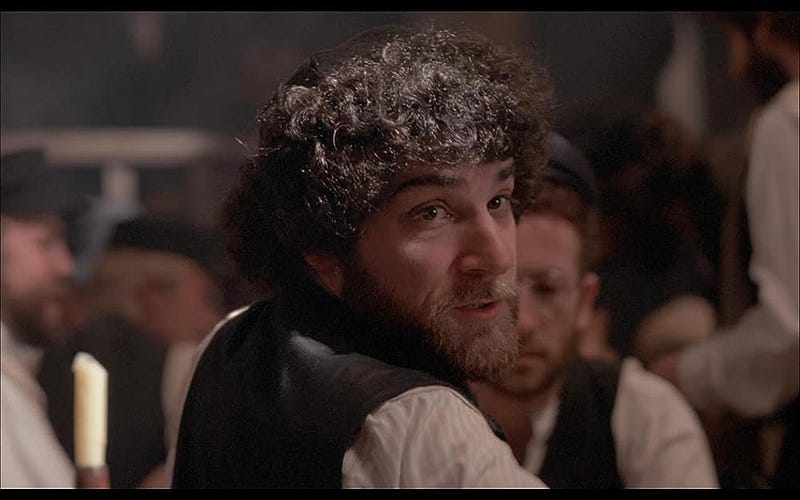
Either way, Avigdor intervenes.
In the movie, he tells the con artist to give his money back and leave Anshel alone, then distracts him from the encounter by correcting his citations and discussing scripture with him. Two things are noteworthy about this scene to me in the film, particularly in regard to Anshel’s masculinity.
Firstly, when the con artist walks away after Avigdor has intervened, he calls Anshel a mama’s boy — if anything, having been raised as an only girl by his father, Anshel is the opposite, but the connotations of the insult aren’t about the fact of one’s upbringing, are they?
A mama’s boy is effeminate, likes women too much, respects his mother too much — he’s too shy, too concerned with getting himself dirty, too nice. To be called a mama’s boy isn’t the same as being called a girl, though: it speaks to emasculation, but more a flawed masculinity than an absence of one.
How does Avigdor comfort him beyond distracting him?
He gestures to his chin and says, “My brother didn’t have one either,” and almost without thinking, Anshel mimics his action and gestures to where his own beard would be if he could only grow one.
The con artist didn’t mention Anshel’s lack of beard, but Avigdor comments on it and assures him it’s not important because even if it wasn’t directly addressed, it remains part of the same core set of flaws in Anshel, that he’s not as masculine as other men. Avigdor, drawn to Anshel, then begins to attempt to convince him to come to the same yeshiva as him to study under Reb Zalman, a genius.
Shimmele looks between the two of them as they talk about Avigdor’s recently deceased brother, and I do think it’s an interesting parallel here that he specifically brings up something about his lacking masculinity and the way we can infer that has to do with his suicide.
In the book, there’s no conning for money with the contest of strength, and it’s merely a boy coming and engaging Anshel in conversation:
“Why so quiet? Don’t you have a tongue?”
“I have nothing to say.”
“What’s your name?”
“Anshel.”
“You are bashful. A violet by the wayside.”
And the young man tweaked Yentl’s nose. She would have given him a smack in return, but her arm refused to budge. She turned white. Another student, slightly older than the rest, tall and pale, with burning eyes and a black beard, came to her rescue.
From Yentl the Yeshiva Boy, by Isaac Bashevis Singer
First, the boy effectively teases him for being silent, demanding he speak — it is often demanded of women that they be silent so that no one is distracted from looking at them; men are far less concerned with one another’s appearance, and they need other men to speak so they can make their measures of them.
It’s noteworthy that Avigdor in the film is also silent until called upon, with the implication that he doesn’t speak unless he has something to say, but his reputation is already made and cemented with the other young men as someone to be admired — they don’t know yet if Anshel is silent because he knows everything, or silent because he knows nothing.
The insult here is twofold — calling Anshel bashful is one thing; calling him “a violet by the wayside” has a few connotations at play.
Calling someone a shrinking violet is an affectionate or insulting way of saying that they’re shy and tend to retire from attention — a beautiful flower that wilts when too much attention is drawn to that beauty. As a trans man nervous about passing, not certain yet if he’s making it or will continue to make it, it’s an anxious spot to be in for someone to compare you to a flower, even if it’s part of a common phrase.
But violets have another association.
Violets are one of the flowers associated with lesbians and the poet Sappho mentioned repeatedly in her work, and violet and lavender are flowers — and colours — that are often associated with queer themes and people, and purple is historically a colour favoured by queer communities, with violets being one of the flowers worn to subtly (or boldly) signal one’s queerness.
Gay boys are often called mama’s boys as well, aren’t they?
The attraction between Anshel and Avigdor in the film is immediate — just as he was distracted by the bookseller when he was meant to be buying fish in the intro to the film, Anshel is distracted by Avigdor when Shimmele is attempting to make conversation with him, and he’s eager to follow him to Bechev when Avigdor calls his name (once he remembers it).
Shimmele thinks that Avigdor’s attraction to Anshel is based on Anshel’s similarity to his brother — Anshel mentions that his father was also his teacher, and of course, Avigdor takes on a similar role in tutoring him on the cart ride; Avigdor mentions that his brother was younger than him, about Anshel’s age, and Shimmele squeezes his shoulder.
This isn’t in the short story, but Avigdor brings Anshel to his usual boarding house, where he flirts and teases Mrs. Jacobs, who runs the boarding house, and it’s natural for Avigdor to suggest that Anshel share his bed.
Anshel is desperate to get out of the same room as the landlady — she’s peering at him in fascination, comments on how young he looks, and while she might not be suspicious yet, perhaps she’ll become so if she looks at him too closely, so early in his transition.
So Anshel goes to Avigdor’s room, filled with books, and reads by lamplight as he procrastinates, stripping off his clothes and getting into the narrow cot with Avigdor.
How much scrutiny will his disguise endure? Can he sleep with his breasts bound — are they even bound, at this point, or did he unbind them for the journey to make sure that he could breathe? Are they small enough to be unnoticed, lying down, still wearing a sleep shirt?
At least it’s dark once he starts stripping off his clothes. He talks nervously as he undresses, apologises again and again for tripping, for keeping Avigdor up. He looks at himself in the mirror and wonders if removing his glasses will make his face look too feminine, if they’ll unmask him, suddenly make him look like a girl with short hair rather than a man with boyish features.
Anshel still has his leggings on in bed — he still wears his tallit katan even, the fringes of his tzitzit visible at his waist: even though he’s set his yarmulke aside to go to bed, his tzitzit will still mark him as a man. Curling up on the very edge of the bed, he inhabits less than a quarter of the mattress’ breadth, but at least like this, his chest isn’t visible, and Avigdor can’t see the lack of bulge between his legs — as if he’d be able to anyway, under the blanket, under his shirt and tzitzit, under his leggings.
“You’ll fall off the edge,” Avigdor tells him, leaning close and over him so that Anshel can feel the shadow of his body over his, probably the warmth of him, perhaps even the heat of Avigdor’s breath at the back of his neck. Has he ever been so intimate with anybody in his life, let alone another man?
“I always sleep like this.”
“Why?”
“Why? I… think it’s written.”
“What is?”
“Two bachelors in the same bed must lie back to back.”
Avigdor’s voice is quiet as he says, “Really?”
“Really — so turn over, please.”
He puts his head down on the pillow pretty hard. It’s funny because at this moment, I don’t think Anshel is even conceiving of the potential that Avigdor could desire him back — men are men, and women are women; men desire women and women men. Anshel might think of himself as “really” a woman, or at least having a woman’s body even though he has a man’s soul, and thus he desires Avigdor.
But Avigdor thinks he’s a man, and for all intents and purposes, Anshel is a man. Avigdor could not desire him unless he somehow suspected what Anshel was.
And yet here Avigdor is, awake now that Anshel is in bed with him, whereas a moment ago, he was desperate to go to sleep. Here is Avigdor with his body close to Anshel’s, moulded against the younger man’s back, with a painful gap between their bodies. Here Avigdor is, subtly complaining that Anshel is so far away from him, so close to the edge — and Anshel replies with what on Anshel’s part is the only reasoning he can think of to explain his own bizarre behaviour, but what on Avigdor’s part no doubt comes across as a subtle shutting down of any homosexual overtures on Avigdor’s part.
Avigdor and Anshel both know full well there’s no such word in Law that two bachelors must sleep back to back.
Avigdor probably thinks that Anshel is being subtler, or at the very least, less potentially unkind in his rejection, by not citing Leviticus 18:22, or Nachmanides, or Ibn Ezra.
Avigdor says, “Why’d you have to talk about Hadass? Now I’ll never get to sleep.”
“Why not?”
“Don’t you ever think sinful thoughts?”
“No.”
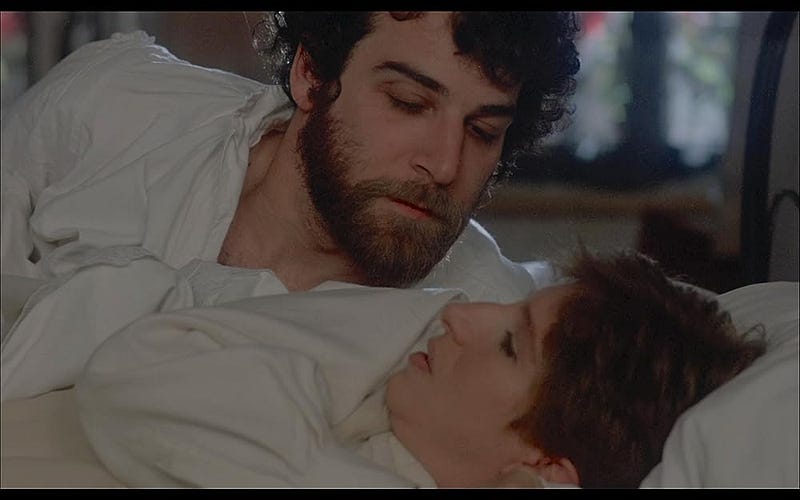
“No!?”
“Yes!”
Anshel is breathing a bit heavier as Avigdor leans over him, much closer than before, trying to look at his face — Anshel is thinking about how feminine his face looks without his glasses on, about how Avigdor will surely notice his breasts if he sits up or if he moves his arms away from his chest; Avigdor is presumably thinking of old arguments about how it’s not exactly lying with a man as you would with a woman so long as he keeps between Anshel’s thighs, or if he threshes on the inside and casts his seed without.
“Don’t be so nervous,” he says gently, because, from Avigdor’s perspective, he’s sleeping in bed with another young man, a young man he’s friendly with, attracted to — and Anshel stammers and says, “Wh — Why should I be nervous?” because he’s not a woman, and men don’t have sex with or have sinful thoughts about other men, and if he showed he was nervous about exactly that, surely it would reveal him as not really a man at all.
Regularly, cishet people ask me, “If you want to have sex with men, why didn’t you stay a straight woman?” and I say, I’m not a straight woman, I’m a gay man.
Straight cisgender people can often understand the existence of gay people, and they might be able to understand the existence of trans people, but to understand people who are both gay and transgender is sometimes hard for them because inexplicably they see homosexuality and being transgender as contradictions of one another, rather than two aspects of identity that can easily intersect.
The trans activist Lou Sullivan was repeatedly denied gender-affirming surgeries in the 1970s because he publicly identified as gay and attracted to other men, and such surgeries were routinely denied to non-het transgender people because the straight cisgender medical institution felt that the goal of transsexual medical care was to create perfect heterosexuals — if someone medically transitioned but was still queer, they felt it went against the point, as queer desire itself was seen as at-odds with male or female genders. Obviously, some progress has been made since then, but even I still have to fight with doctors a bit to assure them that I’m a gay man and desired by other men who love men, and it’s 50 years later.
This story is set in 1904, and while Anshel likely can’t even conceive of the word or meaning of what it is to be transgender just yet (although one likes to think he perhaps found his way to queer Berlin or New York in his story’s epilogue), certainly to transition between the male and female genders also requires in his mind that you take on the correct male and female desires — in his case, yes, desire to study, to smoke a pipe, to discuss scripture, and for women.
“What do I have to be nervous about?”
With a shadow of a wry smile on his face, Avigdor answers, “You’re being tested by the rabbi tomorrow.”
Plausible deniability, and yet as Anshel still stays curled over on his side, Avigdor tips half an inch closer —
And then turns back over and drops back onto the pillow, giving up for the night.
The short story isn’t quite as blatant, but it’s still got its gay undercurrents — once more, they discuss Hadass, discuss the colour of her hair. In the film, Anshel asks if she’s pretty — Avigdor replies that she’s beautiful. In the short story:
“Is she good-looking?”
“She’s blond.”
“Brunettes can be good-looking too.”
“No.”
Yend gazed at Avigdor. He was lean and bony with sunken cheeks. He had curly side-locks so black they appeared blue, and his eyebrows met across the bridge of his nose. He looked at her sharply with the regretful shyness of one who has just divulged a secret. His lapel was rent, according to the custom for mourners, and the lining of his gaberdine showed through. He drummed restlessly on the table and hummed a tune. Behind the high furrowed brow his thoughts seemed to race. Suddenly he spoke:
“Well, what of it. I’ll become a recluse, that’s all.”
From Yentl the Yeshiva Boy, by Isaac Bashevis Singer
He doesn’t speak about what he finds beautiful in Hadass, or what about her is attractive, desirable. He waxes far more poetic about her in the film — here, all he says is that she’s blond and that brunettes can’t be similarly attractive, and yet Avigdor, confident, becomes “regretfully shy” while talking about her and at the end of their engagement, nervous of the secret he’s told his new friend.
And then his solution is to become a recluse — an eternal bachelor.
A confirmed one, maybe?
As Anshel experiences the gender euphoria of being accepted into the yeshiva as a student, meaning that he’s successfully passed as a man, that he’s undergone this testament to and assurance of his manhood even if he never had a bar mitzvah, we obviously see him paired with Avigdor as a student in the yeshiva. In the short story, it’s just a one-line thing, but obviously, in the film, we see a montage where the two of them are intimate with each other.
As a queer person exploring queer desire, especially early on in transition, people often describe gender envy, the desire to mimic someone else’s gender presentation and the way they model and engage in gendered behaviours — cishet people often think of themselves as the baseline for being gender role models, but your average cisgender straight person is often quite bad at gender, simply because they haven’t explored it much, or aren’t doing anything interesting with it.
Cishet people wear and behave gender in the same way that people buy and wear off-the-rack clothes from high street stores — some people look and feel incredibly comfortable in those clothes, they fit them just right, they look and feel very attractive once they wear them, and it shows in their resulting confidence!
Trans and queer people do not really have the same option for these off-the-rack gender presentations and behaviours. We tend to tailor and explore what is important or not about gender for ourselves, making sure that our genders fit us just right, mimicking small bits from other people, picking up fashion tips here and there, cobbling together our wardrobes and our gestures, and our voices from one source or another.
We see Anshel going through precisely that process here.
He desires Avigdor, desires to be close to him, shares subtle smiles and locked gazes with him, speaks passionately with him, craves his company — and at the same time, he’s partially modelling his experience of his transmasculinity off of what Avigdor and other men at shul and in the yeshiva are modelling.
Contrast the moment where Avigdor is speaking passionately while gesticulating with his hands and Anshel, with the shyest of little smiles on his face, subtly copies him in the background with the scene before reaching Zamosc, where Anshel was talking to himself and regularly making his voice deeper. Here, there’s a certain joy in copying that bit of manhood, in exploring it for himself — in the lyrics of the song, he’s talking about the joy of study and his achievement here, that no man can take it away from him, but it’s not just about study, it’s about his manhood, his masculine identity!
And that exploration of his masculinity, it’s not just about external freedoms.
I can travel the past and take what I need To see me through the years What my father learned and his father before him Will be there for my eyes and ears
I can walk through the forests of the trees of knowledge And listen to the lesson of the leaves I can enter rooms where there are rooms within rooms Wrapped in a shawl that learning weaves
I remember, Papa Everything you’ve taught me What you gave me, Papa Look at what it’s brought me
From This Is One Of Those Moments, in Yentl (1983).
Yes, he can study now, and yes, he wouldn’t have been able to do this as a woman, but what we’re seeing in the montage is not just the freedom of study, or a general freedom in mixed-gender spaces — Anshel is playing. He’s reading and he’s laughing, and he’s learning; he’s debating and discussing, but he’s also rough-housing with the other young men, wrestling and playing about.
There’s a euphoria here not only in the freedom to study but in the freedom to be a man and in embracing that manhood to also embrace everything his father taught him — his father and his teacher.
And at the same time, of course, he’s also spending time with Avigdor, the two of them very intimate friends — and because he is a young man in his own right, we see Anshel catch Avigdor up in studies and surpass him, answering a question correctly where Avigdor didn’t. We even see Avigdor fixing his tie for him as the two of them look at themselves in a shared mirror — Avigdor is literally making a small correction on an aspect associated with Anshel’s gender presentation, and at the same time, the two of them are physically friendly with each other, walking arms around each other’s shoulders into the street.
At the same time as Anshel is feeling a sense of new freedom and euphoria in his gender identity and his experience of life as a man, he’s also experiencing the wonder of being intimate with a man he’s so attracted to, and it’s important that like —
This intimate friendship is nothing like what courtship would look like, were Anshel a woman. Here, the two of them can speak like equals, exchange gifts and services.
The two friends, sharing a lectern in a corner of the study house, spent more time talking than learning. Occasionally Avigdor smoked, and Anshel, taking the cigarette from his lips, would have a puff. Avigdor liked baked flatcakes made with buckwheat, so Anshel stopped at the bakery every morning to buy one, and wouldn’t let him pay his share. Often Anshel did things that greatly surprised Avigdor. If a button came off Avigdor’s coat, for example, Anshel would arrive at the yeshiva the next day with needle and thread and sew it back on. Anshel bought Avigdor all kinds of presents: a silk handkerchief, a pair of socks, a muffler. Avigdor grew more and more attached to this boy, five years younger than himself, whose beard hadn’t even begun to sprout.
From Yentl the Yeshiva Boy, by Isaac Bashevis Singer
Firstly, there’s the kiss here — where Anshel smoked his father’s pipe in secret, here he’s sharing a cigarette and the intimacy of that cigarette with Avigdor, their lips both touching the same source, like two halves of a kiss.
But what’s noteworthy here especially is if we contrast the things that Anshel thought of himself as bad at in one of the opening paragraphs of the short story — that he can’t sew, that he can’t knit, that he can’t cook, that he can’t bake.
He thinks of himself as an unworthy potential wife because he isn’t good at any of these things and has no desire to become so — and yet here, Anshel buys Avigdor his favourite baked goods; he said he couldn’t sew, but here he sews Avigdor’s torn button back onto his coat; he buys Avigdor thoughtful, useful gifts, the sort of gifts a wife might buy her husband.
A cishet person might read this as his womanly instincts coming through once he’s found a man — I would say the opposite. Anshel rejected these things (and women, who he frequently discusses in disparaging terms) because he couldn’t engage with them without being labelled a woman, and yet if he did all of them, he still wouldn’t have escaped the gender nonconformity that would have him criticised for not being woman enough.
Sewing is no longer so arduous a task now that he can sew and still be a man.
In the short story, Hadass has already broken off her betrothal with Avigdor, and Anshel dines at Hadass’ once a week — Avigdor remains fascinated with her, and Anshel obviously doesn’t understand what the enthusiasm’s all about.
He makes notes on the flaws in her service as a woman — that she’s as clumsy as Anshel was pre-transition, that she’s not good at waiting on the table, that she was not good-looking — and also on her personality, implying that she’s not as humble as she should be given her looks and that she’s vain for frequently changing her hair-do and looking in the mirror, that she takes advantage of their servant girl, and that she reads too much.
It’s funny because so many of the things that Anshel makes note of as flaws in Hadass are flaws men likely noted in him when they saw him as a woman — always reading books, not good-looking enough, too arrogant, too demanding.
And when Anshel says he has no interest in her, that he would do without her, Avigdor asks him, “Don’t you have evil impulses?”, which is obviously included in the bed scene in the film.
In the film, Avigdor’s preoccupation with Hadass is communicated more subtly — while Anshel speaks with Hadass’ father and comments on the dinner that’s been prepared for them, Avigdor only has eyes for Hadass, and cannot take them off her.
Still, Anshel notices that Hadass is clumsy — and he’s nervous when speaking with Mrs. Vishkower, because this woman is asking him question after question, and there’s that underlying fear that she’ll see what he is.
His song here is interesting, because he’s saying, “No wonder he loves her,” even though she’s clumsy — he’s talking about all the things she’s doing to show Avigdor her potential devotion as a wife, waiting on him, but also talking about how she’d think about the temperature and so on before he realised he was chilly.
“Why should she worry?” he asks and sings blisteringly about how the biggest problem in Hadass’ life is figuring out what to wear and waiting hand and foot on a man, as if he couldn’t bear the idea of doing those things himself.
As Mrs. Vishkower fusses over Hadass’ hair, you see Anshel anxiously touch his own hair, and he’s stuck between Hadass and Avigdor and also Mr. and Mrs. Vishkower on the other side.
When Hadass drops a beetroot this time, her father says, “Don’t worry, it happens…” And with his smile faded, adds, “All the time.” And they laugh, and you can see how much it hurts Hadass, how anxious she is, how the servant girl clocks it immediately as another mistake.
No, Avigdor isn’t noticing these mistakes, but other people are. Her father is commenting on these flaws in her character in front of a guest she’s only just met! Hadass is a flawed and imperfect woman, and isn’t living up to the expectations of her as a woman.
“Why should she worry?” Anshel asks because all he can think of is the fact that Hadass seems happy enough actually being a woman — yes, she’s held to unfair standards, but at least womanhood seems to fit her. At least she’s got a woman’s soul to go with her woman’s body.
It’s commented on that Anshel compliments Mrs Vishkower’s home and her silverware — it’s one of those mama’s boy sort of comments, that’s not quite as masculine as people might prefer, but then it comes to Hadass herself.
“Is she always that nervous?” Anshel asks.
“She’s a girl,” says Avigdor dismissively. “In love. What do you expect?”
“She doesn’t say very much, does she?”
“What does she have to say?”
Anshel has a lot of internalised misogyny going on — he’s very uncomfortable with women, hasn’t yet learned to speak with women as a man, being complimented and cooed over for every little thing rather than criticised and tutted at, but as we see in the short story, he thinks very dismissively of them.
Although he had his own experiences being treated terribly and frequently punished for living while experiencing the world as a woman and being perceived as one, he has this distance from them — he thinks of it being a flaw in women that they chatter about unimportant things or that they gossip, or that they read the novels that he rejected in favour of holy texts; he thinks of women in many ways as ineffectual and unimportant…
And yet here, there’s a realisation.
If Avigdor knew what and who Anshel was, that he had been designated female at birth, he would treat him with just this same level of dismissiveness, with this same level of disinterest — if not disbelief — in his interiority.
“Don’t you ever wonder what she’s thinking?” Anshel asks.
“No,” Avigdor says after a moment of consideration. “What could she be thinking?”
Anshel laughs awkwardly — it’s uncomfortable for him to come to that internal understanding that Avigdor again wouldn’t recognise his inner being, that he was a complicated person just like him, if he knew he wasn’t a cis man; and at the same time, Anshel was on precisely the same train of thought as Avigdor now a moment ago! He was simplifying Hadass only down to her desire for and care for Avigdor, reducing her down to her wifely duties and her desire to please a man, which is not at all dissimilar to what Avigdor is saying now.
“Anyway,” says Avigdor, because he’s a bisexual king, “I don’t need her to think. I can do that with you.”
And then we transition to just… a great argument.
Anshel, on his side, is arguing that the Hebrew for rib ( צלע) as used in Genesis 2:21 shouldn’t be translated as “rib,” but instead should be translated as “side”; Avigdor says, rib, side, what’s the difference?
“Since Adam was created both male and female…”
“Where’s that written?”
“Genesis, Chapter 5, Verse 2 — “
(This is the record of Adam’s line. — When God created humankind, it was made in the likeness of God; (1) male and female were they created. And when they were created, [God] blessed them and called them Humankind. (2))
“ — And if God took one side of Adam and not his rib and created woman, that means they’re the same! We all are; everybody is. Don’t you see?”
“What I see is you’ve never been with a woman.”
Love the little confirmation here that Avigdor fucks, as if confirmation were needed.
Here, Anshel is trying to come to terms with the fact that a lot of the gender binary around him is a lie, or at the very least, constructed, and not innate or biological. If God created woman of man, then man is also of woman, and both are of God — the differences in their behaviours, in their roles in society, if they were truly biological and innate, he would have been found out by now; he would not be so capable and so adept a student.
He tries to defend his point: “What I mean is that they share masculine and feminine qualities since they come from the same source.”
And Avigdor, thinking he’s got a real mic drop moment on his hand, gestures to a woman breastfeeding her baby while chatting with another woman by the river and says, “Look, can you do that?”
“What?”
“Create life, give birth to sons? When you can do that, then tell me we’re the same.”
Even in a conversation about gender equality, about how women are fundamentally the same as men, Avigdor is so dismissive of women and so fixated on his patriarchal vision of Creation that he says “sons” instead of “children.”
And here, Anshel is in a weird spot, right? Because, for all we know, he could well give birth to sons. He doesn’t know unless he tries — but to reveal that might be to lose everything he has: his position at the yeshiva, his life and manhood, Avigdor’s respect, Avigdor’s love, and affection.
Anshel is coming to the uncomfortable awareness that many trans people do, that it’s not as simple as our correctly gendered souls being misfiled into the wrong bodies — that the whole game is rigged, that a lot of the roles in society are down to the social and cultural rules and regulations that organise how we live, that they are enforced by people and communities and society, not by a sort of impersonal natural force.
While chasing and teasing Anshel, Avigdor begins to quote Bereishit Rabbah 18:12: “The true story of Adam and Eve, Genesis Rabba 18: God didn’t make her from Adam’s ear lest she be an eavesdropper; nor from his foot, lest she be a wanderer; nor from his heart, so she wouldn’t be jealous; but from a hidden part of the body so she’d be modest — Like my Hadass!”
Anshel is giggling and laughing as he tries to shove Avigdor off, and at one point protests, “Must you talk with your hands!?” as if he wasn’t copying the way Avigdor talks with his hands not long ago.
“In other words, the rib!”
“No, not the rib. Not the rib, ox head. Side!”
“Rib!”
“Side!”
“Rib!”
And while wrestling Anshel to the ground and pinning him beneath him, Avigdor tells him to admit he’s wrong. There’s a moment of silence as Avigdor gazes down at him, and Anshel’s still laughing, but you can see the desire in Avigdor’s eyes, see the part of his lips, the softening of his eyes.
And then!
And then!
As Anshel says, “Oh my God,” we see Avigdor’s glorious fat ass as he strips naked and dives into the river and swims, every inch of his naked skin glistening with water.
Just a second ago, Anshel was laughing and wrestling with Avigdor, was being tickled, was play-fighting in the grass, and now Avigdor comes out of the water with his cock out, with his wonderful chest hair plastered wet to his tits, and although the other boys are taunting him, this is one thing that Anshel can’t do.
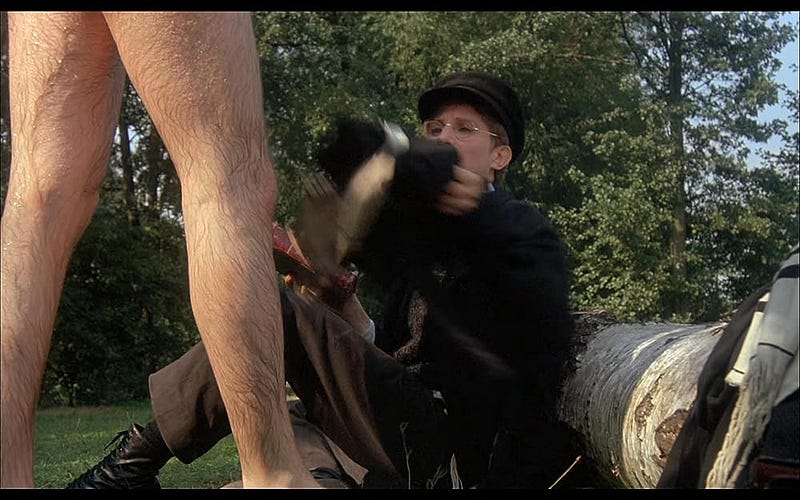
He’s desperately trying to avert his gaze, telling Avigdor to put his clothes on, to cover up his nakedness, and Avigdor doesn’t, stands there right in front of his face, sprawls naked beside him because it’s a warm, summer’s day, and why shouldn’t they?
It’s not a coincidence that he went from wrestling with Anshel, from being so physically close to his body, from being on top of him, to running to strip off his clothes — I expect diving into the cool, refreshing water was a good idea to calm his erection down, too.
He felt desire at that moment for his friend and jumped from that to wanting to get his clothes off — Anshel had subtly turned him down before, but at the very least, they can be naked together here, right? And with all the other young men, so Avigdor can see Anshel without his clothes on, but it’s not weird — there’s deniability here. They’re not lying with each other in the privacy of a room: they’re in public, and it’s only play.
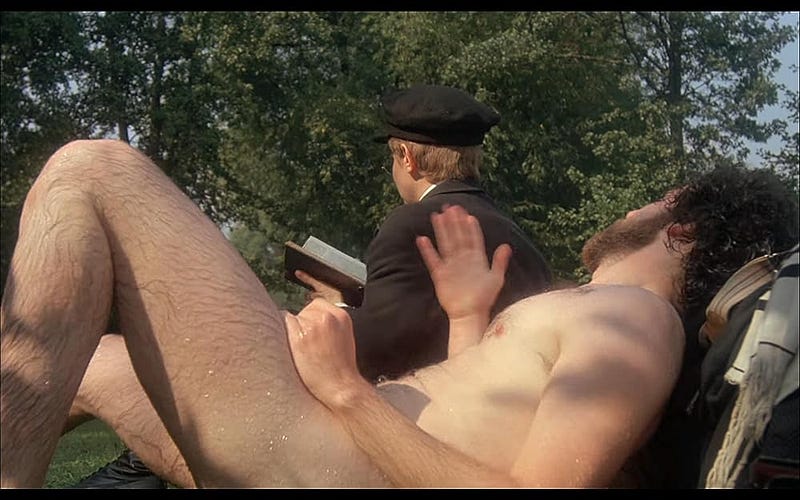
Avigdor tries to drag him into the water, and it’s a very different tone to their play a second ago, where Anshel was laughing, was chasing as well as being chased — Avigdor is telling him to take his clothes off, that he’s going to get all wet (I bet), and Anshel begs him to stop, to let him free, is stiff in Avigdor’s arms where he’s normally relaxed and comfortable in them.
“Okay, okay. If you’re that scared… I’m not going to force you,” Avigdor tells him as Anshel apologises and steps back. “When you’re ready,” he says.
He’s not talking about swimming.
And now we get onto The Way He Makes Me Feel, which is the song that made me want to write this essay.
“Feelings are awakening I hardly recognise as mine…
What are all these new sensations? What’s the secret they reveal? I’m not sure I understand But I like the way I feel”
The Way He Makes Me Feel, from Yentl (1983)
A cisgender person might see this scene where Anshel strips off his clothes, including the binding on his breasts, in front of the mirror as him somehow embracing his womanhood, or being pleased with his feminity, but that’s not what I see.
What I see is a man for the first time stripping off his clothes, looking at himself in the mirror without them on, and not hating his body.
Frequently, we see Anshel looking at himself in the mirror — it’s of course mentioned in the story that when clothed he’s a handsome young man, with the implication that without those clothes he’s not handsome any more, but we also see him regularly paired with Avigdor, and once so far he meets gazes with Hadass in the mirror.
In short, whenever we’ve seen Anshel look at himself in the mirror so far, it’s also been through other people’s eyes — through Avigdor’s and through Hadass’ — and they’ve been desiring him as a man.
This is the first time we see Anshel look at himself unclothed, and still see himself as a man, still liking the way he looks, the way he feels, because he’s feeling desire for Avigdor, his sexuality awakening, and although it’s painful, because he’s certain he could never reveal his transition and still be desired, those sexual feelings make him feel good and affirmed in his manhood.
“I’m a bundle of confusion Yet it has a strange appeal Did it all begin with him And the way he makes me feel?”
The Way He Makes Me Feel, from Yentl (1983)
Here we see him touching his breasts in the mirror, thumbing over his nipples, albeit covered up with a nightgown — has he ever been able to do that before? Has he ever been able to touch his body, think of it as desirable, thinking of it as a body in which he can feel and embrace his own desire, without thinking of the purpose it would be put to if he was treated as a woman again? Bearing and rearing?
From the short story:
“Why can’t a woman be like a man?” Avigdor asked once, looking up at the sky.
“How do you mean?”
“Why couldn’t Hadass be just like you?”
“How like me?”
“Oh — a good fellow.”
From Yentl the Yeshiva Boy, by Isaac Bashevis Singer
Fascinating! Why indeed, Avigdor!
In the film, Avigdor asks Anshel after his realisation that Avigdor makes him feel sexual — and also, sexy! — and then says he’ll take him to the matchmaker, “Get you something soft, round, and sweet!”
Which, we’ve seen Avigdor’s ass. He’s got everything a man needs right there.
But again, it’s so funny that Avigdor constantly brings up sexual implications and for Anshel to go have sex with a woman while physically touching him and wrestling him about.
Sophie, the Vishkowers’ maid, interrupts, and Avigdor keeps hold of him — Mr Vishkower wants to see him. In dramatic fashion, he intones “The wedding night!” as he grabs Anshel again, and Anshel asks:
“Why do you keep grabbing me?”
“What?”
“You’re always grabbing me.” He’s not as naive as he once was — he’s also more aware of Avigdor’s attractive qualities, his desire for him.
“No, I’m not.”
“Yes, you are.”
“So? Everything has to have a reason?” Avigdor asks as he draws away, physically putting more distance between him and Anshel.
In the original short story, Avigdor’s of course had the relationship broken off before the opening of the tale — the wedding is now cancelled in the film, because Reb Alter has found out that Avigdor’s brother died by suicide.
Avigdor is grieving and upset — and when Anshel says that Hadass is capable of making her own decisions, that if she wants to marry Avigdor she still can without her parents’ permission, Avigdor takes his defence of Hadass’ autonomy as a philosophical argument rather than an attempt at comfort and an assurance things will be alright.
“Hadass is a nice girl, but don’t make her more than she is.”
“No, I’m not. She was exactly what I wanted.”
Ouch.
Anshel’s voice is delicate as he tries to assure Avigdor it will be alright — it’s funny that he gets to his knees to do it, honestly. If only he knew what homosexuality was.
When he says that another girl might turn up, and suggests one with brown hair, Avigdor tells him, “I wouldn’t notice her if she did,” and it feels like a rejection.
Like, that’s the funny thing about the two of them, is that they’re speaking different languages and have different gaps in their knowledge, and neither is aware that they’re rejecting the other without even realising it, Avigdor because he doesn’t know Anshel’s not cisgender, and Anshel because he doesn’t know what overtures between men look like.
In Avigdor’s mind, I have to wonder if his desire that Anshel should marry Hadass where he can’t is like sharing a cigarette with him, an indirect kiss — he talks about being like brothers with Anshel, referring to the intimacy of their relationship, and of course, Anshel does remind him in some ways of his brother.
“The thought of her marrying another man is driving me crazy!”
“Aren’t I another man!?”
“Yes, but not a perfect stranger! You marrying her would be the nearest thing to me marrying her!”
But the core of his solution, effectively, is that the three of them can be together. Avigdor wants a throuple solution to the whole ordeal — if Anshel marries Hadass, he can visit, can still see her, meet her.
And when Anshel says no, Avigdor says, “Do you feel anything for me?”
“Of course I do.”
“Then think again.”
Obviously, in the short story and in the film, Avigdor repeatedly brings up his sexual desires and his need to have them fulfilled, talks about the marriage bed, often while touching Anshel…
Avigdor doesn’t even flinch when Anshel says he doesn’t ever want to get married in the film, that he has no desire in that direction. He isn’t remotely surprised, because he suspects that Anshel is gay, thus why he’s made repeated flirtations toward him — and here is a solution.
Anshel can marry, Hadass can be his beard, Avigdor can still meet with Hadass.
Here then, is a reprise of Anshel’s song about why it’s natural Avigdor should desire him, where he’s now feeling bisexual feelings! It’s really interesting comparing this reprise to the original song, because part of it is absolutely that he’s considering marriage to Hadass and what it will be like, but this is also after Anshel’s own awakening and his physically accustoming to his own body, and the fact that he’s no longer exclusively feeling negative feelings about it.
Two bi kings in one movie!
Their conversation is stunted at first, where Hadass is effectively finally allowed to speak after being silent for so long, which is another reason Anshel is able to explore his potential attraction to her and the ways in which she’s beautiful, feminine — her skin, the way she smells, the way she moves.
And for Hadass, like —
Whether she too suspects that Anshel is gay and thus will be good company, or whether it’s merely that Anshel is a handsome young man that she likes and gets along with, whether she could love him too, but either way, she begs him to marry her —
And a few minutes later, Anshel begs that Avigdor stay.
“It’s unnatural!”
“Who’s to say what’s natural!?”
Indeed!
We obviously see a lot more confidence in Anshel as he goes through the tailoring process, oscillating wildly between more dysphoric anxiety than ever before and astonishing comfort in his identity and his ability to pass forever. That up-and-down feeling of going between confidence and uncertainty is so real when in a new situation.
In the story, we don’t quite see this sort of internal turmoil about Anshel’s identity — he worries about the morality of it, about potentially ruining Hadass’s life by marrying her, but the plan to include Avigdor as a third is far less explicit and considered, even without Avigdor murmuring horny poetry in Anshel’s ear, all the way from Nachmanides.
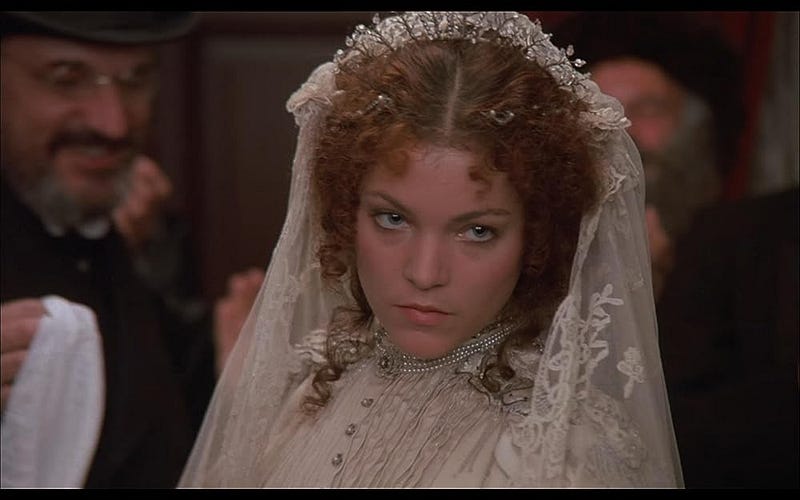
For all Avigdor doesn’t seem to think much of Hadass’ ability to think for herself or make her own choices, it is nice that he cares about Anshel pleasing her in bed? With how preoccupied he is with sex, it’s great that he’s actually got some skill and awareness under his belt, especially when we see Mrs. Vishkower telling Hadass that as Eve was made from Adam’s rib, it’s her duty to obey her husband.
Reb Alter, of course, assures him that Hadass knows nothing of sex, and asks Anshel to get a move on impregnating his daughter, which like. Good luck.
It’s interesting that Anshel immediately moves to assuring Hadass that she doesn’t have to do anything she doesn’t want to, tells her that the Talmud says a woman can refuse her husband, and all in all like… immediately assures her of her ability to consent, to decide what will go in in their marriage as much as Anshel will, and to use that as a way to manipulate her.
In the short story, having sex and finding a way to deflower her while knowing that no one will speak to her explicitly enough that she’d ever clock anything was wrong is different, but like —
What I like about the film’s change is that Hadass is less of a hapless victim and is allotted more agency and consideration by Anshel himself. Yes, he’s still manipulating her and making use of her ignorance of the Talmud by saying that they can’t have sex while she’s still thinking of Avigdor, but it’s a far less severe deception.
I love them being drunk and giggling together; it’s honestly very cute, and like… Pouring a little wine so that they see the “blood” on the sheets is good.
I’m obsessed with Avigdor interrogating Anshel about how Hadass was in bed, asking if she screamed or said anything, where he’s so preoccupied with how Hadass is, and it’s just like… Anshel is obviously trying to avoid the conversation, but at the same time, has his own horny thoughts that he’s trying so hard to avoid while navigating the layers of deception, of hiding his transition, of how to talk about these things in a way that sounds believable but also isn’t too explicit a lie.
Hadass talks with Anshel about how she used to be clumsier with Avigdor, that he would “Make me tremble… inside.”
“That’s love, Hadass.”
“But you don’t make me tremble. You make me peaceful.”
And it’s —
There’s something incredible about this moment, about Hadass working so hard to be seductive when she’s got limited awareness as to how to approach it when she’s a young woman who wants to fuck her husband, and she’s lucky to have a husband who like… cares explicitly about her pleasure and her desire —
And also now is like, listen, listen, listen. Let’s not fuck. Why don’t we study instead?
“I can’t learn Talmud!”
“Nonsense. If I can do it, you can do it.”
“But isn’t it a sin? I thought women were forbidden…”
“Sin, sin! It’s not a sin.”
“Then why are you closing the curtains and me locking the door?”
“Why? Because I’m certain God will understand — I’m not so sure about the neighbours!”
The smile on Anshel’s face as he quotes his father and carries on his good work in teaching Hadass Talmud is really beautiful, in a way, especially given that he’s aware he almost certainly won’t have children of his own because of the choices he’s made with his transition. Repeatedly, we hear the argument in the course of the film that the purpose of study is to live life, and that living life, one should have sons onto whom one can pass one’s wisdom and the knowledge one’s taken on…
And here, Anshel is carrying on his own legacy even though he won’t have children. He cannot have a son to teach, but he can teach Hadass, and in teaching Hadass he will give her the tools to self-advocate, to live a more educated and thus more empowered life, which is what the goal is when teaching a son the same skills.
Poor Hadass.
She just wanted to get her rocks off, and here this bastard is, making her study!
Avigdor coming to dinner is so bittersweet, just the way it’s shot of like… Avigdor only with eyes for Hadass, Hadass only with eyes for Anshel, Anshel only with eyes for Avigdor. Anshel pouring tea for Avigdor and copying what Hadass had said when offering him tea.
I love that his song is effectively about hoping that Avigdor will look at Anshel the way he looks at Hadass, and then Avigdor does look at Anshel, looks at him with desire at the same time he realises that this isn’t going to work, that being there and seeing the woman he loves loving him —
And immediately, he has to run out and leave. Can’t catch me, gay thoughts.
Anyway, Hadass saying, hey, “You told me I had the right to refuse you; you didn’t tell me I also had the right to demand you.”
“Who told you that?”
“The Talmud, the Yevamoth Tractate. I forget what page.”
“Sixty-three A and B.”
She is so right about that. Give that girl some strap, boy! Anyway, this is the danger of women studying Talmud — they want to fuck. I love that Hadass is so concerned for Anshel’s blue and non-existent balls, and she’s in love with him in large part because he insisted on teaching her.
“I feel so certain that you love me. Everything you do shows me you love me.”
Babe, that’s respect! He respects her and cares about you as a human being, extending you every kindness he would anybody! Unfortunately, he wants to fuck Mandy Patinkin, just like we all do, and he’s not gonna do that either!
“I’ll study while you’re away. I want you to be proud of me.”
This poor fucking woman. Someone fuck her immediately, her trans boyfriend is making her into a nerd by blue-balling her.
I love that Anshel went to find Avigdor in the middle of fucking nowhere for the sole purpose of getting his tits out, he’s just like me, for real.
We never really see a wedding walk or procession or anything similar for Anshel and Hadass, just because they’re staying in her parents’ house, and it’s interesting that we see an equivalent between Anshel and Avigdor as they make their way into Lublin, once more in an only-one-bed situation, it would seem.
“We’re friends; what can’t you tell me?”
“All right. Avigdor, what would you do if all you ever wanted to do was study, and it was forbidden?”
I just fucking adore that this is what he starts out with, that he asks that Avigdor think of studying and the core of it, the need to study and to understand the world around him. That’s the thing the two of them share in common.
“I’m a woman.”
“I too have a secret. I’m the tzar of Russia.”
God.
Avigdor has been demanding that Anshel get undressed and lowkey, hoping that Anshel will fuck him for this whole movie, and now this boy is here, tits out, and he literally cannot believe it! He was so down to fuck this boy when he was a boy, and now, ouch!
It’s the pure rage in it, the way he screams, the way he calls him a devil, and like… The screaming and the aggression, the way he grabs him, like, it’s just such a real and constant terror for so many trans men and mascs, because like…
Avigdor was down to fuck, right? He was down to clown.
But it was as men between men — and especially when he says, “I thought there was something wrong with me,” thinking about his desire to fuck him up until now, his constant desire to touch him, to be close to him, and that he was afraid to because it was a sin, and now it’s a different kind of sin.
And when they were two men, like Avigdor says, he trusted Anshel, and told him things he wouldn’t even have told a wife, because a wife — a woman — couldn’t have been trusted with them.
The choice to light Anshel’s face is so utterly golden in this scene, in this moment where Avigdor finally kisses him and to then interrupt the swelling music with the recollection of Hadass, because Avigdor loves her as much as he loves Anshel.
Here, Anshel finally realises the entirety of himself, because here he is, kissing a man — and there’s an understanding that he cannot go back. For a moment, you can see he’s thinking about it, about detransitioning just to be with Avigdor, having kids, and Avigdor still doesn’t get it.
He holds Anshel’s face so gently in his palms, and says he wants Anshel to be his wife, to be like a real woman, and he says, “I am a real woman,” and… No. He’s not. And this is everything Anshel was frightened of and was right to be frightened of, that as soon as Avigdor knew what and who he was, he would no longer respect him and see him as a whole being, a whole person — he would only see him as the value of a man’s rib, and not an equal half of him.
“I’m going to a new place, where I hope things are different,” Anshel writes him in the last letter he sends, sailing by boat to somewhere else, and it’s honestly shit seeing him in women’s clothes again, because like… A lot of trans people detransition after, for example, being violently attacked by a trusted loved one after the revelation that they’re transgender, and then transition again later on.
One would hope that he just dresses as a woman for the boat journey, so that he doesn’t have to risk being discovered in such close quarters, and then can comfortably go back to being himself once he’s off the ship.
The ending of the short story is honestly so much more hopeful, in that Anshel leaves, with the implication that he never detransitions, and Avigdor and Hadass are both so in love with him that:
Not long after the wedding, Hadass became pregnant. The child was a boy and those assembled at the circumcision could scarcely believe their ears when they heard the father name his son Anshel.
From Yentl the Yeshiva Boy, by Isaac Bashevis Singer
Anyway, as I said — one hopes that Anshel finds his way, in the aftermath of the story, to Berlin, and falls in with other trans men, especially other queer trans men!
If he left in 1905, he could have met Magnus Hirschfeld in a decade or so. By the time he was fifty or sixty, he could have been one of the first phalloplasty recipients in the 1940s.
A man can dream.
Resources:
- Yentl the Yeshiva Boy by Isaac Bashevis Singer
- Yentl Movie Script
- Four Flowering Plants That Have Been Decidedly Queered by Sarah Prager
- Violet delights: A queer history of purple by Keava McMillan
- The Forgotten History of the World’s First Trans Clinic by Brandy Schillace