
Yellow Butterfly, A Story of Hope
A little girl in war-torn Ukraine finds hope in a yellow butterfly
I stare at blank screen. Type, I saw the news… No, that’s stupid. Backspace. Try again. Backspace again. What to say? I don’t know what to say.
I want to know. I’m afraid to know. Finally, I tap three words.
Are you okay?
I add xoxo. My name. Hit send. Wait a bit and check email. Nothing. Check again. Nothing. Cry. Sleep. Look again. Please answer, I pray. Still nothing.
When Dad died, I set up an account on Ancestry. Kicking myself for not doing it while he lived. Some while later, I forget how long, I get a message. Hello, it says. I am your cousin in Kyiv. So good to find you here.
Oh my God, I reply, what a miracle. I am so glad you found me!
Barely got to know each other. Comparing faces. Look, this is grandpapa. Like your grandpa, yes? My English is okay, no? It’s good, it’s good. Uncle is gone? I am so sorry, cousin. Then Putin dropped bombs. On Kyiv.
Two years. I don’t know where she is. If she is. Some things, no one teaches us. Because no one can. Like how to carry not knowing for so long.
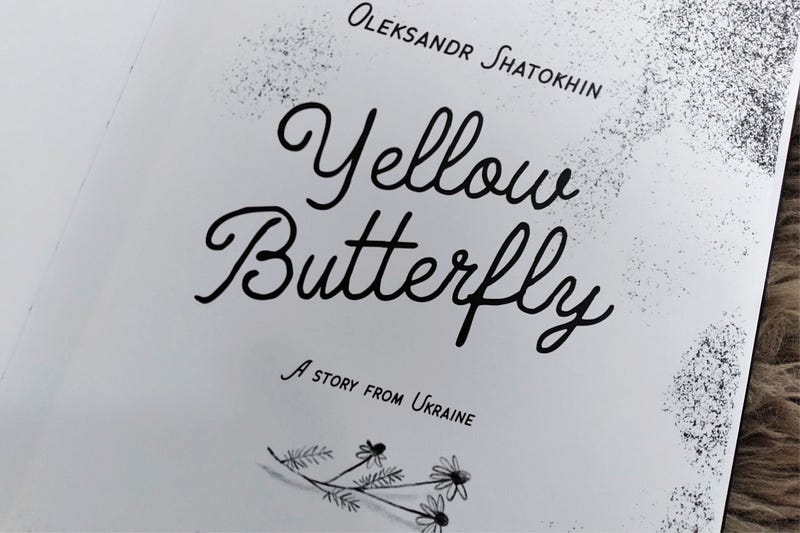
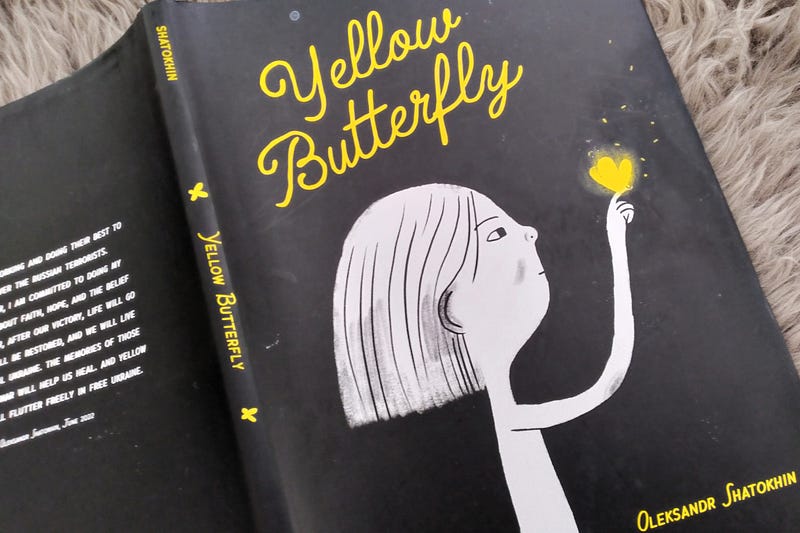
Yellow Butterfly is the story of one little girl looking for hope in the middle of the current war in Ukraine.
It has no words, yet the pictures speak volumes. Of pain. Fear. Atrocities. Of the reverberations of war as they are felt in the heart of one little girl.
Here’s what Unicef says. Two years later, over ten thousand civilians have been killed. Children are deeply traumatized. Loss of homes and family. Loss of friends, school, education, and places to play. Loss of safety.
Yellow Butterfly is the story of one little girl. But she is multitudes.
“A beautiful and heartbreaking tribute to the resiliency of people in wartime;”– School Library Journal
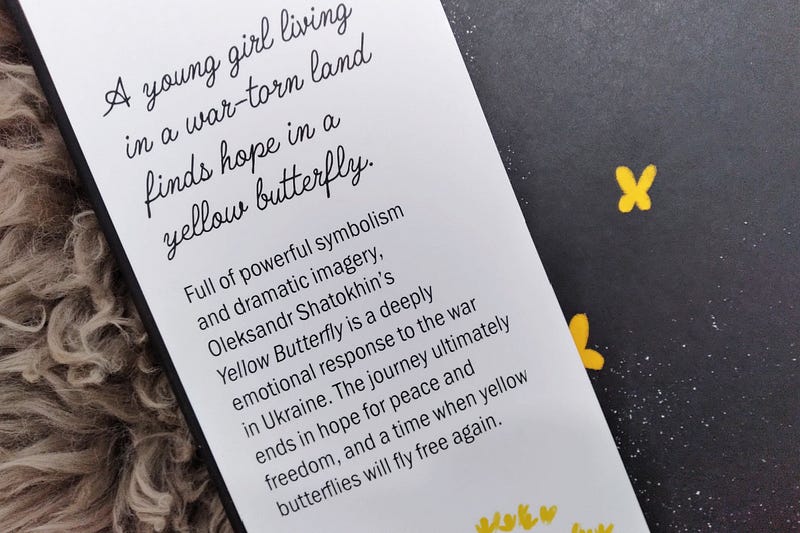
The reviews are stellar. Stunning. Singing the praises of one artist who looked at the war-torn land. Then got out his tablet. Started to draw.
“A moving portrait” said the New York Times.
“Provocative, powerful, breathtakingly beautiful.” A starred review by Kirkus.
“A beautiful and heartbreaking tribute to the resiliency of people in wartime” says the School Library Journal.
“A moving story, both timely — and timeless,” says Booklist.
This book is a work of art. Visually magnificent. Poignant enough to hit you in the gut, as it should. To create impact, yet leave space enough to inspire conversation. And it won’t scare children. But here. Let me show you.
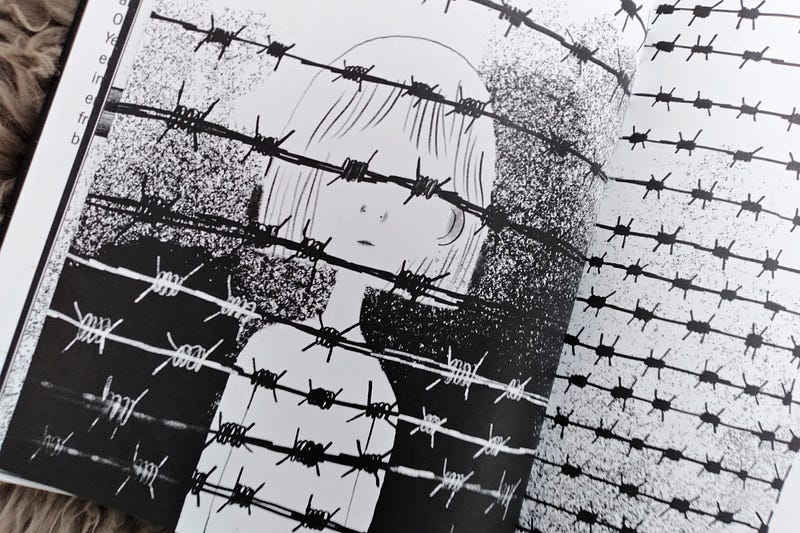
Eyes of barbed wire. It’s all she sees. Barbed wire fences everywhere. Places she played. Once. Before the war came. Before bombs.
Once she was just a little girl. Now she is a child of war. Her country filled with the objects of war. Remnants of bombs and missiles on the ground. Bullet riddled vehicles left behind and forgotten.
The devastation leaves her first breathless. Scared. Sad. And then angry.
I wish I could show you all the pages. Seventy two pages. Not a big book, only a big hearted book. But still, too many pages to share them all.
In photos not included here, you see her rage. Screaming. Beating tiny fists on spent missiles. Crying. Yelling. As she stares at the barbed wire, it turns into a giant barbed wire spider. It chases her. She runs.
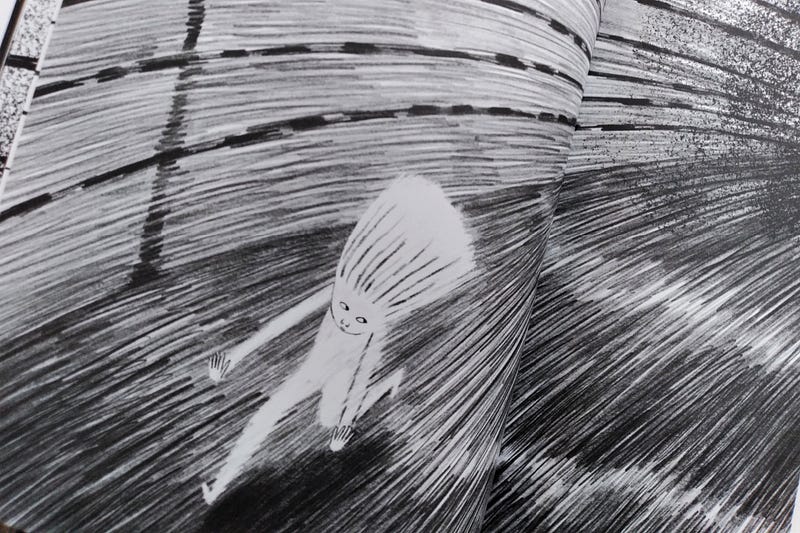
The first sixteen pages are stark black and white images. Stark like war. Black like fear. No color. Just dark, nightmarish images, like war and bombs must feel to one very small girl in Ukraine right now.
Not a single word yet the artists leaves the realities of war on the page in artwork that needs no words to tell the story of one child. Every child.
Image after image juxtaposes scenes of war over the life she once knew. Craters where she once played. Bombs. Bullet holes. Barbed wire.
She is running, running. She trips on a rock. Falls.
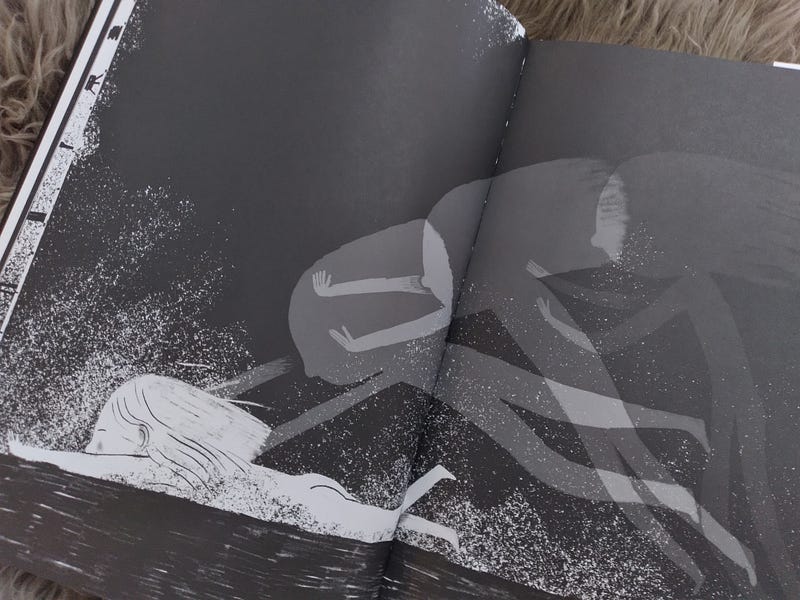
But when she lifts her head, what’s this?
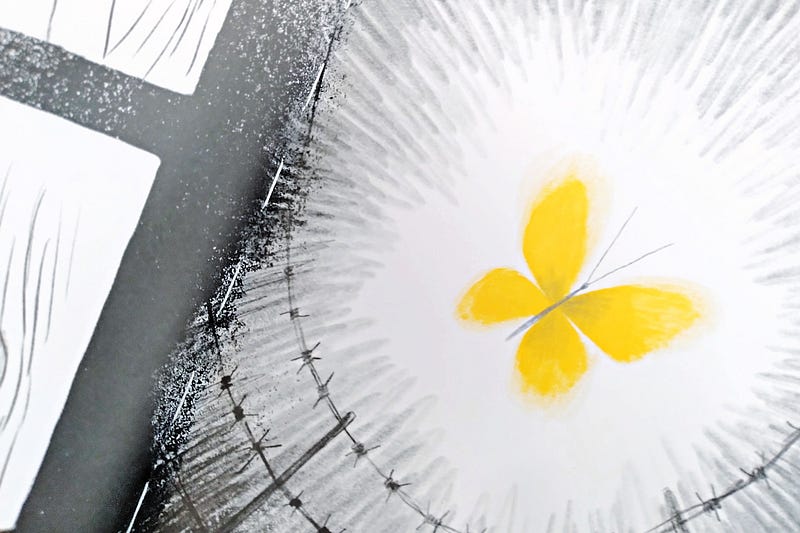
A yellow butterfly.
The first spot of color in the book. After sixteen pages of black and white. She lives in war, but she is still a little girl. She chases the butterfly.
Let me tell you something that hurts my heart. In Ukraine, kindergarten teachers are being trained to help children deal with the trauma of hiding in bomb shelters while bombs fall around them.
So they don’t withdraw, traumatized. So they don’t become silent ghosts of children who once knew how to laugh and play. It’s already enough so many of them have lost family. Fathers. Mothers. Siblings.
One of the most effective exercises is the butterfly game. First they uncurl and open up their butterfly wings. Then sway, sway to soft music. Be a butterfly, teacher says. It calms their stress. Makes them less afraid.
Chasing the butterfly, the little girl sees more. First two. Three. Then four. Then so many butterflies. She pushes a bomb. They take it away. Gone. On butterfly wings. She follows them. Where are they going?
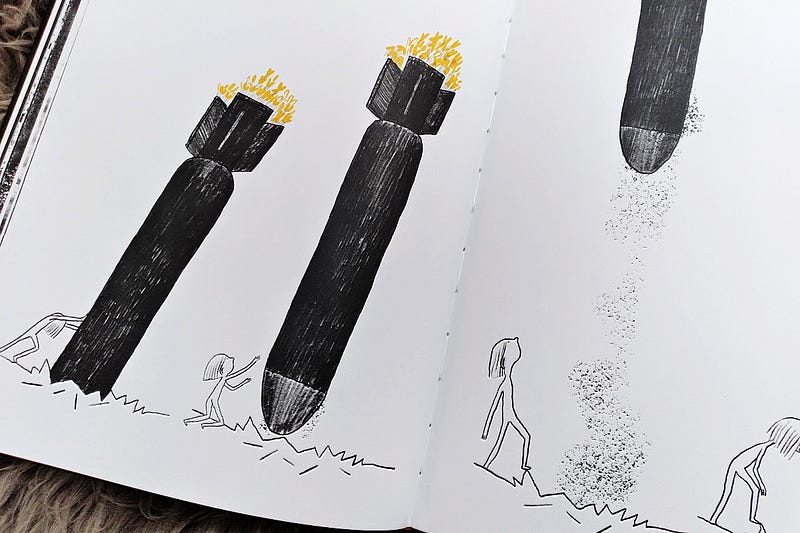
The book is beautifully produced. The pages are stitched in the hardcover version I have. You’ll see the stitching in images below. Watch for it. It’s more than just a book. It’s a work of art.
Just like in the schools, the little girl becomes a butterfly. Butterflies are free. And still, the little girl chases her butterfly. Where is it going?
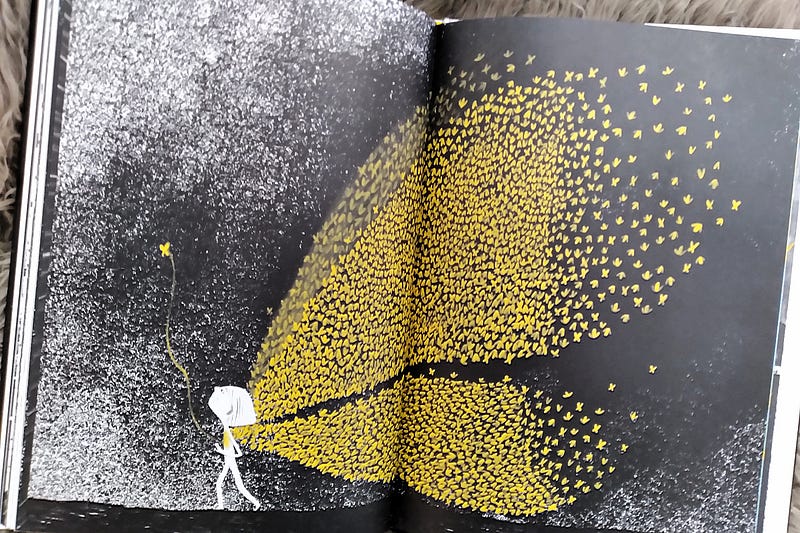
Just over halfway through the book I stop. Catch my breath as it hits me what the artist has done here. I am in utter awe of his brilliance.
Let me tell you where the butterfly took her.
He took her to a place where blue skies replace black ones. Blue and yellow. The colors of the flag of Ukraine.
They run. Bringing the blue and yellow with them. Into the black.
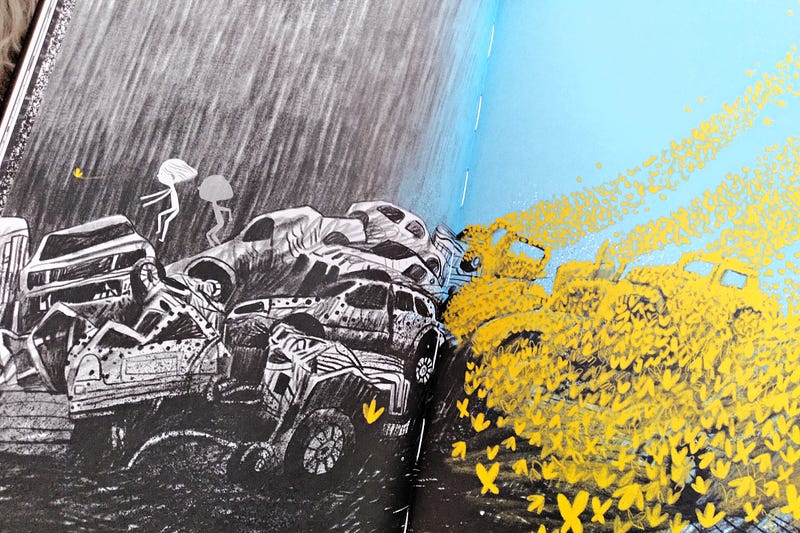
I wept. Remembered standing among a sea of people in front of City Hall. Minus twenty, stamping feet and breathing on fingers. Waving blue and yellow flags. Sunflowers. Chanting, singing in Ukrainian and English.
It’s so easy to get fooled into thinking any war is over there. But it’s not just over there. It’s here. It’s everywhere in tucked away communities of people who have someone they love over there. Someone they haven’t heard from. Someone they did hear about, and wept.
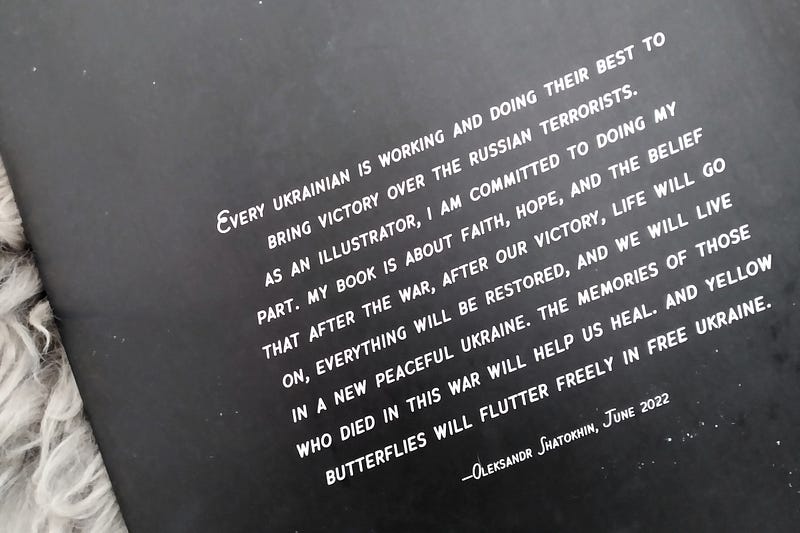
This book is the work of one man. Oleksandr Shatokhin is a Ukrainian author-illustrator. He has created a powerful wordless story about a child’s ability to find courage amid the devastation of war.
In an interview last fall, he said he saw with his own eyes the destroyed homes. The troops. People, frightened. But he also saw their strength.
He said he believes in light after dark. That’s what this book is about. Believing in light after dark.
He said he believes that sometimes, words are superfluous. I agree. If the emotions are present and the message is clear, words are not needed.
You can enjoy more of Shatokhin’s work on Instagram, Behance or check out his two illustrated books on Amazon.
“Almost everyone has at least one person on their phone who will never pick up the phone again.” — Ukrainian President Volodymyr Zelensky.
Hi, I’m Linda. If you enjoyed this, you can get my posts by email here


