
Yeah, About That GETTR Thing
Mocking and blocking the adversary will give us no peace.
After all the complaining about how Google, Twitter, and Facebook are censoring conservatives, some of those people who identify as conservatives have taken another run at building a website just for them. Really. They just want their own echo chamber, yet they still want the rest of us to listen to them and their ideas. Conservatives really do believe in their ideas and that they would do a world of good for the world.
We should take them seriously and at face value.
I’m a liberal. I wasn’t always a liberal, though. In the 1990’s I was a hard-right conservative. I was a tax protestor living underground on very meager wages. I believed that the Fed was a private bank. I believed that Vince Foster was murdered. I believed that the income tax was a fraud and that state citizens did not have to pay it. I drove around without a driver’s license or registration, high on adrenaline. I dared not get stoned. And I believed a lot of things that, even if they were true, didn’t serve me.
I spent years filing Freedom of Information Act requests for myself and for my clients. I learned how the IRS really works. I saw people who were just like me, doing a job that they wanted to do. They wanted to serve our country every bit as much as a private first class with boots on the ground in Afghanistan. I saw how human the IRS was.
I realized that I was so lost.
Then I got a job with a W-2. I started to make money and pay my bills and live something of a normal life again. I got married. I started to see how rigged the system was for the wealthy and the powerful. I have come to believe that we might not need much of a welfare state if a few very smart people could lay off the economic predation. Then I saw Trump elected for president, and I saw the true power of the rentier class.
Those conservatives that we mock in social media, they’re me, about 30 years ago. I know where they’ve been. I know their arguments. I also know that they’re operating on a theory of incentives that has never, ever been proven to work. That theory of incentives reduces our great country, the United States, to a luxurious Skinner Box. I want to believe that people have a greater sense of agency than just working for money and filling their homes with stuff.
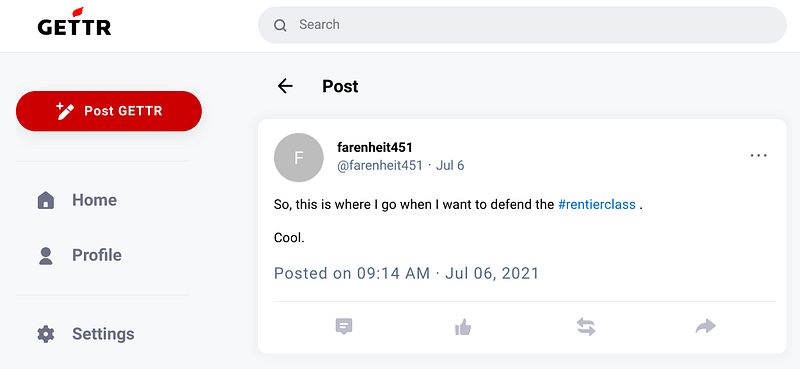
So I went to GETTR to try to better understand them. I wanted to engage them in a meaningful discussion. You can tell by my screenshot above, I’m off to a great start.
I really don’t agree with blocking or banning Trump from Twitter or Facebook. Trump is a symptom, not a cause. Trump personifies the rentier class. He is a wealthy landowner who doesn’t really care for the rest of us. We know this because he got rich on the way things were for 40 years before he ran for president. We know this because he sat on his hands for six whole weeks while the pandemic took hold of the country. He kept someone on the payroll that advocated herd immunity to let 500,000 people die. But he’s still a human being with an opinion, even if I disagree with him.
Blocking and banning people we disagree with doesn’t solve the problem of our disagreement. Those people don’t go away, and if we’re not paying attention, the problems only get worse.
The only solution to our disagreements is a logical engagement of words and ideas. Yes, GETTR bills itself as a marketplace of ideas. But notice how nobody there bothered to question my proposition that GETTR is where I should go to defend the rentier class. No one. That means it’s happening on both sides.
Both sides are dismissive of each other. Both sides, liberals, and conservatives dismiss each other. Conservatives will tell us about all the socialist countries that failed. Astute liberals will ask conservatives to name a single socialist state that failed without sabotage from American agents. Both sides say, “I win!”
The problem on both sides is that there is a lack of discussion of skills and capacities. And there seems to be an assumption that people who suffer deserve to suffer. Conservatives say that people who are poor deserve to be poor. Liberals say that people who are poor have been systematically ripped off by the wealthy. I say that neither side has the skills to take the other side seriously.
I’m reminded of the one-time presidential candidate, Marianne Williamson. I recall her announcement speech. I was blown away by her words:
The United States ranks at or near the bottom on almost every indicator regarding governmental policies toward children today. Our youth homicide rates are more than seven times that of other leading industrialized nations. Social scientists now describe “war zones” — areas in violently charged homes and communities — where levels of trauma and post-traumatic stress among children are similar to those experienced by returning vets.
America is becoming a political war zone. Conservatives say that liberals will destroy the country. Liberals say the same thing about conservatives. But if we cut out the tit-for-tat bullshit that we try to pass off as “discourse”, and we actually talk about how to solve the problems we face, our nation could remain viable. I see a lot of people calling the other side “wrong” but never actually following through on a solution for the problems we name.
That can only happen with honest, active engagement. This isn’t about scoring points. This is about seeing what the other side really believes in and addressing their concerns as if they were our concerns.
That means we must assume that people have something called, agency. What is agency again (from Wikipedia)?
In social science, agency is defined as the capacity of individuals to act independently and to make their own free choices. By contrast, structure are those factors of influence (such as social class, religion, gender, ethnicity, ability, customs, etc.) that determine or limit agents and their decisions.[1] The influences from structure and agency are debated — it is unclear to what extent a person’s actions are constrained by social systems.
We banned Trump because we worried that his influence would be detrimental to people as if they lacked agency. We may have blocked him because we disagreed with him, but in doing so, we demonstrated our own sense of agency.
I followed Trump on Twitter not because I agreed with him, I followed him because I wanted to know what he was doing. I wanted to know what he was spouting so that I could publicly disagree with him when I did not agree with him. I did not insult him with juvenile memes. I made an honest inquiry to question the ideas he was promoting. I was more interested in political discourse than scoring points, and I still am.
And here we are. Banning Trump only put a bandaid on the problem. I agree that Twitter, Facebook, and Google have every right to mute or mitigate the impact of Trump’s statements. I’m glad that Trump sued the big tech companies because then he will have to prove that he has something worth suing for.
But I think we should be paying attention to Trump and his movement, not because we agree with them. I think we should be paying attention to them and addressing every concern as if they were our concerns, with honest and open statements about why we disagree. No insults, no abuse. Just a plain discussion of the issues and solutions that we want to try.
What I’m proposing isn’t even about winning. I have no interest in zero-sum games. I’ve talked to a few conservatives and they seem genuinely animated with a desire to preserve America as a great place to live, even if it isn’t for many people.
In every conversation I have with anyone I disagree with, I’m testing my theories and assumptions. I want to be challenged to see if what I know is right. I want to challenge them to see if they see the same things I see. I’m always looking for common ground because that is where peace can be found.
Write on.