
Yawnsville! Are you creating yet another online course?
Why you need to rethink the format for your online course if you want it to still be making money for you in ten years’ time
Last month I was all set to teach a workshop about current trends in online courses. I run regular free workshops about productising your expertise, so this was the June issue. I scheduled some time to prep for the workshop.
I had no idea what I would uncover and how my thinking about online courses would change. I spent dozens of hours — both before and after the workshop — drilling down into all kinds of deep reports on the future of online learning. And it was an eye-opener.
Online courses don’t have to be like this
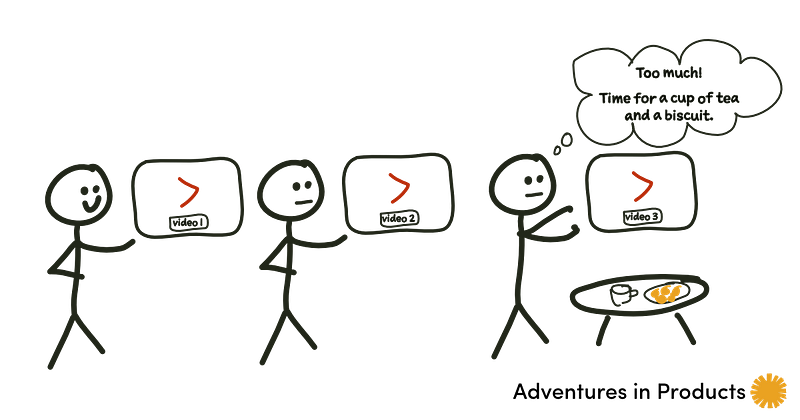
Most of us have a fairly set idea of what an online course looks like. That’s because a good 90% of all the online courses in the world follow the same linear format. Video after boring video.
And this is the first hurdle many people fall at: they pour all of their efforts into mastering the video format for getting information across. When in fact, my deep dive turned up some brand-new approaches I’m going to share with you now. The good news? You’ll enjoy a more creative experience and — bonus! — some of these new formats are much easier to make content for. So, you’re much more likely to finish making your course and get it on sale. Plus, your subscribers will learn more from your course and that learning will stay with them for longer.
Get with the programme or get left behind
If you stick to the old “video-heavy” path, there’s a very real danger that your course will be overtaken by the new trends increasingly being used in the virtual learning sphere. These include using microlearning and adaptive learning techniques to keep your learners engaged.
Did you know that staggeringly, only a small proportion of learners — as low as 0.7% — cross the finish line of an online course? It certainly fits with my experience: I’ve got some people who have bought courses from me and then never logged back in.
Now, you might think to yourself (cue devilish supervillain laugh), “Who cares if people finish the course? I’ve got their money”. But I’d argue that this is short-sighted. What does someone do when they finish a course they’ve got a load of value from? They buy something else, another course or a different product from you.
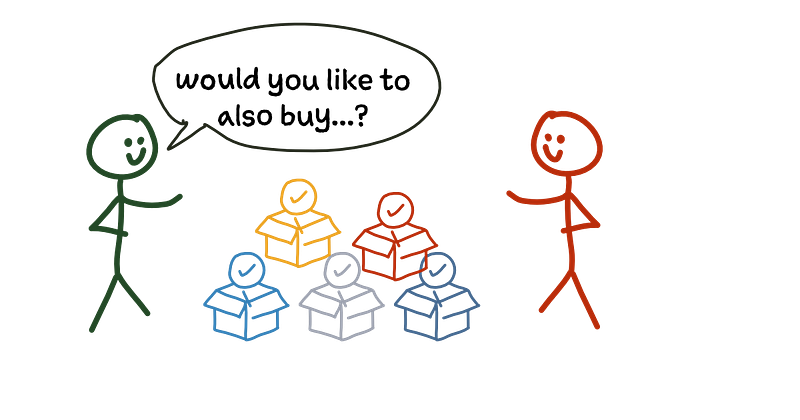
Making your online courses stand out for your learners means that you increase overall customer lifetime value. And I love high LTV for my clients. Plus, you help more people to use the knowledge in your course, which (unless you are an actual supervillain) is at least part of the reason you made the course in the first place.
Bitesize is the right size
Getting my head around the importance of microlearning was the most challenging part of the research process. In a nutshell, it’s about putting together your learning materials into bitesize chunks, so they become easier and more accessible for people. Those old-fashioned 10–15 minute videos put too much cognitive load onto your learners. Even if they are super motivated, they can’t take it all in, and a course which is just video after video can be off-putting. I love taking courses and learning new stuff, but I know that after a while, my attention will wander, my hand will creep to the mouse, and I’ll be checking my email.
Mix it up: tips for making an engaging online course
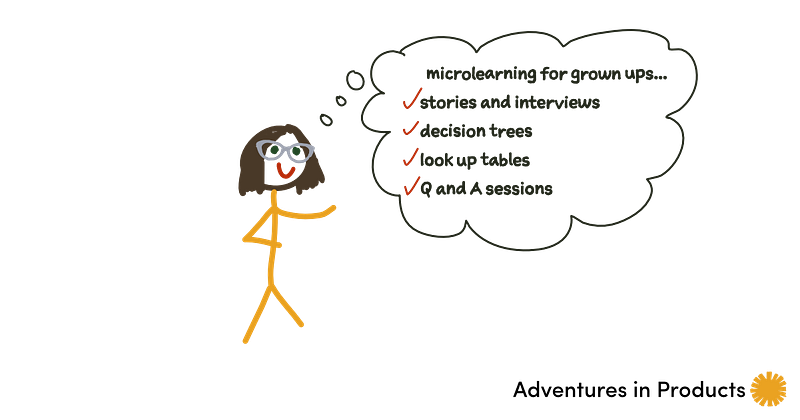
One simple way to decrease the cognitive load on your learners is to chop and change the learning style. For example, you could include super-short videos with just one learning point, quizzes, calculator widgets to test out an idea in practice, or you interviewing someone who has successfully done what you’re teaching. You can add written material, worksheets and polls into the mix, too. Basically, anything that encourages retention or fits new information into learners’ heads in a fun and light way.
In learning terms, we human beings need to repeat information, try it out in different ways and fit it into “schema” — the patterns of existing knowledge in our heads. This is what leads to the “Aha!” moments we want our learners to have and increases motivation.
When you make a course, you risk being so focused on passing on your knowledge or racing to the finish to meet your own deadline that you forget to circle around and repeat what you’re passing on. The beauty of microlearning is that it allows you to create those learning circles pretty effortlessly.
Adding in different forms, shorter videos, podcasts, interviews, Q & A sessions, animations, demonstrations and written materials also means you can try out new forms of expressing yourself. Ignore the little devil in your ear whispering it’s self-indulgent. Trying out new things and creating new formats is fun. So what if they don’t work? You’ve only wasted a couple of hours at worst.
If you’re like me, you might initially find some of these elements a bit gimmicky. I work with a lot of super-clever people, and the thought of putting an online game or even a quick quiz into my courses makes me feel like I’m using juvenile techniques for sophisticated grown-ups. I’m still working out what will fit for my audience.
Different routes, same destination
Adaptive learning is the other big trend I want to highlight. This is where you work out different learning paths and signpost different routes.
For example, beginners need to start with the basic level materials, while intermediates and advanced could be encouraged to start further in or just go into a quick recap first. You could even get people to identify their correct group through a quiz.
Or you could suggest that people who already have a depth of knowledge in one area skip a particular module and fast-track to the next. Conversely, there might be a group of learners who want to do a deep dive into one area, and you can make this optional within the course.
Take it up a notch and make your course look fabulous
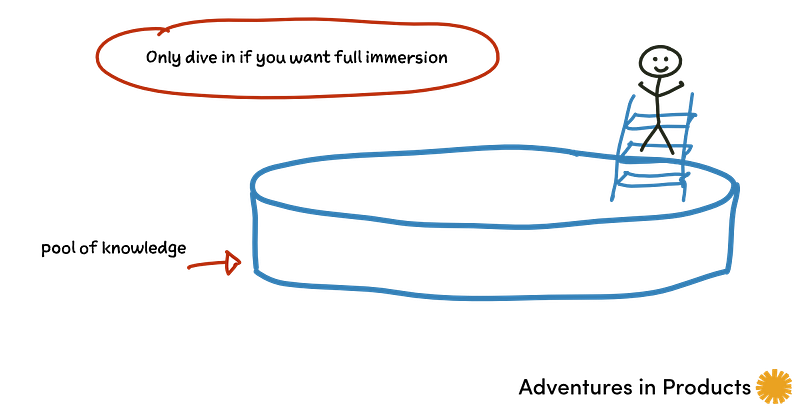
Now you’re across the fundamentals; you get to play with lots of different formats for your online courses. Moving away from the old-style online course gives you the huge opportunity to charge more money and make your course stand out.
When you’re trying to teach something more conceptual or take someone on a transformational journey in your course, you need more than a bunch of videos to ensure you make the impact you want for your learners.
One key learning is that hybrid courses stand out post-pandemic. With “hybrid” courses, most of the learning happens online, but then learners meet up in real life to work together and consolidate their learning. This lends itself to more complex subjects because the subtle nuances are brought out. And it massively increases the amount you can charge for a course.
Online live meetups can also be used to change the pace, help people go deeper with their learning and to make the course more interesting. When I introduced this to my Productise Your Expertise six-month programme, I noticed the level of participation increasing hugely. In fact, immediately before each meetup, I can see participants doing their “homework” and supporting one another much more.
I love this part and gain a lot from it too.
You could consider adding live elements within your own online course, such as workshops where you drill down into a key point, work-along sessions where people show up to report their progress, or even splitting the learners up into smaller groups and setting them an exercise to do. And the advantage of the latter is that you don’t even need to be present.
In cahoots with cohorts
I’m a huge fan of cohort-based online courses. This is where you set a start date for a group of people who all begin at the same time and work together, progressing through the course at a similar rate. One of my smartest early decisions was creating a cohort-based course with fortnightly live online workshops. I was able to launch the product very quickly with a course outline, a sales page and a start date, and telling everyone I could about it. Four years later, I’d made around £75k from the Remarkable Business programme.
Yes, you have to be more present, especially if you’re building the course around live sessions. And if you’re looking for the holy grail of passive income stand-alone products, they probably don’t fit for you.
Reasons I love cohort-based online courses:
- By including access to you and your “magic”, you can charge more money
- People perceive these courses as having higher value, so they will pay more
- People who might not do a course they perceive as basic (such as an Udemy course) will join a prestigious programme to learn
- It’s more fun
- You learn from the learners
- It’s faster to get going, especially if you provide live teaching sessions rather than having to record reams of video
It’s up to you
And, of course, you have the freedom to choose a different format entirely. In fact, if this is your very first foray into the world of digital products, I usually don’t recommend making an online course at all. There are plenty of other creative formats you can use to productise your expertise and reach your audience, using this article as a foundational jumping-off point. Make the leap!
What next?
I work with the clever people who have built up deep expertise in their specialist field. Especially the ones who have gotten trapped in selling their time for money and then found out that they have a limited amount of time and money as a consequence. If that sounds like you, you should probably come and say hi at one of the free workshops I run every month — take a look at what’s coming up over here. It would be lovely to meet up.
Julia Chanteray
All badly drawn images were created by Julia Chanteray