
Yann Martel and His Thoughts on Writing
Insights from Yann Martel on writing and arts
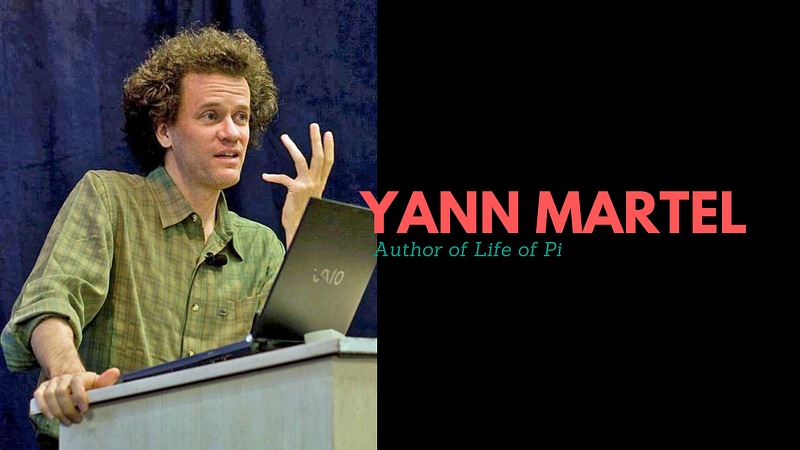

Just do it. Get it down on the page. Work hard. And then let go. Ask yourself why you want to write. You have to be clear about that. ~ Yann Martel
Writing is a deeply individualistic task. And there is no right or wrong way of doing it. But the fact is you love to follow the footsteps of the writers who have achieved tremendous success both in terms of money and fame.
When a writer earns enough money and recognition, you try to follow the path they have chosen, believing that their doings will bring you success too. But the truth is, no one’s rule can make you a successful writer.
You will only be successful when you create your own path. Yes, it is hard as it takes time and continuous effort. But knowing other writers’ stories may inspire you to find out your way. It may motivate you to make good art and find your voice quickly.
That said, today, we will learn about Yann Martel, the author of the book Life of Pi, and his thoughts on writing.
Yann Martel and His Thoughts on Writing
Yann Martel is a Canadian author born on 25 June 1963 in Spain and lived almost all over the world. He is best known for his Man Booker Prize-winning novel Life of Pi, which sold more than 12 million copies worldwide. It was later adapted for a film directed by Ang Lee and was nominated for eleven Academy Awards and won four.
This Canadian philosophical novel was published in 2001, and the UK edition of the book won the Man Booker Prize for Fiction the following year. But you will be surprised to know that at least 05 London publishing houses rejected this rare gem.
Being an accomplished writer, Yann Martel does not possess a strict routine for writing. He considers himself a slow writer, and his writing habits, as he said, are boring.
I write at any time of day in any place, so long as it’s quiet and I can set up my computer. I’m a slow writer, given to playing Spider Solitaire when stuck. Otherwise, my writing habits are blindingly boring. I just sit down at the computer and write.
But Martel does extensive research on what topics he writes. He says that he spent two years researching to keep everything right for the Life of Pi. He studied fundamental and secondary texts of Hinduism, Christianism, and Islam as his protagonist Pi practices three religions.
He also read zoo-biology, animal psychology and did practical research in India for six months extensively, visiting not only to zoos but also to temples, churches, and mosques.
I couldn’t imagine writing without research. I don’t know anything. And I don’t like books that look inward; I like books that look out. To me, the research is a way of exploring what it means to be alive.
According to him, any writer will be happy and good, only if they know what they’re doing and why they’re doing it.
He doesn’t believe in art as a career. Because one needs to be inspired to create art, and he thinks no one can do that on command. He likes to treat art as a gift, and all he can do is just create and give away.
Art is a gift: you create and then you give away. How readers receive that gift is their business. If they hate it, that’s their response to it. Others respond by liking it. Either way, that is their interaction with the book, which is no longer mine.
With each of his writings, Martel tries to understand something. He attempts to understand better the things he is curious about — by exploring them through extensive research and then writing about them.
He writes the books he wants. To him, the success and failure of a book hardly matter.
Every book I’ve written has been a different attempt to understand something, and the success or failure of the previous one is irrelevant. I write the book I want.
As a novelist, Martel loves to see things differently. He says everyone sees things differently as our approach to experience the world varies from man to man. And this is amazing.
He loves all the interpretations of reality — scientific, theological, anthropological, and all.
Martel tries to connect the realities by writing the best stories possible. He argues that as a writer, one should choose the better story and the interpretation of reality.
Why don’t we all say the same story about reality? Why? Because we involve our imagination in reality. And depending on what we bring to it, we get a different interpretation of reality. Reality isn’t out there, it’s an interpretation. And I argue that if you have a choice of interpretations if you have a choice of stories, you might as well choose the better story.
Yann Martel has the eyes of a keen observer and a mind of a life-long learner. He says he is still learning his craft.
He thinks art can see the same thing from different angles. And when you observe something from many different angles, you get a newer truth — a newer understanding of it.
He believes that art is largely amoral, and it is about what life is — not what life should be.
To Conclude
Yann Martel is an extraordinary writer of our time who does extensive research before sitting on the desk to write a novel. He says art understands through the imagination and that kind of understanding is necessary for all of us.
I hope his thoughts on writings will spark a fire in other writer’s minds and inspire them to discover their crafts for making good art.
Thank you for reading.
If you are interested to read more of my writings, you may read the following one