
Xi Jinping could offer Europe exchange Ukraine for Taiwan
French President Emmanuel Macron and President of the European Commission Ursula von der Leyen behave very differently after their visit to China, where they were received by Chinese leader Xi Jinping. Mr. Macron makes loud statements about the independence of Europe, Mrs. von der Leyen says nothing at all.
Let’s try to explain why, based on the real information and analysis of the visit to Beijing that we have.
At the first trilateral meeting on April 6, Ursula von der Leyen and Emmanuel Macron began to convince Xi Jinping that he should put pressure on Russian President Vladimir Putin on the «Ukrainian issue», the European leaders believe that Xi Jinping has all levers to put pressure on Moscow, first and foremost economic. Xi Jinping himself, as a global political figure, has enormous influence over the situation inside Russia.
However, Xi Jinping was terribly angered and offended by this stance of the guests from Europe, as he left Moscow (the visit took place from March 20 to 22) dissatisfied with the talks with Putin. Xi Jinping shortened the program of his visit to Moscow because he realized that it was impossible to influence Putin on the «Ukraine issue».
Xi Jinping was annoyed at the first meeting that the Europeans were pressing him on this unpleasant topic, and he let them know that he was not interested in this topic, and the conversation, which lasted 1–1.5 hours, ended.
In a sense, it was a failure.
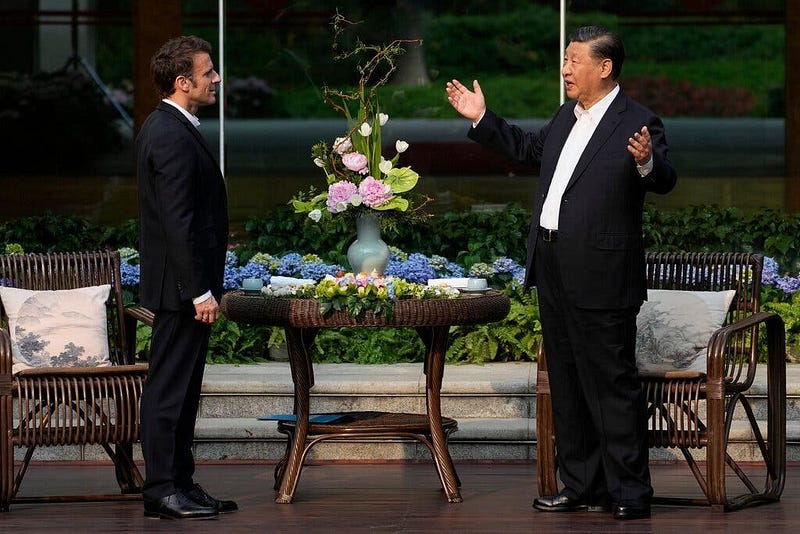
At the second meeting, without ties, which took place in Guangzhou, Emmanuel Macron structured the conversation with Xi Jinping very differently (in fact, this was their third meeting during the visit: first on April 6, their bilateral official talks, then the trilateral talks with von der Leyen the same day, and already on April 7, this informal meeting for two). Macron was now telling Xi Jinping the following:
- France has a huge trade with China,
- We, the European Union, generally have little interest in Taiwan,
- You and I can develop our relations further, we have great prospects,
- but China should not help Putin in Ukraine.
Xi Jinping liked this option. He has announced that he will not help Putin. However, he made his own proposition, saying the following: «You try to explain to Mr. Joe Biden (the American president) that we will not give up on Taiwan, it is ours. You, probably you personally and the European Union, are not interested in Taiwan. But the question is, what is his, Joe Biden’s, position? And if Joe Biden understands that (that «we won’t give up on Taiwan, it’s ours»), then we are ready to give up on Putin.»
In other words, Xi Jinping offered Emmanuel Macron and, through him, the European Union an exchange: Taiwan for Ukraine, China’s refusal to support the Kremlin in the «Ukrainian case».
It should be noted that the Chinese propaganda in every way served the visit of Emmanuel Macron and Ursula von der Leyen as a visit of the President of France, in which the President of the European Commission also flew in. China’s state news agency Xinhua gave separate reports on Macron and Leyen’s upcoming visits (with a very brief summary of her visit).
Xi Jinping did not meet with Ursula von der Leyen separately, the new chairman of the State Council of China Li Qiang had a bilateral meeting-talks with her. Besides, it was reported that it was Xi Jinping and Emmanuel Macron who decided to meet with Von der Leyen (“unexpectedly appeared” in Beijing during their negotiations) only on April 6, as if this meeting had not been discussed beforehand. In other words, official Beijing has made it clear that it does not regard the President of the European Commission as a political leader of the European Union (it only sees her as the head of the EU’s economic government) and does not like interaction with her. Meanwhile, the EU press, especially the German press, presented the visit of Ursula von der Leyen and Emmanuel Macron to China as one in which Ursula von der Leyen was the leading figure.
Observing the changes taking place in Europe, we understand that China may have succeeded in bringing some confusion into its ranks, created by the typically oriental tricks of Xi.
The same is likely to be true of the unity between the U.S. and Europe on the Taiwan issue. Europe is much closer to the topic of Ukraine, unlike Washington, which seeks to win on all the boards of this simultaneous Big (almost chess) Game.