
xAI Releases Grok-1 — The Biggest Open-Source LLM
Elon Musk’s artificial intelligence company, xAI, has released the weights and architecture of their 314 billion parameter Mixture-of-Experts model, Grok-1, under the Apache 2.0 license.
This follows a pledge by Musk last Monday to make Grok freely available to the public. As someone who has been closely following developments in the AI space, I have to say this is a massive step forward in terms of openness and accessibility.
What is Grok?
Grok is a huge language model with 314 billion parameters, making it the largest open-source model currently available. For context, that’s more than double the size of OpenAI’s GPT-3, which was considered a breakthrough when it was released in 2020.
In a chart shared by X user Andrew Kean Gao, you can see how huge Grok’s size is compared to its competitors.
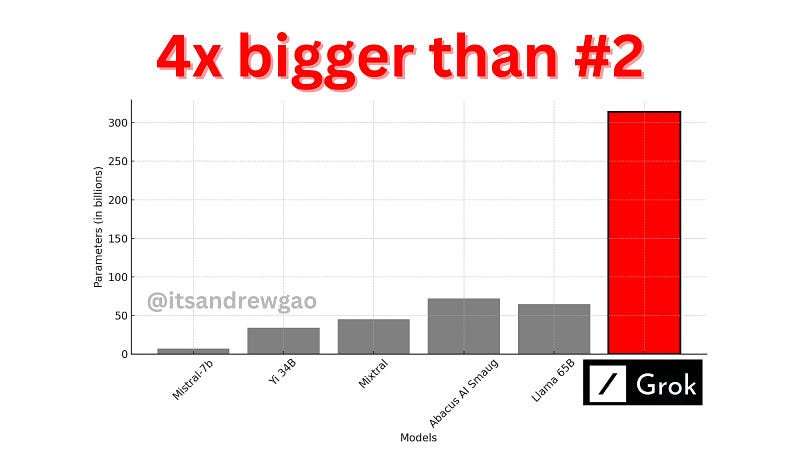
But Grok isn’t just bigger, it also utilizes a Mixture-of-Experts (MoE) architecture, allowing it to strategically activate subsets of its parameters for different tasks. This theoretically makes it more efficient and adaptable compared to a traditional dense model.
Here’s a summary of Grok-1 release
- 314B parameter Mixture-of-Experts model with 25% of the weights active on a given token
- The base model is trained on a large amount of text data, not fine-tuned for any particular task.
- 8 experts (2 active)
- 86 billion parameters
- Apache 2.0 license
- Paper: https://x.ai/blog/grok-os
- Code: https://github.com/xai-org/grok-1
For more updates, follow Grok on X.
How to install Grok
The instructions on loading and running Grok-1 are explained on this GitHub repository. Clone the repo to your local.
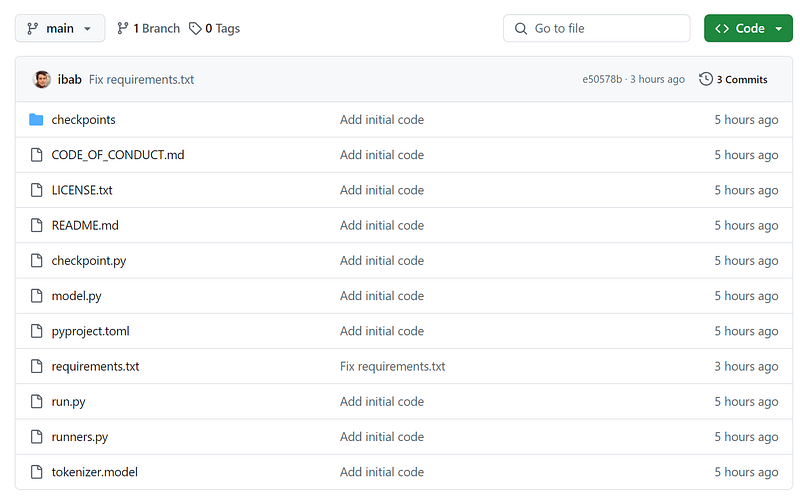
Download the weights from HuggingFace or Academic Torrents and put them inside the “checkpoints” directory.
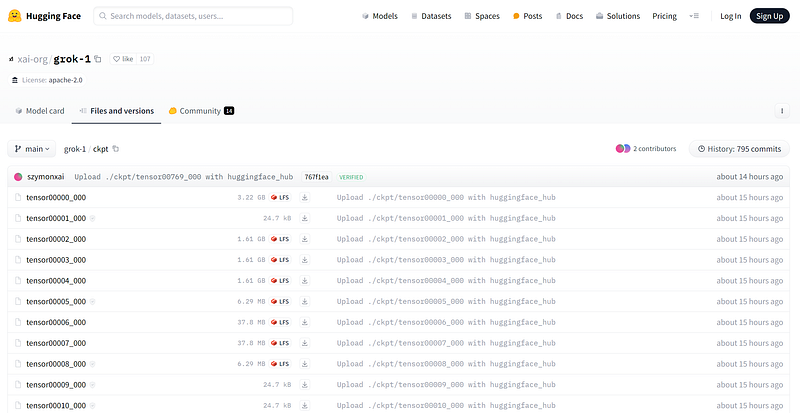
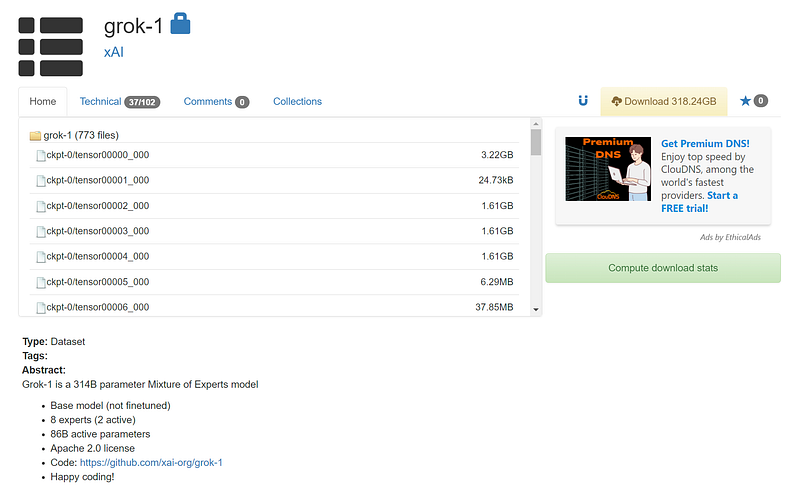
On a side note, some people are questioning why the weights are posted via a Bittorrent magnet link. It may become a norm in the future since models are becoming larger and larger. Plus, distributing a 300 GB data via torrent is cheaper than direct.
Open a CLI and run the following command to test the code:
pip install -r requirements.txt
python run.py
The script loads the checkpoint and samples from the model on a test input.
It is important to note that due to the substantial size of the Grok-1 model, which contains 314 billion parameters, a machine with sufficient GPU memory is necessary to test the model using the provided example code.
Unfortunately, I do not currently have access to hardware capable of running Grok locally, so I am unable to provide a firsthand example of the model in action.
The current implementation of the Mixture-of-Experts (MoE) layer in the xAI repository is not optimized for efficiency. This implementation was deliberately chosen to prioritize model correctness validation and to avoid the need for developing custom kernels.
How to try Grok
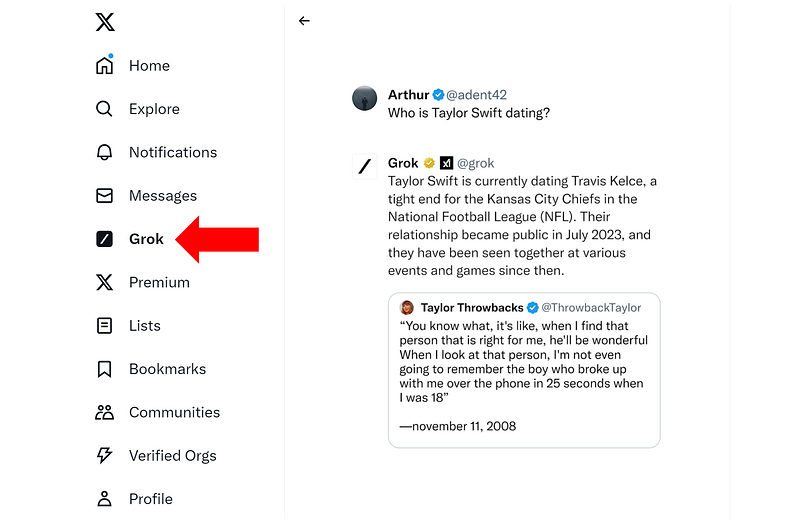
In case you are just curious about what Grok is capable of, it is currently available on X but only accessible to Premium+ users, which is priced at $16 per month.
Grok-1 Licensing
The code and associated Grok-1 weights in this release are licensed under the Apache 2.0 license.
The Apache 2.0 License is a permissive free software license. The license permits use of the software for any purpose, users are able to distribute it, modify it, and distribute modified versions of the software.
The license only applies to the source files in this repository and the model weights of Grok-1.
Final Thoughts
The release of Grok-1 comes amidst a heated debate over the role of ideology in AI development. Elon Musk has been vocal about his concerns regarding “woke AI,” citing Google’s Gemini as an example of an AI system that prioritizes diversity initiatives to a potentially dangerous extent.
In this context, Grok represents an alternative approach—one that aims to create “based AI” that rejects what Musk sees as excessive political correctness.
How about you? Do you prefer AI systems like Google’s Gemini, which are designed to prioritize certain social and political values, or do you favor a more open approach like Grok, which aims to minimize ideological bias in its training and outputs?
There are arguments to be made on both sides. While there are certainly risks that come with open-sourcing such a powerful language model, I believe the benefits far outweigh the potential downsides.
I’m particularly excited to see how techniques like LoRA and Dreambooth expand what’s possible in terms of fine-tuning and customization.

This story is published on Generative AI. Connect with us on LinkedIn and follow Zeniteq to stay in the loop with the latest AI stories. Let’s shape the future of AI together!



