
Wrongfully Convicted and Hanged for Killing her Baby
Now there is a Scottish bar dedicated to Maggie Dickson

Maggie Dickson’s story needs telling.
The story of a woman trying to survive in a man’s world.
Abandoned. Shunned. Tried. Wrongfully convicted. Hanged.
But there’s a twist to her tale…Maggie Dickson had the last laugh.

Maggie grew up just south of Edinburgh, Scotland’s capital, during the early 1700s.
Maggie was a pretty girl, with flowing red hair and pale, freckled skin. Like so many of the time, her looks only worked against her.
When she was around 17 years old, Maggie married a fisherman and left her family home to move to Musselburgh with her new husband.
Not long after they’d settled, Maggie’s husband abandoned her or was perhaps press-ganged*, which was common in that area and time.
Having been completely dependent on her husband for income, Maggie was left penniless. Not only did she have no money, but Maggie knew the disgrace that abandonment brought.
Keen to protect herself and her family from becoming shunned outcasts in society, Maggie fled.
Maggie arrived in Kelso in 1723 with the hope of finding work. As a respectable and unmarried woman, this was achievable. Maggie had selected the town carefully, ensuring that she knew no one there and could pass herself off as someone new.
A local innkeeper offered Maggie a job and lodgings; she tended bar, cleaned and cooked. In this place, Maggie found some peace and security…at least for a while.
In time, the innkeeper’s son fell in love with Maggie. Reciprocating his feelings, but unable to marry him, the pair kept their relationship a secret.
At some point during 1724, Maggie (now aged 22) became pregnant.
In Scotland, any woman discovered to be a ‘fornicator’ (having sex outside of marriage) would be presented at Church three Sundays in a row. Sitting in a chair before the congregation, the women would be publicly rebuked by the minister and then shunned by the townspeople forever.
Maggie couldn’t face this. Many other women couldn’t either and risky backstreet abortions were commonplace. Notable literary references of the time refer to a ‘witch with a stick’ as a ‘cure’ for unwanted babies — Maggie decided against this.
Once more faced with being banished from society, Maggie was no doubt terrified.
At the time, it was illegal for a woman to conceal a pregnancy — it still is illegal in many places.
Not only was concealing a pregnancy a crime but concealing a birth was too.
Tragically, Maggie’s baby was born very early and was likely stillborn. Whether stillborn or not, the babe did not survive more than a few hours.
At home, with the body of her dead baby, Maggie needed to decide what to do next.
Funerals were costly. Even if Maggie could pay for the funeral, she couldn’t declare the birth without disclosing ‘her shame.’ What could she do with the body of her baby?
Maggie walked down to the river.

Choosing a peaceful spot on the banks of the River Tweed, Maggie placed the body of her baby on the earth.
It’s unknown what happened next but it seems most likely that Maggie was hysterical and attracted attention to herself. Later in the day, she was arrested and taken to jail.
Maggie’s trial, like that of so many women, was terrible.
Maggie explained in full that the baby had been born early and dead. Although likely untrue, Maggie also said that she wouldn’t have concealed the pregnancy but had planned on letting people know later on — her labour came on so suddenly, that Maggie claimed she was unable to call for help.
As with any sex-shaming trial of a beautiful woman, her story drew attention.
By the time the judge condemned Maggie, the crowds were already gathering to watch her swing from the gallows in Edinburgh’s Grassmarket.
Executed…for the MURDER of her Bastard Child
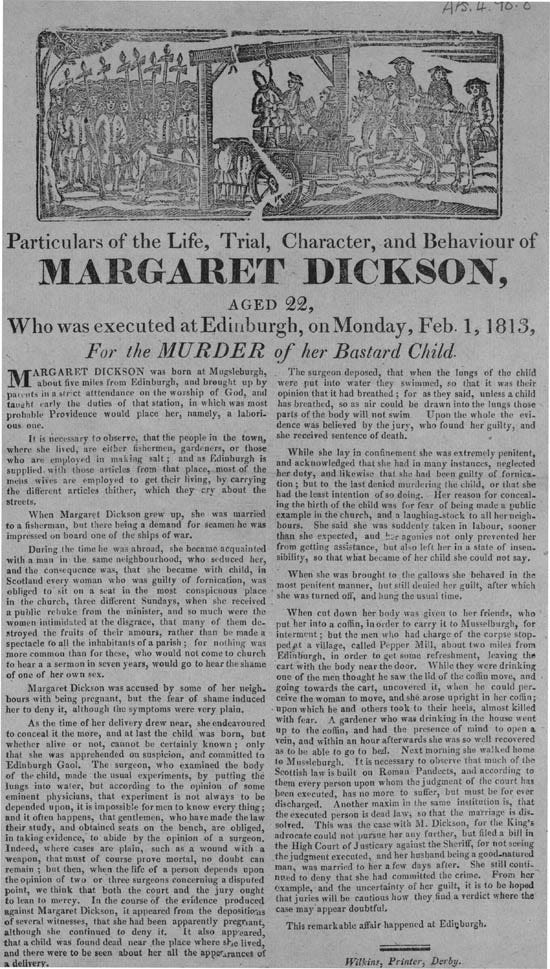
Maggie went quietly to her death, in front of a raucous crowd.
After Maggie’s body had been cut down and declared dead, she was fought over. Oftentimes, the bodies of murderers were given over to science. Luckily, Maggie’s friends won out, and saw her to her coffin.
As was custom, the funeral procession traveled to the cemetery — this journey was frequently long and arduous. Further complications would have arisen from the fact that Maggie was a condemned woman, so many churches would have refused her a place to rest.
Maggie Has the Last Laugh
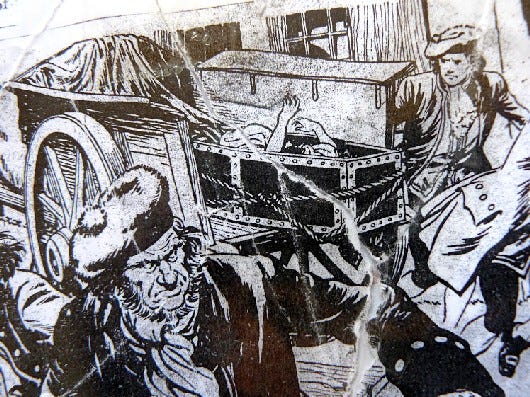
At some point during the journey, the funeral procession stopped to rest the horses and the men took lunch by the road.
As they ate, they noticed a banging sound coming from the funeral cart.
Upon investigation, they discovered it was emanating from Maggie’s coffin.
Opening the lid, there laid Maggie — alive and well.
So petrified were the men that they all ‘took to their heels’ and ran off, leaving Maggie behind.
A man working in a nearby garden saw what had happened and helped Maggie into his home, where she sheltered for the night.
So full of jubilation was Maggie at having survived her own execution that the next day she refused a ride home and chose to walk.
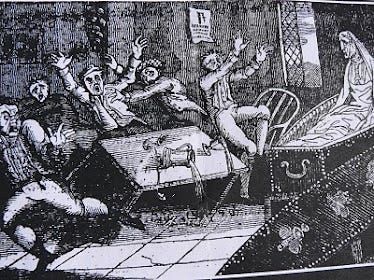
Hanged by the neck ’til you be dead, dead, dead.
Upon arriving home, Maggie was cleared of all charges as she’d been pronounced dead.
In fact, she was classed under ‘dead law’ and as such was freed from her first marriage, all debts and any crime committed before the date of her execution.
The Sheriff who’d been responsible for hanging Maggie was reprimanded and judges henceforth proclaimed those damning words: hanged by the neck ’til you be dead, dead, dead — just to be on the safe side.
Maggie’s lover was thrilled to have her back and immediately proposed to her.
As a now-celebrity dubbed Half Hangit Maggie, she was known around the city as the woman who came back from the dead — needless to say, their inn was never empty.
Maggie went on to live a full and happy life, into old age.
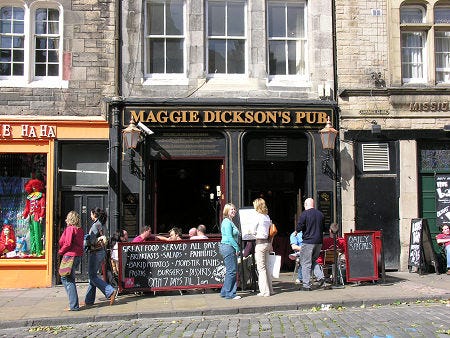
A tavern was opened on the Grassmarket, the site of Maggie’s hanging and it was named in her honour.
There it remains to this day.
I’ve been there twice myself!
So when you next visit Bonny Scotland, be sure to raise a glass to Maggie Dickson.
*Press-gang — a press-gang was a group of recruitment officers who coerced men to join the forces, usually an army or navy. Oftentimes they’d get the men drunk and if the men couldn’t buy back their round, they’d ‘owe’ service instead. The men were press-ganged.
In the UK it was really common for these press-gangs to slip pennies in pints and if the man finished the pint he was deemed to have taken payment from the navy or army and forced into service. To combat this, many men took their own goblets to the pub that had a glass bottom so they could see that the pint was penny-free! Indeed my own Grandfather had several of these goblets, that his father had used in the pub.
Note from the author:
My account of Maggie Dickson is based on my knowledge of the lives of women at this time, in this place, as presented in literature. I’ve incorporated details from newspaper accounts written as close to the time as possible, but please be aware that this is some years after the fact — note the disconnect in the newspaper date shown vs all other accounts. Other accounts differ from mine in their presentation of Maggie, with some positioning her as a reckless seductress, who loved men and ale, abandoned the children she had from her marriage and wanted only to live the glad-life. I felt this presentation unlikely, given that Maggie grew up on the bleak coast, with a fear of God, but in the absence of strong primary sources, Maggie Dickson’s tale is open to interpretation.
More True Crime Stories You Might Like:
Sources
Walter Scott, Rob Roy, Waverley Publishers 1817.
Maggie Dickson — Undiscovered Scotland — https://www.undiscoveredscotland.co.uk/usbiography/d/maggiedickson.html
Half Hangit Maggie — Murderpedia — https://murderpedia.org/female.D/d/dickson-margaret.htm


