
Writing with Balanced Power
Produce more publishable copy using the two-step loop writing method.
You are not a God. Not by a long shot. You are a mere mortal that cannot weave the powers of creation and destruction at the exact same time. That is to say, you cannot think creatively and critically at the same time. It’s just not humanly possible.
Only Shiva can create and destroy at the same time — so why are you editing and writing at the same time?
I’ve been a technical writer for over a decade, writing for companies such as Schneider Electric, Elastic Path, and Atlassian. And I’ve also written and published fiction in many different magazines, Link. And I’ve tried and tried to be a God and create and destroy, to write and edit, all at once. And it just doesn’t work.
Here’s how it goes — I’m sure you’re very familiar with this process. You sit at your desk and try to write the perfect sentence. You scribble it out, then start again, and again and again. After hours, you’re bashing your head against the wall because trying to write perfectly is brutally slow, no fun whatsoever, and if you ever actually finish the work your prose is so stilted that no one will publish it.
Sound familiar? That was me for over a decade. I don’t know how the hell I managed to stay employed.
The problem is that writing perfectly requires you to think critically and creatively at the same time. And because you are not a God, you cannot do it.
You need to be a mortal and learn to use the twin powers of creation and destruction separately and collaboratively, instead of combatively.
Two-Step Loop Writing Method
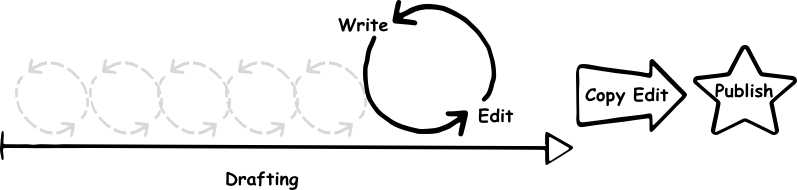
This method combines Dean Wesley Smith’s Writing into the Dark and Peter Elbow’s Writing With Power methodologies.
Two-Step Loop Writing Method Steps
- Write— Write continuously for 250 words
- Edit —Go back to where you started and edit critically up to where you stopped.
- Looping— Go back and loop through the writing and editing phases until the entire piece is finished.
- Copy Edit — Substantively edit the whole piece.
- Publish — Anywhere that will take it 😃
1. Writing Phase
This is where you unleash your powers of creativity. The writing phase is all about ideating, narrating, and getting it the f*ck down on the page. Flow is more important than anything here. And by flow, I mean flow in your writing and flow in the narrative. If you come to a word that you can’t remember or you know there’s a better one, you don’t stop to figure it out. Just write down the closest thing you can think of and then during the editing phase you can come up with a better one.
You must eliminate all critical thoughts from your mind during this phase, which is super f*cking hard to do if you’re primed to write perfectly. Remember, critical thoughts will instantly kill your creativity. To wield the full powers of creation you need to achieve a kind of flow state during this phase. You’ll know you’re there when you lose all sense of time, feel content, and the words just pour from you.
2. Editing Phase
This is where you unleash your powers of destruction, carefully. Think critically and examine your work to:
- Cut out the garbage — Words, sentences, and paragraphs may have to get the axe because they’re crap (sorry, just because you’re in flow and creating at the full extent of your capabilities, doesn’t mean any of it is good)
- Trim down the verbiage — Use just one right word instead of many semi-right words.
- Rationalize your thoughts—Pure creation can be like a crazy dream, so your writing might not make total sense. Tweak time, place, and setting to rationalize your thinking.
- Straighten the narrative flow — Narratives can jump around on you during creation. Straighten the sentences to keep the flow consistent for the reader.
Don’t be too destructive with this phase. When you finish the entire piece, you will do a substantive edit to catch all the nasties, so just stick to the areas I listed above.
The idea is to keep the piece as malleable as possible until you’re complete. Editing too much is like trying to write perfectly and it will stagnate your progress and make it difficult to loop back into the writing phase. At the editing phase, I don’t even check for spelling or grammar.
3. Looping
Shift between the writing and editing phases until you’re finished the piece. If you have to stop writing before you complete, follow Hemmingway’s advice and stop during the writing phase when you are going good and you know where the story will go. It’ll be much easier to pick up the next day.
4. Substantive Edit
You’ve finished the piece, now you need to unleash your full powers of destruction. Follow this checklist to make a thorough substantive edit: https://www.alicefranek.com/notes/substantive-editing
5. Publish
Publish anywhere you can. Dean Wesley Smiths recommends you keep sending it out till it never comes back: https://www.deanwesleysmith.com/heinleins-rules-introduction/
My opinion is a little different. After 5 rejections, I lose interest in sending it out. I figure five is enough to know the piece isn’t going to find a home. My time is precious and I’d rather spend it writing than sending out work that’s likely to be rejected.
Why I ❤️ This Method || Final Thoughts
When I was trying to write perfectly, I hated writing. It was just non-stop torture. And writing perfectly didn’t lead to me publishing a damned thing.
And then I found this method and it produced much more publishable copy. But more importantly, it is fun to write this way. Writing is an incredibly challenging endeavor with little to no remuneration or acclaim for your efforts. If you aren’t having fun doing it, then you should damn well stop because it ain’t worth it.
I’d say the greatest challenge with this method is the time it takes to learn it, particularly if you’re coming from the world of trying to write perfectly. It can take months and months of practice before you’re comfortable looping between the editing and writing phases. But trust me, you can learn it. Eventually, it becomes second nature.
This method works fine for fiction writing. It can also work for technical writing, but only when you’ve done all your tech interviews and research and have a solid understanding of what you’re trying to say.
Good luck and good writing. And have fun.


