
Writing Routines and Productivity Tips — Month #5 on Medium
Plus stats, earnings, and lessons from top writers

Hey, fellow newbies. We meet again.
If you’ve never been on this corner of Medium before, you’ve just landed on one of my “accountability” articles — which means that every month, I’m checking in and reflecting on my progress.
I’ve just ended my 5th month on Medium, and I can’t remember the last time I was this consistent with, well, anything.
It’s one of those things I’d absolutely do for free… Nah, I’m just messing with you :) — yes, it’s fun, but the end goal is being paid, right? This is hard work, people.
And on that materialistic note, let’s check out my stats and earnings for October, shall we?
Stats & Earnings
I wrote 14 stories this month and 45 stories total since my first day on Medium, and even if it’s not an impressive amount, I’m very pleased with my constant level of productivity.
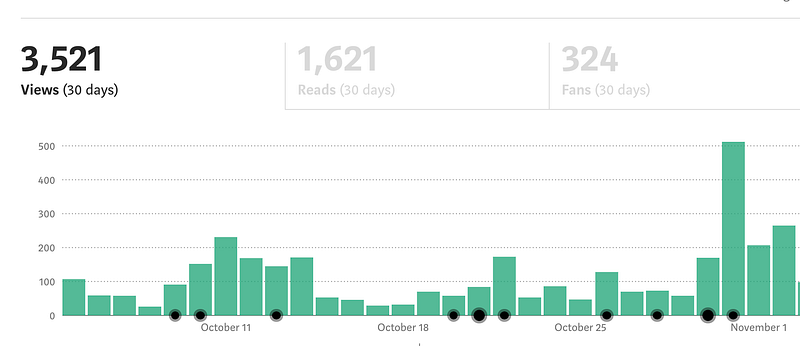
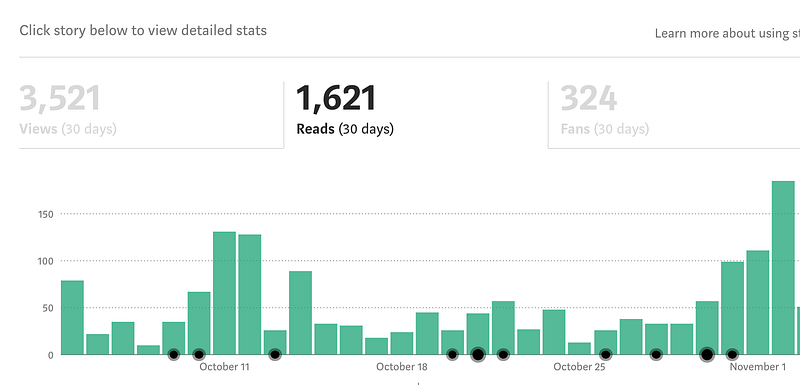
I don’t know if it was Medium’s endless tinkering with the interface and algorithm or if my writing was generally boring this month, but my stats went down. Way down.
Earnings, however, remained the same for some reason.
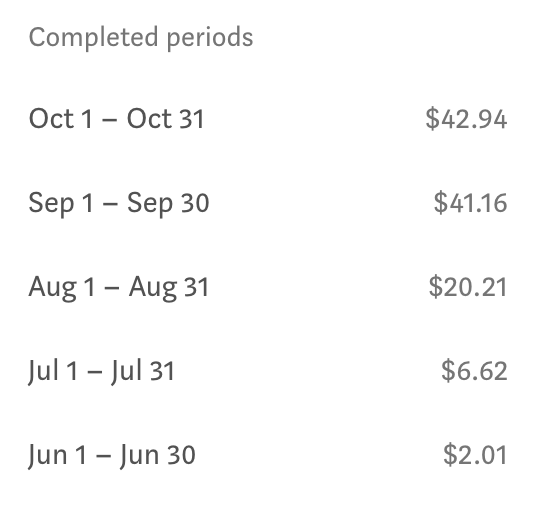
I can’t really psychoanalyze these numbers for you because it’s too early in the game. 45 articles is nothing in the grand scheme of things, so I decided to take some pressure off and accept that it’s probably going to take me at least a good year before I see success on Medium.
Lessons learned so far:
- Sinem Günel taught me to appreciate the platform for the huge opportunity it provides, but also to remember that Medium doesn’t owe us anything — it’s harsh but true;
- Tim Denning taught me to forget about the money in the beginning and race my way towards the first 100 articles;
- Medium will keep changing, but good writing rules will apply regardless of what happens on the platform.
A quick overview of my stories. Curation rate.
Isn’t it ironic that as soon as I dedicated an entire article on curation, Medium decided to make it less obvious?
Writers got angry. Newbies threw in the towel. Facebook group conversations got heated. No more curation? A more relational Medium? What does that even mean?
I got so excited about reaching an 80% curation rate, only to feel the disappointment and confusion of this significant change on Medium. But after the dust settled, we all realized curation was still there. Phew! Curated stories have long legs, and it’s something you should be striving for.
This month, I’ve had 9 articles that were “chosen for further distribution,” not too bad, I would say. The articles that didn’t get curated were either about Medium, about very niche topics, too personal, or lacking sufficient research.
I’ve also been experimenting a lot with topics and writing styles. Here are a few pieces you might enjoy:
- Read this month’s funniest story here;
- Read this month’s cutest story here;
- Read this month’s most successful story here.
You can also check back on my progress here: month #2, month #3, and month #4.
Writing routines & productivity tips I learned from top writers.
Let me tell you a little secret. I joined yet another course on Medium writing. I know, I know, somebody take my wallet away — but I couldn’t help it; I mean, it’s Tim Denning and Todd Brison teaching me how to be a better writer.
I have a growth mindset when it comes to learning: I owe much of my success in my medical career to very expensive courses, and I used to reinvest more than half of my earnings in education. If there’s any way to speed up my journey to becoming a better writer, I’m in!
That said, I’ll be sharing one lesson I’ve learned from top writers like Sinem Gunel, Tim Denning, and Todd Brison each month. These are today’s top tips on consistency, routines, and productivity:
Tip #1: Always capture your ideas the moment you have them.
Trust me; you’ll never run out of ideas. This is a fear most newbies have, but you can count on endless creativity. This doesn’t mean all ideas will be worth sharing, but you never know what they will develop into while you write.
Most top writers have a system for capturing ideas. Some go as far as writing them in the shower. Whether it’s a Trello board, pen and paper or Medium’s app, make sure you jot down your idea before you forget it.
Don’t limit yourself to the title; instead, try to elaborate some thoughts you have on the subject or write down bullet points that crossed your mind. If you don’t do this, you may even forget what the idea was about.
Tip #2: Prep your body and your writing environment.
When writing, you should be in the right state of mind: alert but also relaxed.
Make sure you’re properly caffeinated, and maybe jump in a warm shower to loosen up and relax your body.
Your writing space should be tidy and free of distractions — a physical door helps keep away noisy intruders, but if you don’t have that, noise-canceling headphones should do the trick.
Tim&Todd also mentioned the power of emotions: every once in a while, if something stirs up a powerful emotion: anger, sadness, frustration — sit down and write about it as soon as possible. Emotions can convey a very powerful message.
Tip #3: Reach that coveted state of flow — that’s where the magic happens.
I’ve written about flow many times, whether applied at work or in our free time.
Flow is difficult to achieve in today’s world since we’re getting constantly interrupted. Writing is particularly sensitive to interruption, so be religious about silencing your notifications, putting your phone on airplane mode, locking your doors, going missing — whatever you have to do.
Here is the tip of the day for entering a flow state: when writing, just write. Don’t stop to do your research, don’t go back and edit, don’t look for images, don’t tweak your title. Just get the words out — that’s the hardest part. Don’t allow yourself to do anything else but write until you’ve finished the story.
Tip #4: Try batching certain similar activities.
Switching tasks also ruins our concentration. It’s like having multiple “thinking” caps. When you put your editor’s cap on, it’s best to keep on editing until that task is done. The same goes for writing, submitting for publications, replying to responses, etc. Don’t switch caps too often, or you’ll mess up your brain and your hairdo.
When I first started on Medium, I wrote whenever I had some spare time and felt like it. I aimed for one story every other day. It worked for a while, but it was a very unstructured way to spend my days. I would allow myself to become distracted, and articles took me a very long time to write.
Now, I apply Tim Denning’s strategy: I have specific writing days. I write on Tuesdays, Thursdays, and a little bit on Wednesday morning. Those are my days off work that I can dedicate entirely to writing.
I must admit, I was very skeptical at first — writing more than one article per day, was that even possible? Even half of an article felt exhausting. But I gave it a try, and by the end of 4 hours at my treadmill desk, I had produced more than 3000 words and two full articles. I was sold!
Final thoughts
This final tip is on a subject I’m very familiar with: procrastination.
If you don’t set a goal for the number of articles you want to produce and don’t create a sense of urgency, writing them will probably stretch to occupy all your waking hours.
If, however, you limit your writing to certain days and certain hours per day, you’re forced to produce that content in that designated time. This, for me, is both consistency and efficiency. I’m not there yet, but at least I know it’s possible with enough practice.
Remember, top writers weren’t always top writers. Tim Denning started with one hour of writing per week! Can you even imagine that? He started small and didn’t get discouraged. Sinem Gunel wrote 150 articles mostly because she enjoyed it, without seeing much success for 18 months.
We’re all works in progress. And this here is my process; you’re welcome to check back with me every once in a while. Thanks for stopping by, I really appreciate you.
Here’s to a productive month of November!


