
Writing Roots
The transformative experience of writing by hand
2020 has brought so many changes, adjustments, work-arounds and reinventions. Many include technological solutions, and it seems that remote everything is King.
With this technological take-over of our daily existence, I never expected one are of my life would move in the opposite direction.
But that’s what’s happened to my writing practice.
As a teacher I have had a computer in front of me, a keyboard at my fingertips, daily for a couple of decades now. In the classroom, the computer is always open, on, ready to project something, print something, search a grade, email a parent, and if I’m not using my computer I’m just as likely to be working with a student on her own machine.
As a writer I began using a desktop computer for composition the summer of 1991, when I was awarded a writing grant for 3 months to create an anthology of short stories, and needed to work fast. The habit stuck, and I’ve composed on a computer ever since.
But this year has doubled-down on my normal tech use. Teaching is now 100% on-screen, virtual, computer dependent. Work days that used to be merely facilitated by my laptop are now dominated by its use, shackled to it.
Seven or more hours a day in front of the little screen, mousing and keying around in the virtual classroom, wrestling with ornery software and mercurial wifi.
Pre-pandemic, I claimed an hour or two after my teaching day, whether at home or in a quiet cafe, during which I wrote. Fingers flying across they keyboard, I could type as fast as I could think, and I cranked out novels, short stories, poems, essays.
But I no longer have it in me to sit another two hours with a laptop, even to do the thing I love, even when words are crying to be written.
I tried to fix the situation by creating a new writing place for myself. I set up a card table in front of large windows, looking out into the trees behind my house. I put books, a candle, flowers there. I thought perhaps if I could stare out the windows at the natural world while I typed….
Even that was too much. Any more time spent sitting at a computer was too much.
And so I faced facts: if I was going to keep writing, I was going to have to do it by hand.
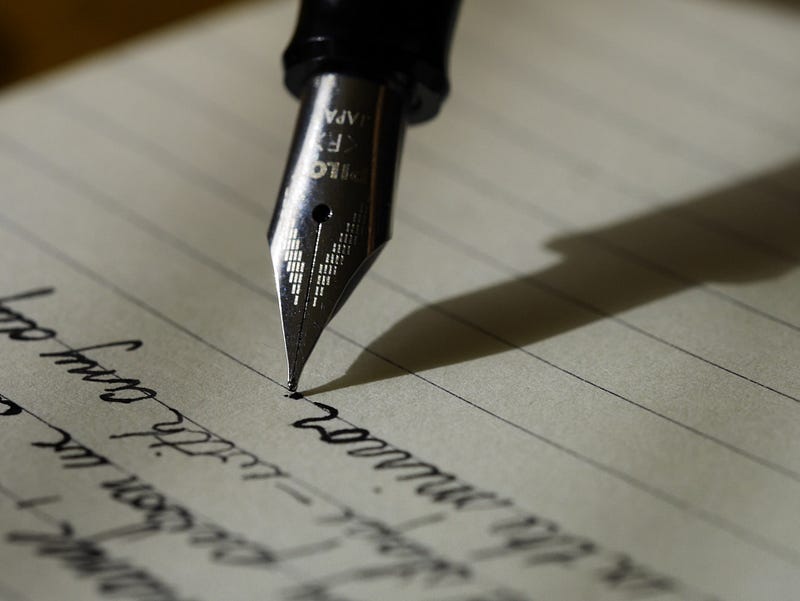
I bought a large spiral notebook, with pages lined the way I like them — not too wide, but big enough for handwriting to still be legible. I bought a set of three very nice ball point pens. I set some ground rules for myself: it was okay to cross things out, scribble, and interrupt one narrative with another when inspiration strikes. Then I rolled up my shirt sleeves and began a new novel.
By hand.

I have been doing this for several weeks now. I don’t know how many words I’ve written, because there is no wordcount in my notebook, but it feels like a pitifully small amount. Twice I’ve had to interrupt the novel for a poem, and once for a short story. I struggle with dismay at the snail’s pace of this work, and an unsettling suspicion that the writing is crap.
But I keep doing it anyway.
Most writers in human history did it this way, after all. I imagine myself amidst all that good company, and square my shoulders each day as I pick up my pen and my notebook, and scribble out a few more pages.
It does not feel normal yet. I don’t know if it ever will. When I become discouraged (which is almost daily), I keep in mind my great-grandmother’s quilts, one of which I have wrapped around me on the sofa as I work: thousands upon thousands of tiny stitches, and she had to do them one at a time, with a single needle and her own two hands. If she could persevere and create works of folk art that have warmed her family for generations, then I can write my novel, and what ever else comes along, by hand.
And who knows? Perhaps, as so often happens, there will be an unlooked-for gift in this. A slower pace may result in deeper thought, a better book eventually.
In the meantime, I cherish the feel of a pen in my hand, paper smooth and creamy and scribble-filled. I’m enjoying the physical movement of writing letters and words.
And blessing every moment away from the screen.


