
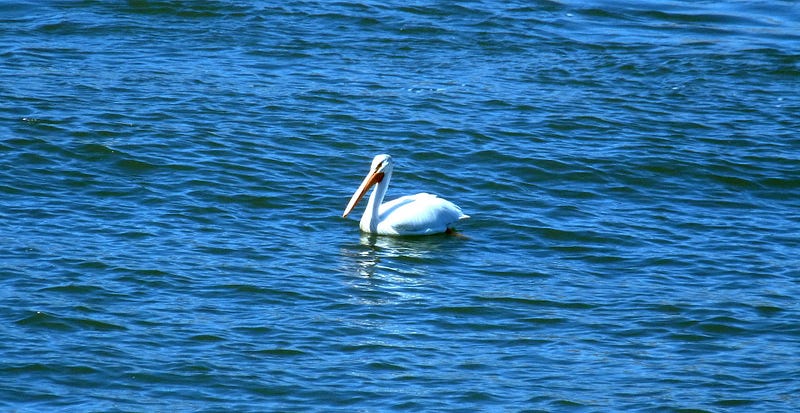
Writing On Water
The story of an unplanned stop at the bookstore
Cynthia Walters was driving her fifteen-year-old Subaru wagon down Main Street. She had just finished running her errands for the day and was headed home for what she hoped was a quiet afternoon of writing.
Her life was very quiet these days. Even her car was quiet. It was not that long ago that the inside of her car was always very loud with the sounds of teenagers on their way to school or soccer practice or dance class or band rehearsal or football practice or drama auditions or proms or clothes shopping. But the kids had all grown up and moved on and since both her dog and her husband had passed away the previous year Cynthia was always alone now when she was driving her car.
She entered the last block of Main Street before the intersection with the highway. Taking a left turn at that intersection she would only be three minutes away from home. The traffic light at the intersection was red so there was no hurry to get to the intersection.
Cynthia looked to her right and noticed that all the parking spaces in front of the White Pelican Bookshop were empty. And that is when her hands and feet and body seemed to take over. She found herself pulling into one of those empty parking spaces.
Why am I stopping here? she thought to herself. She did not need any books right now. And the writers’ group she was a part of that met at the bookstore did not meet again until next week. She had not made any conscious decision to stop at the bookstore and she had not planned to stop there. It was if her body decided to stop there without any input from her mind. Was she having some sort of early ‘Alzheimer’s moment?’
Cynthia turned off the car and sat there for a very long moment. Perhaps it was her subconscious that directed her to stop there. Maybe it was some kind of synchronistic impulse….
Grabbing her purse, she got out of the car and went into the bookstore.
There was a rope of tiny Tibetan bells nailed to the inside of the wood and glass front door of the bookstore. Whenever anyone entered or left the bookstore the little bells would clang. It was a soft and subtle ringing of bells and Cynthia enjoyed the sound. It emphasized the feel of entering a small Main Street business in a small town.
Once inside, she was immediately greeted by the wonderful smell of old books and coffee. It was always a pleasure simply walking into the bookstore.
Cynthia was then greeted by Sally, the official bookstore greeter. Sally was an old Siberian Husky who was always in the bookstore and who greeted all the customers as they came in. Pulling her purse up over her shoulder, Cynthia bent over and rubbed Sally’s face and ears. Cynthia was a dog-lover who truly missed her own dog. After her dog passed away a little over a year ago she knew she could always get a “doggie fix” by going to the bookstore and getting some “doggie love” from Sally.
Standing upright, she looked around the empty store. She then looked back down at Sally, “Sally, are you the only one working today?”
Sally looked up at Cynthia with her big brown loving eyes…. but obviously said nothing.
Just then Peter came walking out of the back room carrying a stack of books in his hands, “Cynthia. Hello. How are you on this fine, cold wintry day?”
Peter was the proprietor of the bookstore. He was an older man with a neatly trimmed white beard and long, straight white hair that fell down to just below the middle of his back. He was wearing blue jeans and a dark brown sweater which highlighted his white hair. He wore thin wire-framed glasses.
“I’m okay, I guess. I have to admit that I’m ready for Spring. I just can’t take the cold much anymore. It’s probably just me but I swear the winters just keep getting colder.”
Peter placed the stack of books on the front counter then turned to face Cynthia, “Imagine being a Native American in a tribe that used to live here in this area. They were out in this cold weather all day long, all winter long.”
“I don’t know how they did it. On cold days like today I don’t even want to leave the house.”
Peter smiled, “So, is there a book that you’re looking for?”
“No. I’m not really looking for anything. I don’t even know why I came in here…. except maybe to get a doggie fix. Just seeing and petting Sally warms me up.”
“Yup, she’s the very best employee I’ve got. She makes everyone feel good.”
“Isn’t she the only employee you’ve got?”
Peter laughed, “Yeah, but she’s still the very best. Now if only I could teach her how to alphabetize.”
Cynthia laughed.
“How about a nice, hot cappuccino?”
“Oh no, I’ve already reached my caffeine limit for today. It does sound good, though.”
“How about a big, tall mug of hot cocoa?”
“Oooooh! Okay, I can’t say no to that.”
Peter turned and went behind the bar as Cynthia walked over to the bar and sat on a barstool.
In an age when reading was becoming ever more electronic, small-town independent bookstores were disappearing and those few still open struggled to stay afloat in face of the seemingly insurmountable competition from Amazon and the rest of the internet. To stay in business bookstores needed to branch out into other goods and services besides books.
Peter did this by having a bar in his bookstore. Of course, his bar did not serve alcoholic beverages but rather various coffees, hot chocolate, a small selection of pastries, and, at certain times of the year, fresh fruit smoothies. The bar at the White Pelican Bookshop was small — only four barstools — but often it was the center of activity.
Cynthia took a five dollar bill from her purse then set the purse on the barstool next to her. She placed the bill on the bar then unbuttoned her coat.
It was not long before Peter placed a mug of steaming hot cocoa in front of her. He took the five-dollar bill and went over to the computer at the front counter where he rang up the sale. He then brought her change back and placed it on the bar in front of Cynthia.
As Peter turned to wipe up the small mess he had made on the back counter behind the bar, Cynthia took the change on the counter and dropped it into the tip jar.
Turning to face Cynthia, Peter asked, “So how’s the writing going?”
Peter knew that Cynthia was a writer because she regularly attended the monthly meetings of the Prose Posse Writers’ Group which met in the back meeting room of the White Pelican Bookshop. Renting out meeting space was another way Peter augmented sales in his store.
“Well…. to be honest…. I’m really frustrated right now. I spent three weeks on a short story and I thought it was really, really good. I share it with the writers’ group and no one was excited by it. And they had very little constructive criticism to offer. They just said, ‘That’s good,’ or ‘That’s nice.’”
“And then I published the story online and it just sat there. It’s only been read a handful of times with no responses and no up-vote claps. I worked so hard on that story and…. nothing! I really….”
Just then the bookstore phone rang and Peter excused himself and walked over to the front counter to answer the phone.
Cynthia started to take a sip of her hot cocoa but it was still too hot. Placing the mug back down on the bar she looked at the white pelican image printed on the mug. All the mugs and cups at the White Pelican Bookshop coffee bar had the store logo emblazoned upon them on one side. On the other side was an inspirational quotation. No two mugs had the same quotation. Every mug offered a different quotation so every time a customer enjoyed a hot beverage they were treated to a different inspirational quote. It was like a bookstore coffee bar’s version of fortune cookies. (There were also White Pelican Bookshop inspirational quotation coffee mugs for sale on some shelves near the bar; yet another way Peter augmented book sales.)
Cynthia slowly turned her mug around to read the quotation:
“It’s never too late to have a happy childhood.” — Tom Robbins
She stared at the quotation for a long moment trying to absorb it. She then slowly turned the mug around and brought it up to her face. She blew on the hot cocoa for an inordinate amount of time then finally took a sip.
It was delicious!
Just then Peter reappeared on the other side of the bar from Cynthia, “So you’re frustrated because you’re not getting the feedback you want from your writing?”
“Yeah. I know that’s probably stupid but, darn it, I put a lot of work into that story and I’d like to know that it’s at least being read.”
“That’s not stupid at all. I’d say it’s rather normal.”
“Normal? Peter, I’ve always wanted to be a writer ever since I was a kid. I used to write little stories in high school and I even took some literature classes in college before I dropped out after getting pregnant. Instead of becoming a writer I became a wife and mother and cook and housecleaner and nurse and child psychologist and chauffeur to three wonderful, yet life-sucking, kids. I didn’t write anything for decades. Then I became a care-giver to Clarence. After Clarence passed away I realized that I was about to turn 50 and I was NOT a writer!”
“When I was young I figured that by the time I turned 50 I’d already have numerous bestsellers under my belt that were earning me a decent living and I’d be living the life of a popular author. Instead, I turned 50 and I’m just a newbie, a wannabe writer. I’m 50 and I’m just starting out. My writing career just started and it’s going nowhere. I should be in a much better place at this point in my life.”
Peter poured himself a cup of coffee, “I would suggest eradicating the word, should, from your vocabulary. You can never be happy if you’re shoulding yourself.”
“Shoulding myself?”
“Yeah, that’s not a real word but expectations can ruin everything. If you’re busy struggling to reach goals and expectations then you’re struggling and not living. You’re not in the present. Instead of trying to be a writer, just write.”
“But….”
“Writing is like water.”
“Huh?”
“Imagine a flowing river and you are sitting on the bank of that river writing stories. We could say that the river represents life or consciousness or an endless torrent of stories. You’re sitting on the bank of that river crafting the very best story that you can. You pour your heart and soul into that story. When you’re done with the story what do you do?”
Cynthia was speechless.
“You toss it into the river. Immediately it starts floating downstream. Within just a few minutes it is gone, out of sight.”
“Oh that sounds horrible!”
“It’s only horrible if you won’t let go of the story, if you’re still holding onto the story in your mind, if you are clinging to your expectations of what that story will bring you. When you toss that story into the river you’ve got to fully release it. Stories are like children. You can mold and shape them into upstanding adults but once they enter adulthood you’ve got to let them go. Release. If you’re still thinking about that story that is now flowing downstream away from you and you’re obsessing over how it will be perceived by people down river then guess what? You’re NOT working on your next story.”
Cynthia turned her face downward as she thought about what Peter said. She then took a long sip of her cocoa.
Peter also took a sip of his coffee, “Have you ever heard of Masaru Emoto?”
“Who?”
“He’s a Japanese scientist who wrote a book called, The Hidden Messages in Water. He discovered that we can directly influence the molecular nature of water by directing our thoughts and feelings and attitudes and even words toward that water. He filled two jars with clean water. With one jar he would project loving thoughts into the water from his heart and mind. He even wrote loving words like love and joy and peace on slips of paper and taped the words onto the jar.”
“With the other jar he would project very negative thoughts and tape words like hate and war and kill onto that jar. He then froze the water in both jars and then he took high-speed photographs of the snowflake-like water crystals that formed. The crystals in the water that had been fed positive, loving thoughts formed complex, brilliant, beautiful patterns while the crystals in the water that had been fed negative thoughts formed dull, asymmetrical and incomplete patterns. This showed how water and essentially the world around us is affected by our thoughts, emotions, feelings, words and attitudes.”
“So you’re sitting there on the bank of the river tossing your words into the river. If you’re obsessing over your expectations of what your words produce for you then you’re tossing your obsessive struggle in with your words and the resulting energetic crystalline pattern, so to speak, won’t be as beautiful and intricate as possible.”
“Like I said, writing is like water. It flows and it flows in only one direction. If you want to go with the flow of writing it also needs to be one-directional. Write-release. Write-release. Concerning your self with BEING a writer can really disrupt the flow of the writing.”
Peter took a sip of coffee.
Cynthia tilted her head slightly to one side, “Can I ask you a personal question?”
“Uh…. well…. sure. You can certainly ask.”
She tilted her head in the opposite direction, “You seem to know about writing. I recently heard rumors that you’re a writer. Is that true?”
Peter was lifting his coffee up to his mouth but his hand and arm abruptly stopped moving. The look on his face was like that of a deer caught in headlights. After a moment of zero movement, he smiled, “Well…. uh…. you shouldn’t be listening to gossip.”
“Yeah, but are you?”
Peter looked back and forth around the empty store as though ascertaining that no one was eavesdropping on their conversation. He then set his coffee down on the back counter and stepped up to the bar, “Okay, I’ll tell you but you’ve got to promise and swear that you won’t tell a soul.”
Cynthia’s head returned to full upright position, “Uh…. sure…. I promise. I swear.”
“Yes, I am what most people would consider a writer. Like you, when I was a kid all I ever wanted to be was a writer. Like you, there were several periods in my life when I was too distracted to write. But my desire never stopped. I managed to write and write and write. I’ve written thousands of stories and published a few books, none of which ever made it to the New York Times Bestseller lists.”
“With me, writing is like a disease. I just can’t stop writing. I went through many years of struggle and obsession and trying to BE a writer. But then one day I finally decided that I didn’t want to be a writer anymore. Of course I didn’t stop writing, heck no, in fact my writing output significantly intensified. The only thing that stopped was my identification as a writer. I no longer told anyone I was a writer when they asked me what I do. I now tell them I’m a bookseller, a shopkeeper. My writing is strictly a private thing.”
Cynthia put her right elbow on the bar and rested her face on her fist, “Why on earth would you not tell anyone you’re a writer? Don’t you want to get the word out and sell books?”
Peter waved his hand through the air, “I’m serious when I say that I don’t care if my books sell. It would be nice if I made a little more money on them. Lord knows this bookstore doesn’t make much for me. Sure, it would be nice to get on the New York Times bestseller lists. And yes, a Pulitzer Prize would be nice or maybe a National Book Award. But to reach that level of success I would need to market myself as a writer. I would need to do book signings, book tours, have my picture in literary magazines and appear on talk shows. I would need to BE a writer — and I don’t want to be a writer. I just want to write.”
“Holy cow, you’ve got some weird J. D. Salinger thing going on. Except instead of hiding in the woods you’re hiding in plain sight.”
Peter smiled, “Hey, I like that. That’s a great way of describing it. Yes! So anyway, you see why I don’t tell anyone that I write. I want people to come into my bookstore to buy books, not to hunt down some published author or, god forbid, ask for autographs. I spend every morning upstairs in my apartment writing on my laptop, my fingers going a mile a minute, but when I come downstairs to open the bookstore I am just a shopkeeper and that’s the way I’d like to keep it.”
“Wow,” Cynthia took a sip of her cocoa. “I feel terrible for asking this — and you’ll probably hate me for it — but would you read my story?”
Peter laughed, “How could I possibly hate you for that? As long as you promise to keep my secret I’ll be happy to read your story.”
Cynthia picked up her purse from the adjacent barstool and pulled out a folded manuscript, handing it to Peter.
Peter took the manuscript and, without looking at it, placed it on the back counter. He then took a sip of his coffee.
“I’m guessing that you probably write under a nom de plume.”
Peter nodded his head affirmatively.
“And you’re probably not going to tell me what that name is.”
Peter shook his head negatively, “I will say, though, that my books are on the shelves of this bookstore.”
“Oh great! That narrows it down. You must have thirty thousand books in here.” Cynthia looked at the many bookshelves, all crammed full of books.
“Close. I’ve got a little more than that. Like me, my books are in plain sight. They’re also like a few needles in a giant haystack.”
Cynthia laughed then sipped her cocoa, “You know, I find this water thing to be rather intriguing. You wouldn’t happen to have that book by that Emoto guy?”
“Actually, I do believe I have a used copy of it. Be right back.”
As Peter went down an aisle of bookshelves Cynthia took another sip of cocoa. It was now only luke-warm. She was suddenly glad that her car, of its own accord, happened to turn into one of the empty parking spaces in front of the White Pelican Bookshop. She now had a lot to think about.
Peter returned with the book and placed it on the bar next to Cynthia’s mug of cocoa. She picked it up and examined the cover. Then flipping through it, she saw that there were many photos. Looking at the back cover of the book, she saw the price tag which read $3.99.
“I’ll take it!” She slapped her hand down on the bar and handed the book to Peter. She then turned on her barstool and was about to step down onto the floor when at the last minute she saw Sally sleeping on the floor next to her barstool. She barely caught herself before stepping on the dog.
Abruptly, Sally awoke and sprang to her feet, stepping back to allow Cynthia to disembark from the barstool.
“I’m sorry Sally. I almost stepped on you. I didn’t mean to scare you.”
Peter had walked the book over to the front counter and scanned it, “She may be my very best employee here in the bookstore but she sure does sleep on the job a lot.”
Cynthia walked over to the front counter, “Oh, but I love her so much.” She looked down at Sally who was now sitting on the floor next to her.
“With tax that will be $4.27.”
Cynthia pulled another five dollar bill out of her purse and handed it to Peter, “Don’t worry. I’ll keep your little secret.”
“Thanks.” Peter handed her the change.
“I know you’re ‘not a writer’ but have you written any good stories lately?”
“Actually, I just finished one.”
“Really? Well…. uh…. I sure would like to read it.”
Peter smiled, “You just did.”
Copyright by White Feather. All Rights Reserved. This is a work of fiction.
Stay tuned for further episodes of The White Pelican Bookshop Chronicles