
Writing Of Once Upon A Story: Choose Your Adventure, Choose Your Words
Pages From: Wise Cajun Wordsmith’s Handbook
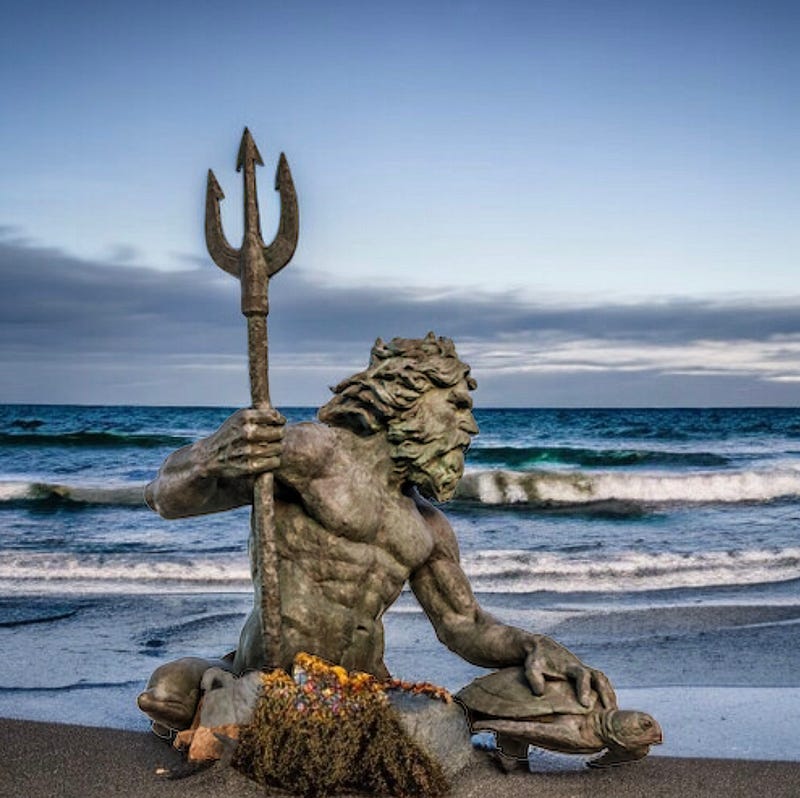
As most days, after the morning gardening chores are done, my world revolves around breakfast, and begins with a story. The stories, of course, are from my Cajun nonagenarian mother whose personal daily mantra is laughter and discussing a “story.” Today’s mantra: “Everybody has a story to tell. Make sure you choose which one and your words wisely!”
We both have long laundry lists of writing projects we are working on. But, Mama can’t seem to make up her mind which one to do next. Today’s topic of choice? Once Upon A Story!
Now, I know that Cajun culture is all about folktales and legends and was already wondering what that story may be. As she began talking about a French author who is famous for writing a poem that turned into the first play production in the New World in Port Royal Acadie — I once again was taken aback with how much of a history buff she probably has always been.
Yes, as a long time historical researcher and content writer, Acadian, Cajun, and Creole histories have been a part of my writing life. However, since she is daily full of surprises in terms of what she knows and what she is thinking about — I was surprised at what she really means about storytelling before she continued.
What I didn’t expect was her knowledge of King Neptune with a side serving of the history of storytelling since time began. Nor, did I know today she was deciding between her traditional story telling and telling the same in a rhyme.
Tales My Cajun Mama Tells Me
“Before we were Cajuns, before our ancestors came to Acadia, we were French. Did you know it was a French author who wrote the first poem in Port Royal, and turned it into a play in 1606? This is the one I’m talking about,” as she handed it to me on her yellow note pad.
Théâtre de Neptune
The sea-god Neptune, sitting on his throne, Was pleased to grace our théâtre alone; And with him came his comely train of nymphs, Whose beauty did all other beauties damps.
The waves, obedient to his powerful nod, Brought forth a Triton, mounted on a cod; Who, sounding loud his wreathed conch, did call The lesser Tritons to attend their king.
They came in troops, and on the sands did sit, And on their shoulders bore their instruments, Wherewith they made such harmony on shore, As never was before in mortal ear.
The god himself began to speak, and said: “O worthy Frenchmen, that in this new land Have planted France, and made it flourish so, That it already doth all other vie.
“Your coming hither hath been prosperous, And your beginnings fair and fortunate; And therefore I, great Neptune, King of floods, Do here salute you in my watery court.”
The Frenchmen, hearing this, did all rejoice, And made their answer in this manner wise: “O great Neptune, we do thank your grace, And vow to honour you with all our might.”
Then Neptune, rising from his watery throne, Did bid the Tritons sound their wreathed conchs; And so they all departed to the sea, Leaving the Frenchmen in great jollity.
This was the first play that ever was seen In this new world, that is so lately found; And it was acted in the year of grace 1606, by the French colonists at Port Royal.
— Marc Lescarbot 1606 (French author, poet, playwright, lawyer)
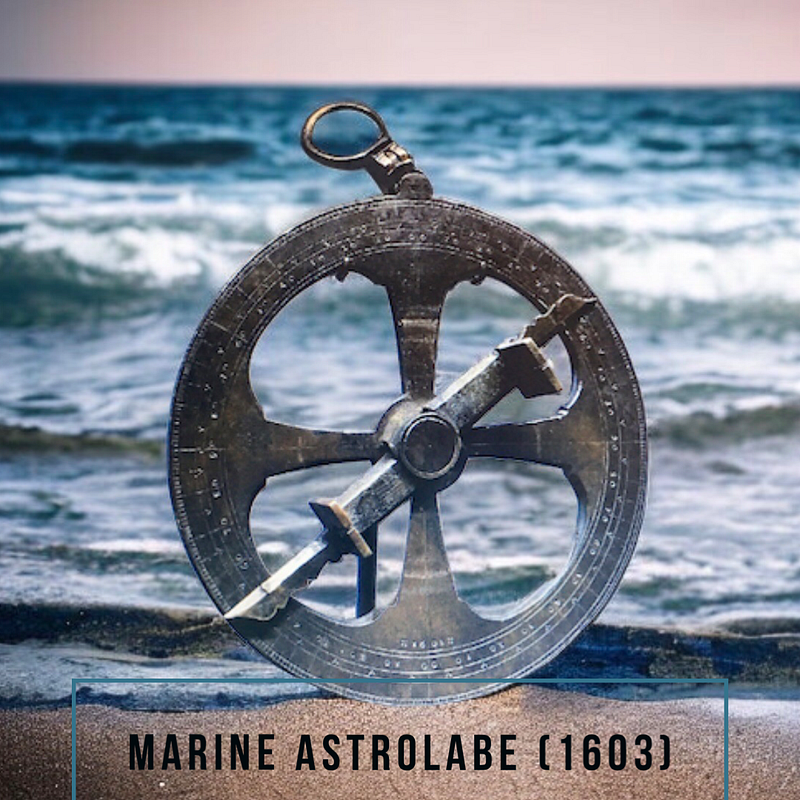
“Do you think the Mi’kmaq knew he was calling them Tritons? I hope not, because maybe it was, and it wasn’t a exactly a compliment,” Mama was making it very clear she’s been pondering on all this for awhile. For those of you who don’t know it, all sixty-seven original Acadian families that we Cajuns descend from, also include many Mi’kmaq women on our complicated intermarriage family trees.
Now, if you knew Ginn Navarre like I know her, she’s quite opinionated these days when it comes to a male patriarchy still holding on to power and women and minorities being excluded from decisions that affect us all. That is tied to the doom and gloom of much of today’s political woes. Doesn’t mean she’s a man-hater, quite the opposite.
Her “Triton” questioning tells me that somewhere somehow she’s aware of Greek mythology. Merman creatures were the guardians of the sea who were like King Neptune, male creatures, just lesser on the totem pole of gods. Never thought she’d be talking about that.
Where this discussion was going this morning was about who was in the audience of that first French poem turned play. Plot wise, “Le Théâtre de Neptune en la Nouvelle-France,” revolved around the arrival of Neptune, the god of the sea, in the newly established French colony of Acadia.
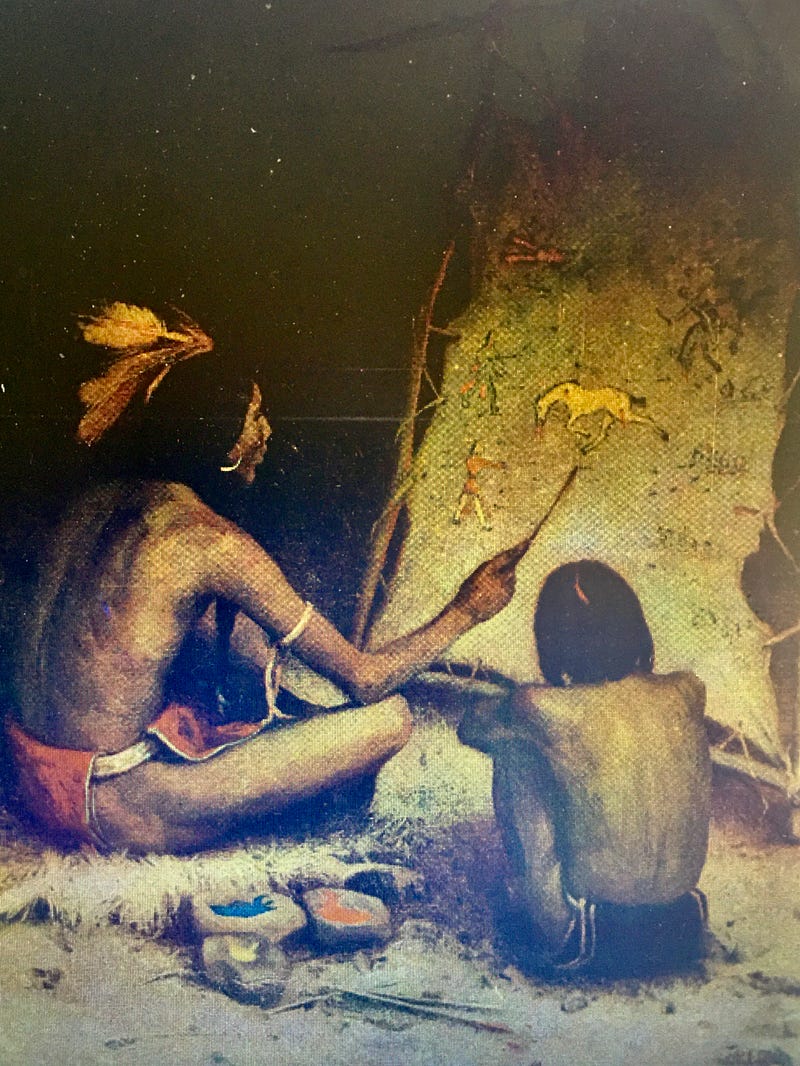
The play begins with the French settlers celebrating their successful settlement and their interactions with the Mi’kmaq people. If it wasn’t for the kindness and help of Chief Membertou (a powerful indigenous leader respected by both the Mi’kmaq and the French), the French colonists wouldn’t have survived. He and his tribe members were in the audience.
Keep in mind that “Le Théâtre de Neptune” of November 14, 1606 was a masque, a form of entertainment popular in Europe during the Renaissance. It took place on its outdoor stage against the backdrop of the Port Royal Sound. It also included music, dance, and elaborate homemade costumes.
It’s been said that as the god of the sea, Neptune’s costume was a regal blue green cloth that he wore draped around him like a pepoli. The French settlers wore doublets, breeches, and cloaks, typical of the day and the French audience. The Tritons (the Mi’kmaq) were Acadian actors who painted their flesh, wearing animal hides adorned with beads, feathers, and shells.
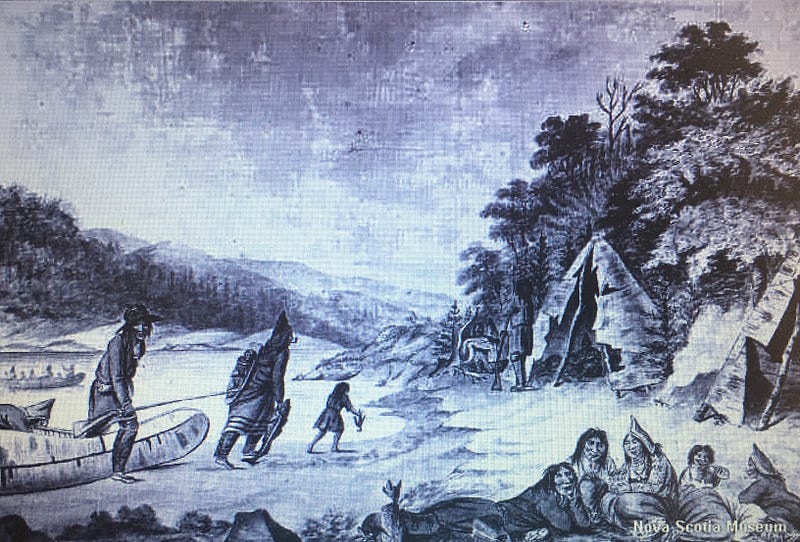
In the audience were the settlers now known as the “First French Colony.” They’d arrived on the 150 ton fluyt merchant ship, “Jonas.” Among them sat Jean de Biencourt de Poutrincourt (a nobleman educator and leader of the expedition who was granted the rights to claim the land; Samuel de Champlain; Pierre Dugaus de Monts; Father Pierre Biard; Father Ennemond Massé; Captain François Gravé Du Pontand; Louis Hébert (apothecary farmer who would later be considered one of the founding fathers of Canada); and surgeon François de la Rocque.
The rest of the audience was made up of the 20 crew members, 8 soldiers, a few carpenters, and farmers all who traveled on the Jonas. Sitting there too was Chief Membertou and some of his tribe.
My Cajun Mama, was hot on the trail of stories behind the stories of this first poem and theatrical production written and directed by Marc Lescarbot. Why? Because he returned to France to write and publish not only more poems, but to spread the word all over Europe about the New World with his books. He was a story teller who chose his adventures, and chose his words to influence and inspire others to brave a new world.

Her curiosity didn’t end there. As she headed for her laptop to begin her own day of storytelling, she left me with a couple of her Cajun wisdom gems:
“Can you imagine what the great leader, ol’ Chief Membertou and his people thought of those Frenchmen? Laughing she continued, “He must have thought they were a bunch of Français stupide who had lost their minds.”
and
“I’m maybe writing a poem about storytelling and why you need to choose your words and your audience carefully.”
I guess I get to stay tuned for tomorrow’s wisdom to find out if it’s going to be a poem or Cajun story.
Historical Backstory Note: The natural stage on that beach in 1606 has returned to King Neptune’s domain. Some eighty-six years later, Port Royal Sounds and the town that grew there was destroyed by a hurricane and has remained under water since that time.
“There is a great joy in creating stories, or poems, singing, reading, or listening to stories. When we read or listen to a story, we instantly form mental images of the characters and actions in our minds. We can visualize in our mind that person and what they look like or sound like. The places become real and we travel all over the world with our imaginations.
Everyone has many stories to tell, about our family, friends, or those we have loved, or lost. As we sit around the campfires of our experiences and memories — Let us again let our chosen words carry us beyond the glow of the fire light within the minds of our audiences.” — Jerilee Wei © 2023


