
Writing in All of Our Voices
We are not flat, one-dimensional beings. Our writing should reflect this truth.
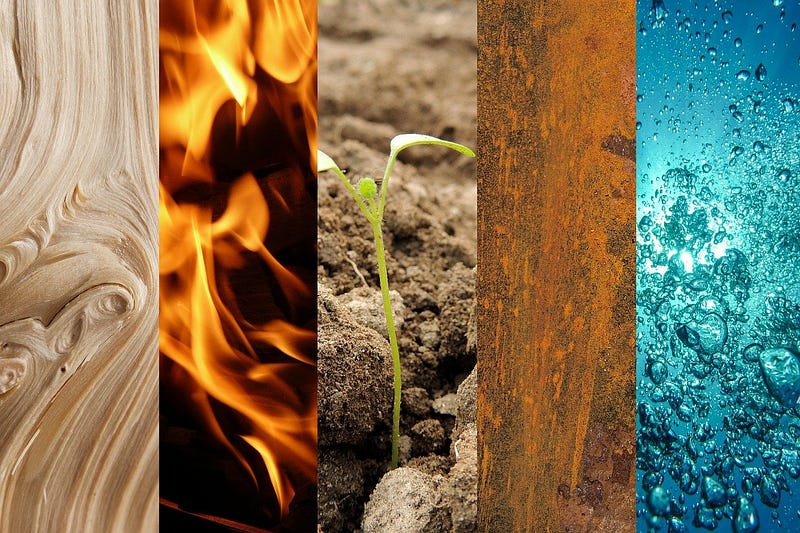
Which of the following elements would you say most describes your primary writing style?
Earth—grounded, practical, daily-life, routines, habits
Water—emotional, sentimental, vulnerable
Fire—passionate, truth-telling, challenging, justice-seeking
Air—thoughtful, meditative, pondering, questioning, philosophical
Ether—creative, spontaneous, ethereal, magical, of the spirit/soul world
These are the Five Great Elements (Pancha Mahabhuta) according to Ayurveda. In other systems of thought, such as Alchemy, they did not include Ether. But, I’ve always preferred the addition of Ether from Ayurveda, as Ether is the space from which all the other elements emerge.
Briefly, this is the Ayurvedic explanation of how the elements came into existence from the Ether.
Air emerged when ether began to shake, move, and shift.
Fire emerged when friction and heat were added to air.
Water emerged as the fire cooled and settled.
Earth emerged as water condensed and hardened.
Each element has a purpose in the creation/maintenance/destruction cycle of the universe. According to Ayurvedic wisdom, all the tangible things in our lives, such as foods, environments, and our bodies (which is where the concept of the Doshas is built from) are comprised of the five elements.
We can also use the elements to describe intangible parts of our lives; in fact, we already do. Anytime we’re describing a fiery relationship, a grounded business plan, or a sentimental ceremony, we’re coming from a place of understanding that the elements influence everything in our lives.
If you’ve already guessed where I’m going with this, then yes—we can also use the elements to describe our writing voice.
When beginning a writing practice, we often stabilize into one or two writing categories. This becomes our trademark voice and an identifying marker for our work.
It can then be confusing, even upsetting, when a reader who knows our work from one voice (element) comes across a piece of writing done from another voice.
“That piece seemed angry.” “This didn’t feel grounded.” “Where did this voice come from?”
It isn’t surprising that people would want us to write in the same voice, day after day, when you think of how we want people to act and look the same, day after day.
But if it is wholeness we are interested in, then we must embrace the full humanity of who we are, as I discuss in this article.
If we seek “wholeness” in our lives, then we should seek it in our writing as well.
When we write in all of our voices, we become more human on the page for our readers. We are not one-dimensional, flat beings with flat, predictable work. We are real human beings, experiencing and writing about the full array of our humanity.
I encourage you to explore writing with this elemental perspective in mind. Note where you tend to live most comfortably. And then challenge yourself to write from another element, another voice. Let yourself speak from all the parts of yourself.
This is a writing practice, but it is also part of a greater wholeness practice.
All the elements need expression through our bodies. If writing is how we do that, then a commitment to expressing a fiery side of ourselves one day and a vulnerable side the next—well, that’s exactly what the universe does every moment.
Thanks for reading! You might also like:
Keri Mangis
Award-Winning Author & Wholeness Advocate
Founder: KeriMangis.com
Interview on Illumination
Author: Embodying Soul: A Return to Wholeness — A Memoir of New Beginnings, winner of the 2020 IPA for Body, Mind and Spirit
Elephant Journal Writings, Newsletter, Medium Writings, Facebook, Twitter, LinkedIn, Instagram