avatarRochelle Deans

Free AI web copilot to create summaries, insights and extended knowledge, download it at here

3474

Abstract

time for that, here’s a compilation of the opening scenes of the movie and one that comes a little later in the film.</p> <figure id="3436"> <div> <div> <img class="ratio" src="http://placehold.it/16x9"> <iframe class="" src="https://cdn.embedly.com/widgets/media.html?src=https%3A%2F%2Fwww.youtube.com%2Fembed%2FJ3AE8lzddOg%3Ffeature%3Doembed&amp;display_name=YouTube&amp;url=https%3A%2F%2Fwww.youtube.com%2Fwatch%3Fv%3DJ3AE8lzddOg&amp;image=https%3A%2F%2Fi.ytimg.com%2Fvi%2FJ3AE8lzddOg%2Fhqdefault.jpg&amp;key=a19fcc184b9711e1b4764040d3dc5c07&amp;type=text%2Fhtml&amp;schema=youtube" allowfullscreen="" frameborder="0" height="480" width="854"> </div> </div> </figure></iframe></div></div></figure><p id="596f">In this clip, we have the opening scene of the movie, which establishes Westley’s character as always saying “as you wish” to Buttercup. In just a few minutes, we see how this phrase turns — the narrator even tells us that “as you wish” is Westley’s way of saying “I love you.”</p><p id="663b">The first two “as you wish”es provide a pattern. The third one sets us up for experiencing the love between the two characters, when Buttercup asks something ridiculous just for Westley to be close to her. In that, the phrase has already worked as a callback with meaning, and the movie isn’t even 5 minutes in yet.</p><p id="de07">Then we move on. Westley is dead by the hand of the Dread Pirate Roberts, Buttercup is engaged to a prince, and she’s off on an adventure of her own. She meets the Dread Pirate Roberts at the 3:25 mark of the compilation above, five years later, and learns of her beloved’s death at his hands. The Dread Pirate Roberts mocks her for her engagement to the prince.</p><p id="226c">Buttercup says, “I died that day, and you can die too for all I care.” She pushes him down a steep hill.</p><p id="db53">As he falls, he says, “As you wish.”</p><p id="1b1f">These three words that once meant “I love you” still do — but they also reveal to her the Dread Pirate Roberts’s identity. The callback is doubly poignant in that moment.</p><p id="0acc">But the author doesn’t stop there. The words come up again. Watch the following clip.</p> <figure id="54bb"> <div> <div> <img class="ratio" src="http://placehold.it/16x9"> <iframe class="" src="https://cdn.embedly.com/widgets/media.html?src=https%3A%2F%2Fwww.youtube.com%2Fembed%2FUquVCYL4C0Q%3Fstart%3D111%26feature%3Doembed%26start%3D111&amp;display_name=YouTube&amp;url=https%3A%2F%2Fwww.youtube.com%2Fwatch%3Fv%3DUquVCYL4C0Q&amp;image=https%3A%2F%2Fi.ytimg.com%2Fvi%2FUquVCYL4C0Q%2Fhqdefault.jpg&amp;key=a19fcc184b9711e1b4764040d3dc5c07&amp;type=text%2Fhtml&amp;schema=youtube" allowfullscreen="" frameborder="0" height="480" width="854"> </div> </div> </figure></iframe></div></div></figure><p id="f1cd">The final words the grandfather speaks to the child change the whole movie before it. Without the context built up over the course of the movie regarding those three words, we would still have the sweet moment of a grandson who’s learned to appreciate his grandfather’s stories.</p><p id="1f29">But with the context? Well. Just a look at the comments on that YouTube clip show how powerful a callback can be.</p><figure id="602b"><img src="https://cdn-images-1.readmedium.com/v2/resize

Options

:fit:800/1*sSSlu5hE9aZIx-U9Yy5aLw.png"><figcaption>YouTube comments screenshotted by author from the above clip</figcaption></figure><p id="cbea">The context of the callback is too powerful for our emotional brains to handle. The “as you wish” speaks so loudly for three words repeated seven times over the course of less than two hours.</p><h1 id="36f6">Delight for the Re-reader</h1><p id="80c6">Beyond the emotional catharsis at the end of the movie, this example also shows the specific delight that comes in a callback for a re-reader. That final “as you wish,” and the implications that come with it, makes re-watching the movie an entirely new experience.</p><p id="7424">Not to ruin a joke by <a href="https://quoteinvestigator.com/2014/10/14/frog/">dissecting the frog</a> or anything, but I’m going to. The first instance of “as you wish” sets up a phrase as important: it’s all Westley says to Buttercup. The second one establishes a new meaning: when Westley says “as you wish,” it really means “I love you.” The third shows that Buttercup now knows this, and wants to hear it.</p><p id="b5f5">Then we have the Dread Pirate Roberts’s “as you wish.” This one means what it says. It means “I love you.” It <i>also</i> means “I’m Westley.” And we as the audience know it means that because it is soon revealed explicitly that the Dread Pirate Roberts is, indeed, Westley the farm boy.</p><p id="25d6">When the grandfather says “as you wish” to his grandson to close the movie, we get all three of these meanings. Not just “Okay, sure,” and not even just, “Of course; I love you,” but this final meaning of “I’m Westley” is layered into the words as well.</p><p id="9270">This then colors not only the grandfather/grandson interactions, but the whole story being told. You’re in on a secret that only a callback as the last line of the film could have given you — at least in so powerful a way.</p><h1 id="ef89">Applying Callbacks to Your Own Writing</h1><p id="8419">How can you do this? The best way is to provide a phrase that not only means something, but that changes meaning. When you’re creating shorthand between two characters in love, a callback will be more powerful than an “I love you,” every time.</p><p id="026c">What do you think of what you hear “Always”? or “Okay?” “Okay.” “Maybe okay will be our always.”?</p><p id="11d3">What sort of phrase can change the context of your story if you apply it in the beginning, middle and end?</p><p id="2bf3"><i>If you like my work and would like to read more of it, consider joining Medium with <a href="https://medium.com/@rochelledeans/membership">my referral link</a> to get full access to every article on Medium. Using my referral link doesn’t cost you anything extra, but half of the fee goes directly to supporting me each month.</i></p><div id="5973" class="link-block"> <a href="https://medium.com/@rochelledeans/membership"> <div> <div> <h2>Join Medium with my referral link - Rochelle Deans</h2> <div><h3>As a Medium member, a portion of your membership fee goes to writers you read, and you get full access to every story…</h3></div> <div><p>medium.com</p></div> </div> <div> <div style="background-image: url(https://miro.readmedium.com/v2/resize:fit:320/0*cP5hubGsSYhxUAYn)"></div> </div> </div> </a> </div></article></body>

Writing for the Re-Reader: Callbacks

Or, why the simplest phrases illicit the biggest emotional responses

Photo by Saad Chaudhry on Unsplash

The biggest emotional pulls in a narrative often come from the smallest of moments. A single word or phrase can turn a work from something enjoyable to something cathartic. That is — a reader of a book or watcher of a movie becomes a participant in the narrative. Tearing up. Smiling. Laughing harder than a joke would warrant without context.

That context is what we’re going to talk about today. Almost always, the emotional turns in narratives elicit catharsis because of a callback, whether explicit or implied.

What Are Callbacks?

Callbacks, as discussed by Jo Eberhardt on Writer Unboxed, are moments in a narrative that immediately call to mind an earlier moment, and bring with them the thoughts and emotions associated with the earlier scene, which then get reinforced. She notes that foreshadowing, which we’ve already discussed, and callbacks are different things, and supposes that main difference is in a plot moment versus an emotional one.

Callbacks in Comedy

Callbacks are probably most well-known in stand-up comedy. Writing a program this way is pretty much the only way to get onto my list of favorite comedians. Eddie Izzard does this brilliantly in all of her work. I enjoy Hannah Gadsby for similar reasons.

For an example, this Medium article shows how a simple answer to a question can become a running joke as a sketch continues.

When callbacks are used in comedy, it’s to get a bigger laugh from an audience than a joke would in a vacuum. The first joke appears to be just for laughs, and the comedian moves on. But that joke is doing more work as context than as a joke in its own right. It gets funnier with reuse — this is repetition done well, not redundancy, because the punchline is implanted into a new context, where it becomes more than either joke could be alone.

In fiction, though, callbacks are usually used to gain more poignant emotions than laughter.

Dialogue Callbacks

While Eberhardt says that callbacks should have the same emotion as the moment they are referencing, I’d argue that fiction callbacks are the strongest when they take all the emotions from an earlier scene and put them into a new context, with new emotions, thus layering the effects.

Let’s take a perfectly popular example: The Princess Bride. Some spoilers follow, if you haven’t seen it yet. But the article will still be here two hours later if you want to watch it first. I wouldn’t blame you.

If you don’t have time for that, here’s a compilation of the opening scenes of the movie and one that comes a little later in the film.

In this clip, we have the opening scene of the movie, which establishes Westley’s character as always saying “as you wish” to Buttercup. In just a few minutes, we see how this phrase turns — the narrator even tells us that “as you wish” is Westley’s way of saying “I love you.”

The first two “as you wish”es provide a pattern. The third one sets us up for experiencing the love between the two characters, when Buttercup asks something ridiculous just for Westley to be close to her. In that, the phrase has already worked as a callback with meaning, and the movie isn’t even 5 minutes in yet.

Then we move on. Westley is dead by the hand of the Dread Pirate Roberts, Buttercup is engaged to a prince, and she’s off on an adventure of her own. She meets the Dread Pirate Roberts at the 3:25 mark of the compilation above, five years later, and learns of her beloved’s death at his hands. The Dread Pirate Roberts mocks her for her engagement to the prince.

Buttercup says, “I died that day, and you can die too for all I care.” She pushes him down a steep hill.

As he falls, he says, “As you wish.”

These three words that once meant “I love you” still do — but they also reveal to her the Dread Pirate Roberts’s identity. The callback is doubly poignant in that moment.

But the author doesn’t stop there. The words come up again. Watch the following clip.

The final words the grandfather speaks to the child change the whole movie before it. Without the context built up over the course of the movie regarding those three words, we would still have the sweet moment of a grandson who’s learned to appreciate his grandfather’s stories.

But with the context? Well. Just a look at the comments on that YouTube clip show how powerful a callback can be.
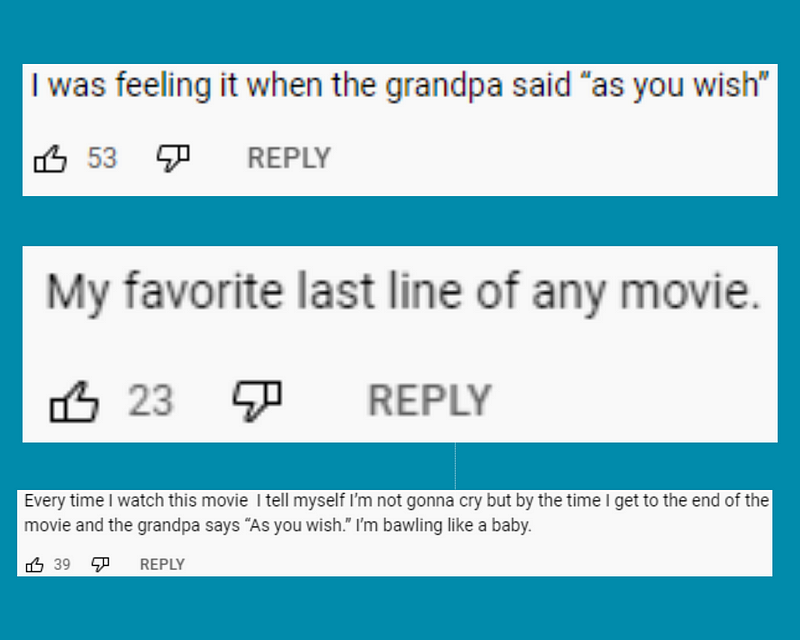
YouTube comments screenshotted by author from the above clip

The context of the callback is too powerful for our emotional brains to handle. The “as you wish” speaks so loudly for three words repeated seven times over the course of less than two hours.

Delight for the Re-reader

Beyond the emotional catharsis at the end of the movie, this example also shows the specific delight that comes in a callback for a re-reader. That final “as you wish,” and the implications that come with it, makes re-watching the movie an entirely new experience.

Not to ruin a joke by dissecting the frog or anything, but I’m going to. The first instance of “as you wish” sets up a phrase as important: it’s all Westley says to Buttercup. The second one establishes a new meaning: when Westley says “as you wish,” it really means “I love you.” The third shows that Buttercup now knows this, and wants to hear it.

Then we have the Dread Pirate Roberts’s “as you wish.” This one means what it says. It means “I love you.” It also means “I’m Westley.” And we as the audience know it means that because it is soon revealed explicitly that the Dread Pirate Roberts is, indeed, Westley the farm boy.

When the grandfather says “as you wish” to his grandson to close the movie, we get all three of these meanings. Not just “Okay, sure,” and not even just, “Of course; I love you,” but this final meaning of “I’m Westley” is layered into the words as well.

This then colors not only the grandfather/grandson interactions, but the whole story being told. You’re in on a secret that only a callback as the last line of the film could have given you — at least in so powerful a way.

Applying Callbacks to Your Own Writing

How can you do this? The best way is to provide a phrase that not only means something, but that changes meaning. When you’re creating shorthand between two characters in love, a callback will be more powerful than an “I love you,” every time.

What do you think of what you hear “Always”? or “Okay?” “Okay.” “Maybe okay will be our always.”?

What sort of phrase can change the context of your story if you apply it in the beginning, middle and end?

If you like my work and would like to read more of it, consider joining Medium with my referral link to get full access to every article on Medium. Using my referral link doesn’t cost you anything extra, but half of the fee goes directly to supporting me each month.

Writing Tips
Developmental Editing
The Princess Bride
Editing
Recommended from ReadMedium