
Writing Everyday is Hard, Try Writing Titles Instead
To make things easier, and let the universe help you while at it.

The first of August has arrived!
Here we are on our first day of the month. Medium publication groups, Facebook groups, Slack, Discord, and other chat groups all share similar messages of well wishing and content. Some of which stuck out most today: How did you do for July? Give yourself a pat on the back. What is your goal for August?
“How did you do for July?”
“What is your goal for August?“
What goal indeed? Surely this thought has come across your mind before as a writer. Unless you have a fervent hatred towards the practice with a conviction that can rival the staunchest of devotees, then you must have considered giving yourself a higher chance at hitting the viral jackpot by simply increasing the number of post.
Well, the larger the number of post, the higher the chance of curation right? Simple arithmetic.
There you have it, the origin of the 30 days challenge.
30 Days Challenge?
The 30 day challenge is simple enough: write everyday for thirty days, rain or shine; day or night; alive or dead.
The rationale is that consistency trumps almost everything. In the ever lasting battle between perfection and consistency, perfection can wait — actually no, you don’t wait at all. The point is, don’t wait till the post is written in perfection, and value consistency over most other things.
Many writer abide by this rule. Some of the most successful writers praise such a method.
Of course, writing 30 days in a row is no easy feat. It requires mental resilience and fortitude in the face of rejection and dreadful writer’s block. A bad hair day is no excuse to stop writing.
“A bad hair day is no excuse to stop writing.”
My Proposal
Since we are at the start of the month, it is high time to make a new month’s resolution in writing. Pardon me, the writing process warps time and space, so I do goal setting every payday instead of the new year.
As are most good things, they don’t come easy. In fact, writers go through months of writing and have little to show for it. Although punishing, the good things will appear by surprise and, hopefully, last long term.
I decided to take on the write everyday challenge. I was worried that I was not ready for the grind.
Then I looked at my drafts.
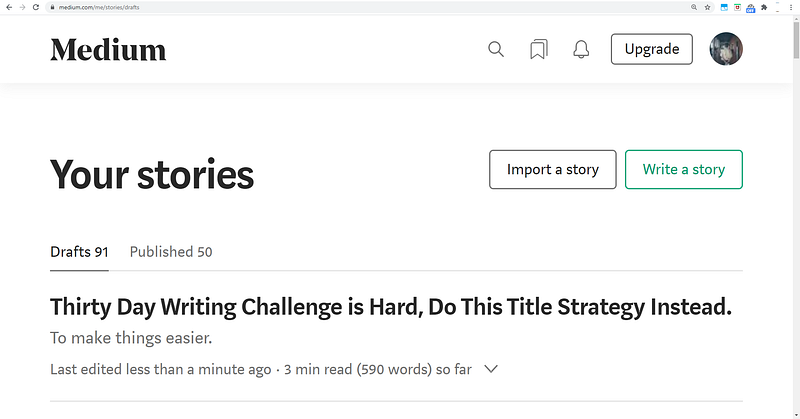
I have 91 incomplete drafts.
“I have 91 incomplete drafts.”
Suddenly, I felt the mammoth task of writing everyday lighten into a baby elephant task – still tough but less so. I already have the necessary preparation done for my challenge, what’s left is only to write.
Without having to consciously sit down and allocate time and effort for it, I had my content scaffold built with some foundation, the foundation being ideas in the form of short prompt words.
I had accumulated 91 drafts simply by writing down titles after titles that randomly bubble up in my consciousness as I went about my days in the past.
The Title Strategy
It seems the universe is set to help you for this challenge. Now you only have to utilise it.
Times when you are doing mundane chores or everyday daily routines that are as monotonous as brushing your teeth, taking a shower, or even while taking a dump, ideas just seem to pop up freely. Instead of letting them pop and fade into oblivion, record it down as short titles on a note-taking platform to extend its otherwise fleeting existence. For me I record them down on the drafts page of Medium itself on the app.
“It seems the universe is set to help you for this challenge[…] even while taking a dump, ideas just seem to pop up freely. Instead of letting them pop and fade into oblivion, record it down …”
Then you might say, “Wait, but I don’t have 91 unpublished drafts, how do I even start the challenge?”
Alright, you may not have a pool of drafts to jumpstart your writing. It may feel like running in the dark. No worries. Here, I detail the step-by-step actions to take to recreate the my situation.
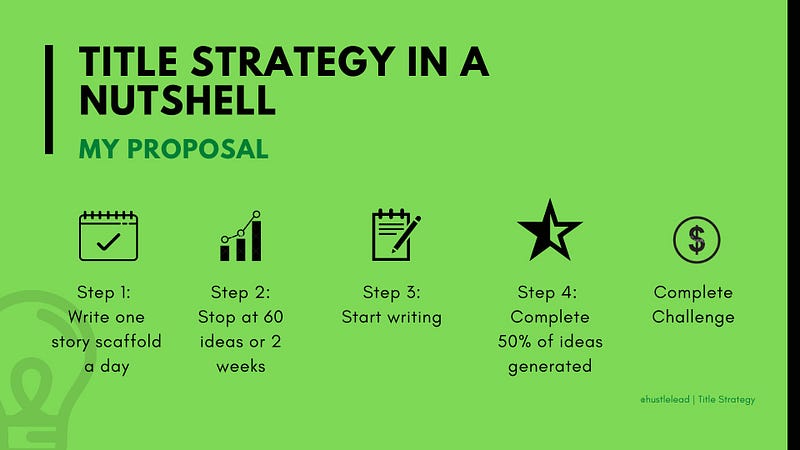
Step 1: Write down at least one story scaffold a day.
What I mean by a story scaffold is a stripped down version of an article, consisting only of the title primarily, complete with a few prompts if necessary.
Ideally, you can aim to have at least two story scaffolds drafted everyday. This way, it would allow you to build up the pool of ideas faster than a month — we’ve no time to waste!
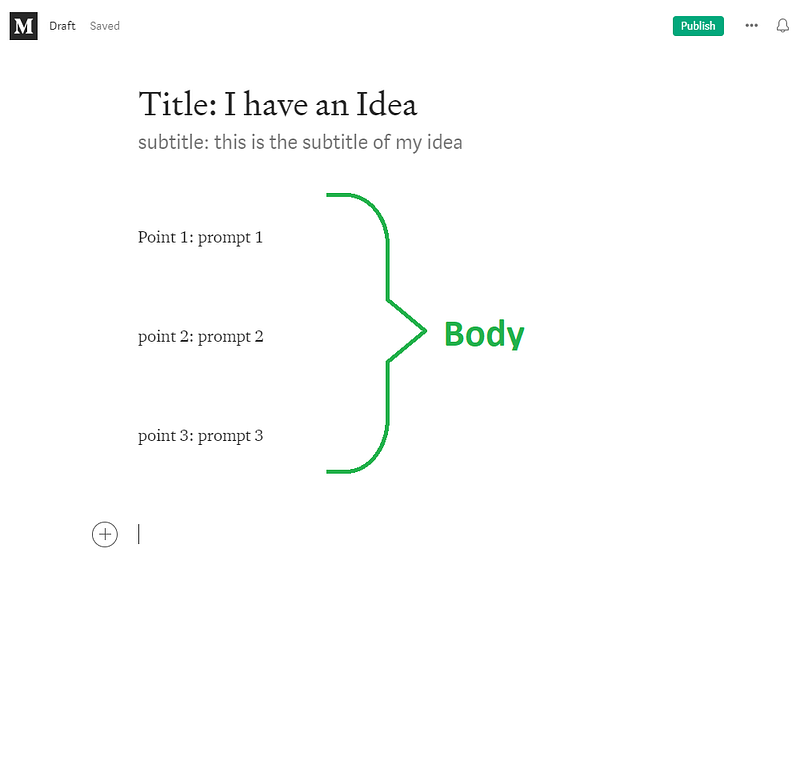
The above is a possible version of a story scaffold. If you must, include the points as prompts for the body. You can add more pointers for notetaking, but keep things short.
The scaffold should be understandable to you such that if a freelancer were to be hired to complete the writing for you, he can do so yet without feeling constricted.
I say “without feeling constricted” because I know there would be people who, like me, feel limited by partially formed ideas that were hastily recorded down in cursory statements. To avoid that and allow the mind to write unbridled, minimal sentences should be written in the scaffold. Ultimately, a carefree writer is the most relatable because coherence is important in a piece of writing.
If your goals is to be curated, then this is ever more pertinent.
Step 2: Stop at 60 ideas, or 2 weeks, whichever comes first.
Or if you can, reach 91 drafts. Depending on what is your goals for that month.
For example, the goal is to write 30 articles, then use about 15 days to build your arsenal of ideas so that the next 30 days would be a breeze to write.
With that, you would have minimally written 30 stories by the end of 45 days, or 1.5 months.
As for me, since I already have my arsenal of ideas, I am currently at this step too.
Step 3: Start writing!
Now, here is the start of the real game. Start letting the writing juice flow.
The danger is in letting yourself slip during uninspiring times. Don’t let that happen by keeping your short term goal in sight.
“The danger is in letting yourself slip during uninspiring times.”
“write everyday for thirty days, rain or shine; day or night; alive or dead.”
There are many more experience writers out there who have written on how to survive the grind of the write-everyday-for-thirty-days challenge.
Basically, they all agree that one should keep writing and stop needing motivation. Remember, you have your arsenal of ideas.
Step 4: Complete at least 50% of the ideas generated by the next month.
Let’s be realistic, having 60 drafts and 30 days doesn’t mean you can suddenly produce 30 stories.
That’s why aim to complete at least 50% of the drafts in waiting. That’s a conservative number, I believe you can do more.
This way you would have completed at least 30 writings in a span of less than 2 months. This will take advantage of the heavily view-dependent algorithm of Medium recommendation, by contracting your best publications into a shorter span of time, than spacing them out.
Consistency often trumps everything. Quality will come.
“The point is, don’t wait till the post is written in perfection, and value consistency over most other things.”
Accept Challenge
Try it! And see for yourself the results. Let me know how it did for you and if it has eased your struggle.
Better still, if it helped you win the viral lottery.
Stay motivated; Stay inspired; Stay writing.


