
WRITING | CREATIVITY | PRODUCTIVITY | EDITING | EDUCATION
Writing Advice I Keep Forgetting: You Have to Molt
Getting rid of what you don’t need any longer — a necessary hurt
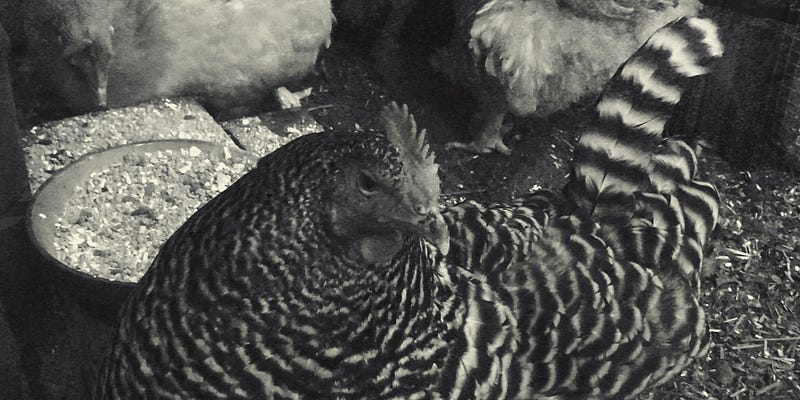
Amelia tried to hold onto that tail feather sticking out at an odd angle for three days, but in the end, it had to go. It was the first of many she molted.
My brain is like Amelia’s when I read sentences and paragraphs and even entire passages that I’ve written. I don’t want to let them go. Normally it’s about now that I say “my autistic brain,” but this isn’t that kind thing. It’s just a “being alive” thing.
Letting go, a necessary hurt
Amelia is my best flier. It’s what she was hatched to do. And you may feel writing is what you were born to do.
That first year, Amelia had taken to flying from the perching bar across from the coop door right into the coop itself. It was bold, daring, and just the sort of thing she loves to do. Everyone else used the chicken ladder, but once she knew she could fly across to roost for the night, it was her favorite aerial maneuver.
And then one night, she didn’t make it. She landed clumsily on the ladder and had to skitter off to the side. She looked stunned and embarrassed. This had never happened before. She didn’t realize the feathers she had molted over the last few days had affected her ability to fly.
It was the first molt of her young life. Since that time, whenever she begins to molt she resists it by waiting to shake off the loose feathers — no matter how uncomfortable they make her. She doesn’t like the unprotected feeling of being naked and without feathers.
For me, it was like freshman high school English.
My first “real” English teacher (in exactly 500 words)
My ninth grade English teacher was Mrs. Luke. Every week on Friday, we had to turn in a composition.
Each had to be exactly 500 words. Sentences had to end in periods, and paragraphs had to be indented the width of the index finger of the hand you weren’t using to write.
Each had to be written in black ink using a cartridge fountain pen. If an error was made in a word, we could start again or mark through it with three separate horizontal lines. We were allowed only three of these mark-throughs in a composition. If we got to three and made another error, we had to start the page again on a fresh sheet of paper.
If you did all those things, you received an “A” on your composition. If you had one spelling error, your grade was lowered to a “C.” If you had two spelling errors, your grade was lowered to an “F.”
When this was first announced to the class, someone sheepishly said it sounded like we were being graded on how well we could spell.
Mrs. Luke explained we had an entire week to do each composition about whatever topic we wanted. We had lots of paper and pens and an entire week to check the spelling of every single word in the dictionary if we needed.
Now you may think she was a mean and cruel teacher. Some in every class always did. But here is what I think she was doing — she was teaching us to edit and proofread our sentences before she taught us anything else.
She never worried about inspiring us to write creatively. It didn’t matter if we wrote 500 words about hanging the clothes on the line or feeding the hogs.
And that’s what we did. We stuck with what we knew. We played it safe from one sentence to the next. We cut out a lot of gobbledegook sentences and run-on sentences and convolutedly unclear sentences — the ones that we thought teachers want to hear because they sound like we knew a lot more than what we actually did — the academic-sounding stuff.
We thought for sure we would fail without all the filler and fluff. We were going to prove she was wrong. She would be bored to tears by with our compositions. We edited out everything we weren’t 100% sure about. We were molting! (And we didn’t know it.)
By giving us this weekly assignment, Mrs. Luke was looking at us as the writers we were. These were not really compositions. They were assessment tests. She knew exactly what we did and did not know about the English language. We were naked writers unable to fly! (And we didn’t know it.)
Whenever we received an “A,” Mrs. Luke would have a personal meeting to suggest new things to try from her perspective as a reader, not as an English rule-enforcing teacher. We were growing new feathers! (And we didn’t know it.)
So can I be my own Mrs. Luke?
That is my goal this month. To get back into that high school freshman mentality for a while and see what happens.
I’ve already tried waiting for my brain to accept what my heart has already decided is perfect. But it doesn’t work. Filler and fluff have to go.
Here is my plan
I will start with molting sentences and paragraphs. I will resist the urge to leave my precious college-educated words undisturbed because I truly can come up with the most intricate rationalizations for not changing a single word no matter how long and complicated a sentence may become. (Mrs. Luke also taught us how to diagram sentences. That last one is horrible.)
Molt.
Look at myself as a naked writer.
Grow new feathers.
I will take whole sentences and even whole paragraphs out of a piece of writing. Then I will paste them somewhere else. My best-ever-defend-with-my-last-dying-breath words will be safe. I can always restore them.
It’s just like how I save Amelia’s most perfect flight feathers after she molts them.
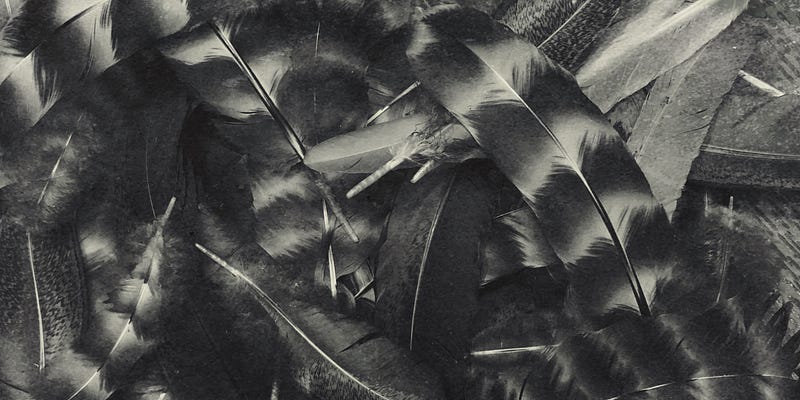
Fun Fact: When chickens molt, their egg production stops. This is because their bodies shift from concentrating their energy on laying eggs to growing new feathers. Chickens can’t do both.
My Theory: Whenever a writer shifts from getting words onto a page to taking words off of a page, the writer will grow. It’s the best way for a writer to view themselves as “a naked writer” before growing new skills.
This article is part of a series. You can view the full list of available articles here.
Will I be able to keep my promise to have the word “chicken” at least once in every Medium story? Find out by subscribing to Medium today as a reader or writer — or both!


