
WRITING | FICTION | AUTISM | CREATIVITY | FEELINGS
Writing Advice I Keep Forgetting: Write What You Know
But Only Because It Doesn’t Mean What It Sounds Like It Means
“Write What You Know.” That’s what the expert professional writers say. Well, I know chickens! I can write about chickens all day long! That’s what my autistic brain was thinking when I first read that piece of writing advice.
I was absolutely, positively sure I could do that. Cut me a check for the advance on my royalties!
Brilliant Advice: Write What You Know
Chickens have 120 bones and between 5,000 and 8,000 feathers. Chickens do not have laps. Chickens have five different light receptors in their eyes, but they can’t see when it begins to get dark. That’s why they go up to roost every night. Hens lay eggs even if there is no rooster around. Chickens sneeze. Although their sneezes sound like the metal and rubber bicycle horns we had growing up, chickens are unable to ride bicycles. This may have something to do with not having laps.
Make my flight arrangements for Stockholm, Sweden. I’m ready to pick up my Nobel Prize in Literature!
But…
None of that is what “Write What You Know” means.
“Write What You Know” is not about the facts. It’s about the feelings — and not just the happy feelings that come with sharing fascinating fun facts about chickens either.
It’s writing about the feelings we know and and have in commn with people everywhere. Hope. Sorrow. Grief. Excitement. Melancholia. Love.
More Specific Brilliant Advice: Write What You Know — About Feelings
All humorous looks at myself aside, this next statement is so important when writing fiction.
Unless feelings are expressed truthfully by actions, not adjectives, your story will not ring true.
The old science fiction movies may have errors in scientific facts, but if the feelings are real, people will continue eating their popcorn through to the end of the film.
By the way, chickens love watching Godzilla movies.
You may not be the first person to step foot on Mars, but maybe you know what it feels like to be the first person in your family to do something else. Don’t let anything stop you from writing a story about being first to walk on Mars just because it’s never been done. Draw from your feelings about being the first at something else.
And that’s what I do. I write about feelings that I know.
Chickens have very deep emotions. When I write about my chickens, I pull from my own experiences and feelings. My hope is that readers can see themselves in how my chickens feel in each action along the way. Then readers will become emotionally engaged and what happens next will matter to them.
Without that, readers will not turn the page.
The Big Hand
This is the beginning of my first novel in a series for older readers (including grownups). It is built on what has already been published as a series of shorter books for upper elementary school readers.
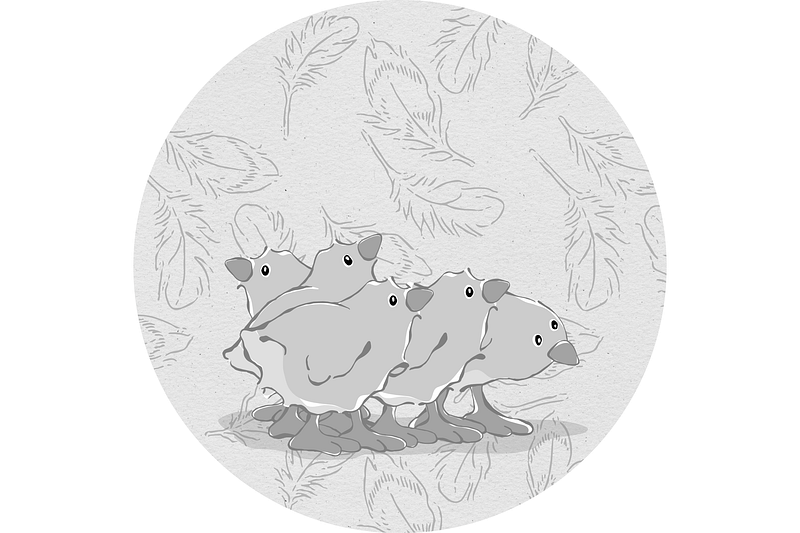
“Are you sure you want that one? The one with the lopsided feathers?” asked the sales clerk.
I looked more closely at the two baby chicks she was holding in her hands. I could see what she meant.
“If you ask me, there’s something wrong with that one,” she said. “It doesn’t look good enough to me. I’d never take it home and call it mine.”
Then the one she was talking about looked up into my eyes and simply said, “PeeP!”
I wondered if she realized the sales clerk was talking about her.
“I’m sure,” I said. “They look like they belong together.”
I took the two little balls of fluff from her and carefully placed them into a shoebox with fresh straw.
“Suit yourself,” she said and shrugged her shoulders.
“You are so much more than good enough,” I whispered into the small shoebox on the way to the cash register. When I held my ear to the shoebox, I could hear their happy peeping inside.
That spring day, I made two trips to The Feed And Seed Store. On the first trip, I hand-selected the baby chicks to take home with me in a large shoebox. Few things are any cuter, and so I went back for more. Those two were just scooped up by the sales clerk. But without the second trip, there would be no Gracie and Bessie in my life, and you would not be reading this.
Gracie did look a little different, just as the sales clerk had said. With the others, the feathers above their beaks were even. Gracie’s weren’t, and so her face seemed slightly odd. Nevertheless, you can’t always tell baby chicks or people by how they look.
The first week, a small lump appeared on Gracie’s side near her thigh. As the weeks went by, it grew with her. It kept her from moving like the others. Even so, she did her best to act like them. She wanted to avoid getting picked on or jostled by the more active and assertive chicks who got quite rambunctious at times.
She stayed close to Bessie whenever she could. Bessie would go off to play with the others, but she always came back to Gracie. They slept beside each other, perhaps more by Gracie’s choice at first, but Bessie didn’t mind. It’s just like that with friends.
Most mornings, after the spring showers, I would collect earthworms from under the bricks and logs outside. While the others were enjoying their treats, Gracie stayed back from the excitement. When it was over, she would go to Bessie. Every so often, she was lucky and found a small earthworm the others had overlooked.
Once, I picked her up out of the brooder box and tried hand-feeding an earthworm to her, but she wouldn’t take it. Any of the others would have eagerly gobbled it down. For Gracie, being with Bessie was more important than even a tasty snack.
Maybe the sales clerk had been right about this timid one, I thought. But as I held her little body in my hands, my heart told me otherwise.
“You are so much more than good enough,” I said to her.
“PeeP!” she said to me, and so I put her back in the brooder box next to Bessie.
She snuggled against her best friend and happily looked up at me.
“PeeP!” she said again.
Soon I would learn Gracie’s gentle heart had many more important things to tell me other than just “PeeP!”
Hopefully in these 590 words, there is something that connects you as the reader to Gracie, the main character.
I was never a baby chick. But I have known what it feels like to be small and insignificant, hoping that I will be loved and cared for just as I am. Haven’t we all at one time or another?
If I’ve done my job as a writer, you know how Gracie felt throughout without naming her feelings, and you want to know what happens next.
Are you ready to go get your own baby chicks yet?
This article is part of a series. You can see a list of the other available articles here.
Will I be able to keep my promise to have the word “chicken” at least once in every Medium story? Find out by subscribing to Medium today as a reader or writer — or both!