
WHILE BLACK SERIES | RACISM
Writing About Racism While Black
Are Black voices being suppressed on social media sites?
So, is our moment over? After George Floyd’s murder and the wave of online and offline outrage, are we just supposed to stop talking about racism now? That’s certainly what the social media algorithms seem to suggest.
Suppression of Black voices seems to happen on every social media platform, but two of the most recent examples have been on LinkedIn and Facebook.
How Is it possible to get 0 views on LinkedIn?
I was recently involved in conversations on LinkedIn with several Black people (mostly women) who have seen reduced visibility for their anti-racism content.
While some white anti-racists have seen views and comments drop for their anti-racism posts, it’s most noticeable with the Black people with huge, active followings (again, especially women) who are getting zero visibility, which you wouldn’t even think would be possible on a network with millions of members.
I noticed it myself. In early June, people were reading, sharing and commenting. One of my posts had more than 10,000 views, which is a lot for me. By early August, those numbers were falling, and in some cases views were down to the hundreds. Don’t get me wrong; I don’t expect everyone to see and comment, but with approximately 1800 LinkedIn connections, I think it’s fair to figure that a reasonable percentage will see my content.
The way most social media algorithms say they work is that they show you more of the content and people you’re engaging with. That should mean that I see more anti-racism content rather than less. But that’s not what’s happening. There are a bunch of us of all hues actively posting and amplifying. Most of us have found that certain people’s content just isn’t showing up in our feeds.
On LinkedIn, my answer to this has been to stop hashtagging my posts. Again, this is counter-intuitive. Hashtags are supposed to make it easier for people to find relevant content. But I believe they also make it easier for algorithms to find content they want to suppress.
Without the hashtags, more people started seeing my content again. It’s not a perfect solution, though, because the algorithmic bots can still see what I post about if they choose to. For now, that’s where I am on LinkedIn.
Facebookery strikes again
I’m having a similar issue on Facebook with this article: The Loneliness of the Sole Black Employee. Read it for yourself and see if you can find anything objectionable (other than expressing my hatred for racists).
I’ve always had mixed feelings about Facebook (actually, they’re not that mixed. I don’t like their ethics, but I have friends and family members worldwide who are on there, so I’ve stayed). But Facebook, too, has a serious case of “suppressionitis”, which appears to be targeted largely at BIPOC.
There are a number of things that could be going on here: 1) Facebook could be blocking all Medium articles (which would be weird, as it’s a large and prominent site). I’ve seen some links to other Medium content, so I don’t think this is the issue. 2) Facebook could be blocking all ILLUMINATION articles (this is possible as the publication is a prolific Facebook poster, which could have resulted in spam reports) 3) People have reported this specific article as contrary to the Facebook terms of service (TOS). Some friends have shared the message they get when they try to share it, and that seems likely. 4) The Facebook algorithm is automatically flagging this article. That’s more than likely, as other people posting anti-racist content have also had it removed. Ironically, getting actual hate speech and violence removed is much harder.
A few friends (and some relative strangers) have taken up the cause on Facebook. Lisa Hurley, Risée Chaderton, Dawn Rose, Kathie Daniel and many of their personal networks are running an active anti-suppression campaign, reposting the article in full, and also sharing the link. (Thanks, everyone.) It doesn’t take long until the linked content is removed. Check out the screenshot of Dawn’s original post below:
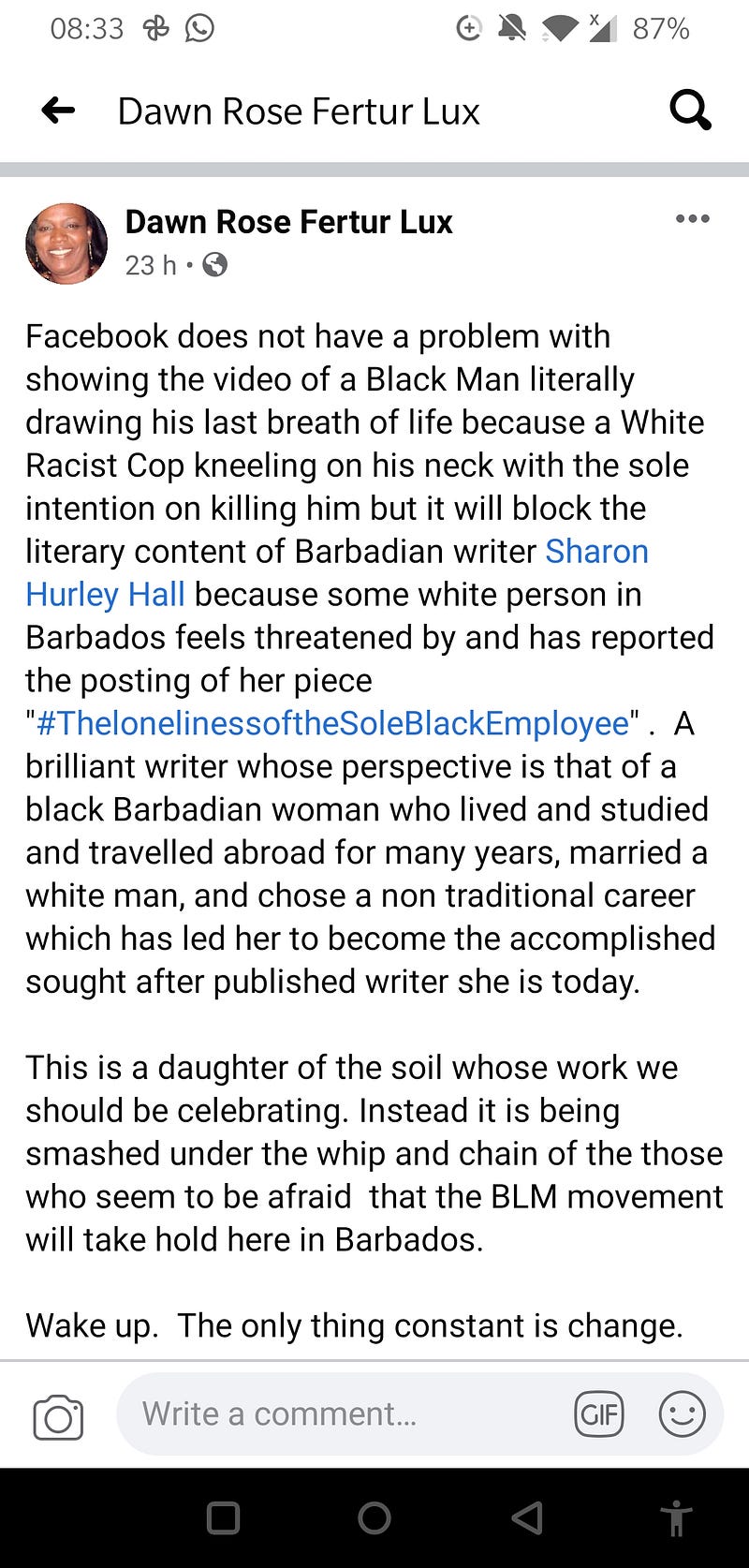
Clearly, many social media algorithms don’t think it’s acceptable for Black women to call out racism. I don’t care. Racism isn’t over, and I and many others will keep talking until it is. I’m expecting this to be a lifelong fight.
In the meantime, all social media sites need to do better (because this happens on Instagram, too). They need to stop privileging the voices of racists over actual anti-racist content. They need to stop preventing Black people from getting their anti-racism messages to a wider audience. They need to stop hiding what they should be amplifying.
If you want to help, report it when something’s blocked that shouldn’t be, amplify Black voices, and keep working to fight racism. And if you have other suggestions for how to fight the algorithms, I’d love to hear them.
© Sharon Hurley Hall, 2020
If you found this article interesting or insightful, I invite you to subscribe to my anti-racism newsletter to see more of my articles on racism and anti-racism.
This article was originally published on Medium. If you’re reading it anywhere else, it may be stolen.


