
Writers: Readers Don’t Just Want Information, They Crave Connection
Your Personal Perspective is the Experience They’re After

As I sit here, enjoying a glass of Glenfiddich on the rocks in front of my century-old Corona 3 typewriter, it occurs to me that much of the reason for my writing success stems from taking a personal approach to the business of selling words.
You see, people connect with what they can relate to. And the only thing people genuinely relate to is other people. They want to know the person behind the screen, to find a piece of themselves reflected there.
They want to read about how you’ve overcome struggles similar to their own.
Much of what is published on this platform is indeed informative, but painfully dry in its delivery of wisdom. It reads more like an instruction manual than a story written by a human soul.
The recipe is as simple as it is banal. Hype up the intro, throw a bunch of bullet point lists and H2 tags in for Google, then make the reader slog through a 2,000-word swamp of filler and fluff before finally finishing off with an anti-climactic answer in the form of an affiliate link.
Forgive me for my critical witticisms. But if your writing is going to reside behind a paywall, you had better finish what you start without hiding the ecstasy of climax behind yet another paywall. Anything less is the written equivalent of four hours of foreplay without fellatio.
And let us not forget the endless lists, such as “7 Things Rich People Do Better Than You,” or my personal favorite, “10 Ways to Die of Boredom.” Perhaps “reading this story” could be #1.
Whatever niche you’ve carved for yourself here, there is one literary tenet that applies universally, regardless of genre. Reading is an emotional experience, just as much as it is a means of communication. Good writing is felt more than observed.
It awakens that same part of you that sobs during a sad movie and gets goosebumps while listening to a touching song. A sensation not constrained to the limits of your physical senses.
It is the difference between explaining and expressing.
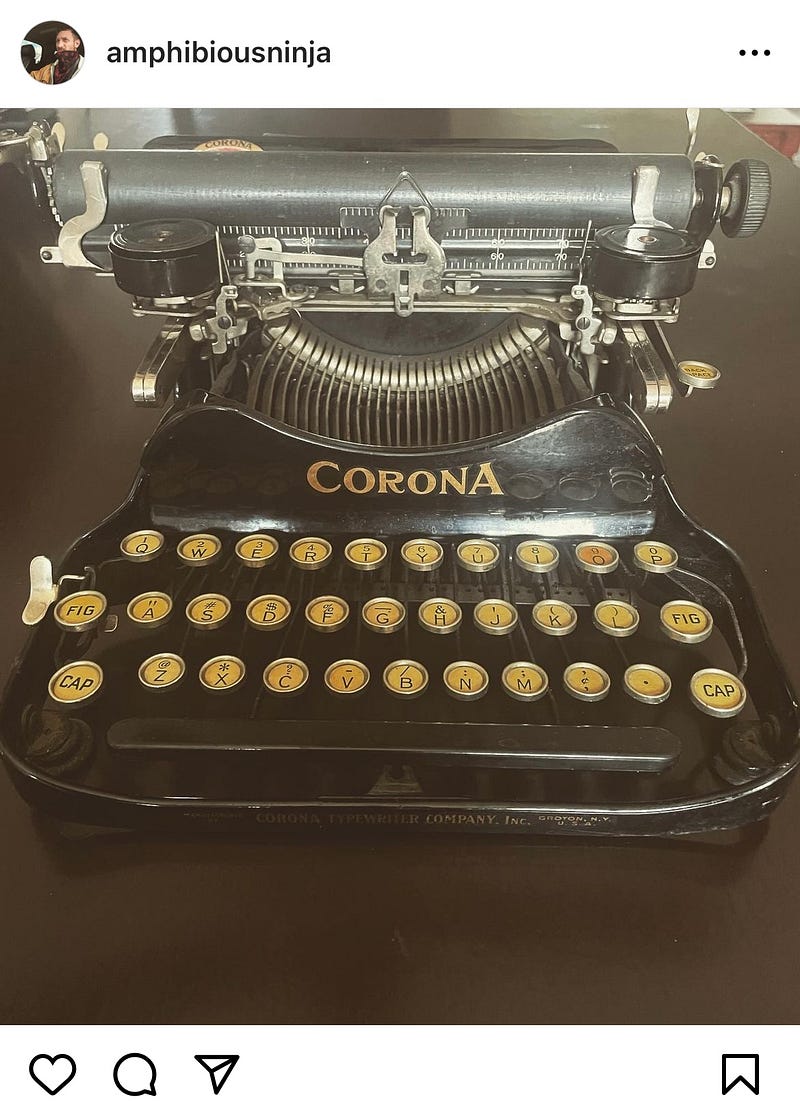
Before I go, I’ll give you an example of what I mean. Let me take you back to that typewriter I mentioned at the start, yes, there was a reason I referenced it. A Chekhov’s typewriter, if you will.
Every weapon should be given a name. Ask any Vet and they’ll tell you what I mean. To name something is to give it value, to assign worth to it beyond whatever lifeless title it bears as a mere description of its function.
A rifle is but a thing, a device. Calling it by its appropriate nomenclature does little more than tell us which iteration of design it is. But in the hands of a teenage Marine, it becomes “Roxy,” imbued with the essence of his hopes and dreams. All the things he holds precious and will only ever see again with her assistance.
So, I named my trusty old typewriter Millie, short for mitraillette, the French word for “machine gun.” Which is exactly what my entire house sounds like when my heavy-handed fingers meet the round steel keys and slam them into the platen with the force of a 50 cal fired in anger.
A symphony of violence, the rhythm of my thoughts taking shape on the page. I suppose it’s rather fitting then that Millie was built in 1917, as millions of young men charged towards inevitability in the fields of Verdun and the Somme. I’m reminded of this with every “clackety clack,” as I rattle away the remnants of memories made during my youth’s more adventurous moments.
Don’t ask me why, but I find it strangely soothing. If you have never had the pleasure of hearing it, or if the memory has been overwritten by the soulless sound of a computer keyboard, the clacking of typewriter keys is a beautiful noise.
There is not a writer of a certain age who does not feel this way. It is the sound of effort, of passion.