
Writers and Booze. What’s Up With That?
It’s both seductive and dangerous
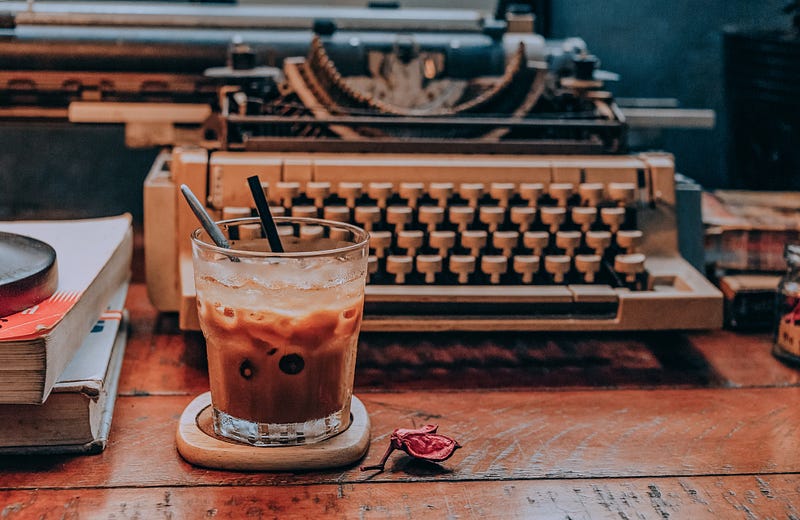
Note: I’m writing this early in the day, and the only buzz I have is java-induced.
The diminutive Truman Capote swilled generous helpings of double martinis while writing In Cold Blood. Raymond Chandler subsisted on gimlets and not much else while penning The Blue Dahlia. Carson McCullers was fueled by gallons of tea and sherry while producing the gut-wrenching The Heart Is A Lonely Hunter.
And the panoply of drunken literary giants marches on: Ernest Hemingway. F. Scott Fitzgerald. William Faulkner. Eugene O’Neil. Dorothy Parker. A list that also includes contemporary writers like Stephen King who famously and publicly battled his struggle with alcohol and addiction while writing The Dark Tower series, which, to his enormous credit, he completed, sober.
So, what is it about writers and the allure of alcohol? Do those of us who drink think we see, through our boozy haze, some sort of magical genie who shimmies out of the bottle of Jack, cracks a tiny whip, and intones: “Think great thoughts! Write! WRITE, you undeserving schlub!”
Is booze then — a sort of muse? In 1976, writer and literary critic, Alfred Kazin, wrote in Commentary, alcohol “has come to seem a natural accompaniment of the literary life, a symbol of the profession’s loneliness, creative aspirations, and frenzies.”
Kazin went on to state that “the drive for success of any kind,” coupled with “the hunger for prestige, fame, and money” is what led so many writers to drink — and drink excessively.
Thinking about Kazin’s words, I question my own goals…my wants, my desires. Do I hunger for success? Check. Fame, of a sort? Check. For validation that I’m good enough, smart enough, and worthy of recognition? Check, check, and check.
The flip side of that obsessive, yet somewhat optimistic coin, exposes a darker, more world-beaten visage. The poet-novelist Charles Bukowski, who was such a legendary drinker that two taverns were named for him (one in Boston, the other in Prague) once stated in an interview, “I have the feeling that drinking is a form of suicide where you’re allowed to return to life and begin all over the next day.”
I do drink. Not to excess, not anymore, but I have been known to, in the past. On too many occasions to count, I cringingly admit. Killer hangovers? Been there. Blackouts? Done that, thank you very much. Thinking about it now, troubles me, deeply, but if I’m going to speak my truth — there it is. I’ve behaved badly on many occasions and have had the most mortifying of “mornings after.” Payback, richly deserved.
One incident, in particular, haunts me: Years ago — many years ago — my husband and I were at a party in a far western suburb of Chicago. It was quite a haul from our place in the city.
As I mixed, mingled, and imbibed, something my husband said or did pissed me off. I know now, years later, that “the something” was actually nothing, as I was already pretty addled at the point of the imagined slight.
That particular night, as Charles Jackson wrote in his autobiographical The Lost Weekend, “One drink was too many and a hundred not enough.” So, I downed shot after shot of some nameless brown liquid, chased that with a big, fat joint, and puked and peed myself on the long drive home. TMI, maybe, but hopefully, my fellow drinkers will get it.
We were living on the third floor of a vintage apartment in Chicago at the time and my poor husband had to haul me up three flights of stairs while I was stretched out, face down, on my stomach. He literally pulled me up the steps by my arms as there was no way I could stand. As he yanked and tugged, I alternately retched and cried out for my mother.
I don’t know how many times I apologized in the coming days. Even though my husband never made me feel bad about what I had done. He saw how sick I was as a result of my idiotic behavior, both in body and in spirit. What can I say? The man is a saint. If that incident occurred today, we’d end up in matching body bags.
It should be noted that the day after the party as I cleaned vomit off the side of our car, I thought, “never again.”
“Right. I’ll never drink again.” The mantra of someone who has behaved like a complete asshole. As my body just can’t bounce back the way it used to, I’ve found that cutting back — way back — is a reasonable alternative to never touching another drop.
That said, as a writer chasing my dream, and unsure of my ability to attain it, I do still enjoy a little vodka or wine, as well as the occasional whiskey. I am an equal opportunity tippler, albeit a much wiser one.
On occasion and depending on my mood, a cocktail at the ready as I stare at my monitor loosens me up and fuels my creativity. Weed used to do that for me, and I still partake, but sometimes it makes me feel…a little wonky, a little scared, if you know what I mean.
Writers and booze. Yeah…there is something so seductive, so romantic associated with the notion of a celebrated author penning a best-seller while sipping The Macallan 1926.
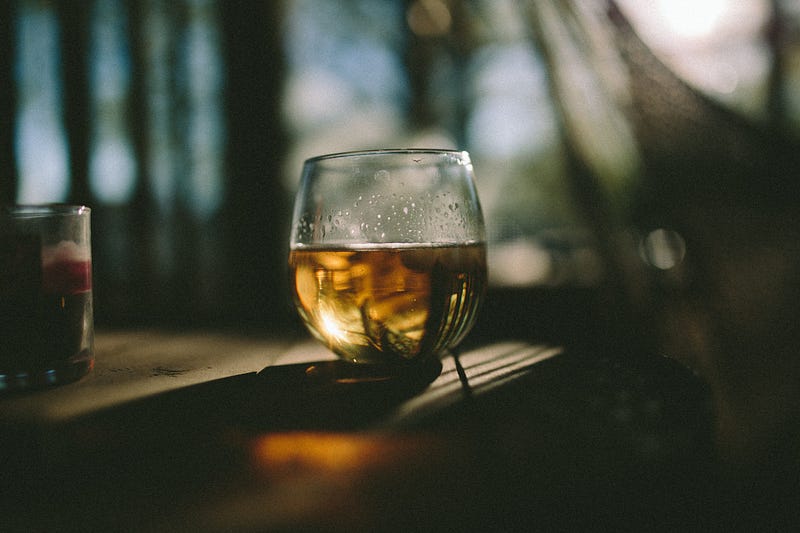
In my imaginings, whiskey, especially, is the perfect accompaniment to writing. A really fine whiskey. Oh, that gorgeous amber hue, like Tupelo honey (minus the greenish cast.) That smoky silkiness, with just the merest hint of a bite as it trickles down the throat. And that afterglow…like great sex, but without the mess and musk.
Whiskey is what I imagine Hemingway drinking while writing The Sun Also Rises. And he did, indeed, reference “whiskey and sodas” several times in his novels. Personally, I prefer to think of him taking it neat. Like a “manly man.”
“Sip, Mr. Hemingway. Write a memorable line. Sip. Write an even better one. Sip and sip some more…then pick up and load that double-barreled, 12-gauge shotgun with which you’ll ‘accidentally’ shoot yourself.”
And there goes the “romance.” In the stench and smoke and unthinkable loss left behind from one shotgun blast.
In spite of that nod to the dark side, this is not going to be one of those “I’m quitting the booze” tales, even though I have the deepest respect for those resilient and brave individuals who have achieved complete sobriety. The deepest respect.
Rather, I’d like to discuss whether alcohol, when used in moderation, can actually help us in our “frenzied” quest for literary greatness. Think about the writers mentioned earlier in this piece. How were they able to drink so much and still remain prolific? Are there actually positive aspects to being a writer who likes, as our Irish brethren so aptly put it, “the drink?”
Well, as it turns out, yes…and no. Just as a glass or two of wine helps us unwind after a day in the trenches, it can also help get the creative juices flowing, especially if you’re a writer who agonizes over every word. But the key here is ONE OR TWO glasses. Once you’ve finished the whole bottle, you’re done for the night. Put down your phone, stow your tablet or laptop, suck down a big glass of water with two aspirin, and just…go to bed.

In a 2012 Psychology Today article about alcohol and its effect on creativity, Sian Bielock, Ph.D. writes, “The answer has to do with alcohol’s effect on working memory: the brainpower that helps us keep what we want in mind and what we don’t want out. Research has shown that alcohol tends to reduce people’s ability to focus in on some things and ignore others, which also happens to benefit creative problem-solving.”
I’m confused because, to me, “not focusing on some things and ignoring others” seem like one and the same thing. If that’s the case, when drinking alcohol, we’re thinking about…nothing. So how can we write if we’re thinking about nothing?
Indeed, Bukowski, who was known for his two-fisted drinking as much as his literary achievements admitted, “It’s hard to write prose when you’re drinking because prose is too much work.”
At the end of the day, fellow writers, what’s important is what works for you. If a cocktail or two enhances your creativity, reduces stress, and helps you solve problems, then go for it: Responsibly, just like the stellar scribes you are.
For me, I think I just talked myself into cutting back even more. Because, just like dialing or texting drunk, writing under the influence could possibly bite me in the ass big time. And the last thing I want is to have a Ray Milland moment à la the movie version of “The Lost Weekend.” That bit with the bat and the cute little mouse freaks me out to this day.
Cheers.
Sherry McGuinn is a longtime Chicago-area writer and award-winning screenwriter. Her work has appeared in The Chicago Tribune, Chicago Sun-Times, and numerous other publications. Sherry’s manager is currently pitching her newest screenplay, a drama with dark, comedic overtones and inspired by a true story.


