
The Path To a Perfect Voice (what’s voice anyway)
Even the dumbest stories can be gripping if told with a strong voice

Have you read (or listened to) any Craig Alanson books?
Well, if you haven’t, let me tell a little about what, or more accurately, how he writes and attempt to make sense of why he is such a successful writer.
His most notable work is the Expeditionary Force, a series of 15+ books with a plot so dumb it’s only matched by its addictiveness.
I constantly refer to it as, ‘The one where hamsters invade Earth.’ I could tell you more about this fantastic series, but I won’t. I want to tell you why despite its abhorrently moronic plot, these books are New York Times Best Sellers.
And it has to do with voice.
What the hell is voice, anyway?
I’ll let best-selling author Craig Alanson explain,
‘What is this writer’s ‘Voice’ BS?’
‘‘Voice’ is a fancy pretentious way to say ‘style’. My style is heavy on dialog, without a lot of description. Also my style is sometimes considered to be sarcastic (I know, I couldn’t believe that either). When I first started writing, I tried to write like authors I admired, and I quickly told myself ‘Ugh, this is not working’. I was bored while writing a scene, so I figured the reader would be bored also. So, I started writing the kind of books I like to read, and that works for me.’
— Craig Alanson, excerpt from his website’s FAQ page
I highly recommend you check out Craig’s website.
So, voice is style.
Great, John. I’m glad we cleared that up.
What the hell is style, anyway?
Ah! Let’s see. Here’s my favourite quote of all time from a writer I read nothing to date, Gore Vidal.
Yes, I know you probably have heard of him before. He is, after all, a depository of endless quotes. But I want to focus on one quote in particular.
‘Style is knowing who you are, what you want to say and not giving a damn.’— Gore Vidal, American Author
So let’s break this down. If we leave it here, you’d probably think that in order to write better, you don’t need to do anything besides being yourself.
I’m sorry, but that isn’t enough.
You’re not off the hook
To understand style, you have to understand not only the basics of storytelling but also, like Vidal said, who you are.
If people knew who they were, therapists would all be working at Mcdonald’s.
I can’t help you figure out who you are. Not in this article, at least. So, let’s figure out who you are as a writer.
Well, first, you need to read a lot, and then you need to start by emulating other writers.
You can try to skip this emulating step, but here’s the bad news, you can’t.
You can certainly try, but you won’t be able to. Simply because you don’t know who you are until you crank out a lot of words and your style has settled. It’s a sort of literary catch-22.
Style is what you sound like. It’s your prose.
Read a lot and write a lot, yadda yadda yadda. There’s no way around it. There are a gazillion articles about it, and I may have even written some.
So what can you do to improve?
You first have to be aware of three unadmissible styles that usually plague new writers.
As new writers, there’s a big chance you’ll end up going through some weird phases. Don’t worry; it’s just like being a teenager again; you’ve been through it once, so you got it in the bag.
So let’s talk about these styles and how to get past them.
The Purple Monster
The purple monster (prose) strikes when you are at the early stage of the Dunning — Kruger graph:
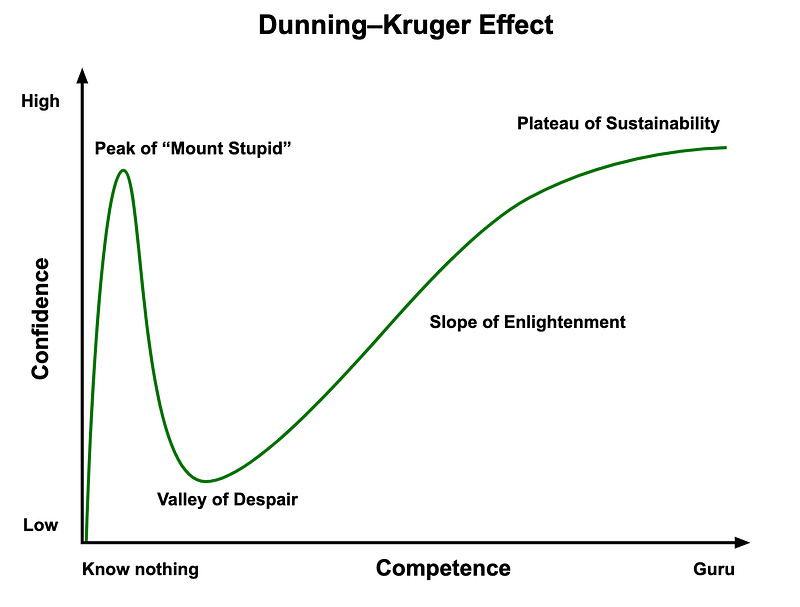
You are filled with confidence and thinking, How hard can writing be? I’ve been writing since first grade.
Well, turns out you are on a steep climb of Mount Stupid. Anything you write while on this part of the learning curve is rubbish, and I’ll leave you to deal with that on your own terms.
Symptoms of the Purple Prose disease,
Wait, I thought you said it was a monster?
Well, now it’s an illness; keep up.
Symptoms may include intensely flowery prose, overuse of adjectives, adverb rashes, temporary delusions of too-full-of-your-self, rant diarrhoea, mind-stream spillage, long sentence headaches, and not getting to fucking the point.
If your prose has any of these symptoms, well, you have been bitten by the purple monster.
The only way to defeat this monster, or cure this illness, is to be aware of it.
It’s that simple.
All you need to do is choose some unassuming targets (I chose my wife and friends), flash your work in their faces and ask for feedback. (My friends refused to read any more of my stuff for years, and they actively evaded talking about writing. It became a bit like talking about your parents having sex. Luckily, my wife hasn’t divorced me.)
It is best to find someone who bears no love for you. Writer’s groups are great for this sort of thing. If you can’t find one, use Scripbophile or any other such platform. Used this one for a while, then pissed off a lot of people, at some point even got banned, and then was reinstated again. It was a mess.
I found help with a publisher’s editor. And things went a little as expected. Yup, he kicked my butt so hard that I got knocked right off Mount Stupid and into the valley of despair.
It was a superbly fun experience which I never want to go through again.
Now that you have defeated the Purple Monster and are steadily climbing the slope of enlightenment, you are in for another treat.
The Abstract Abomination
For reasons I can’t describe (even though it happened to me, too), the writer afflicted by the abstract abomination will take unusual paths to describe the simplest things.
Here’s how I once described a road:
The continuous repetition of the white lines on the tarmac gave way to lesser roads.
See, I didn’t want to say road twice, so I came up with Vogon poetry.
Don’t do this. For the love of all that is sacred, please don’t do this. It’s embarrassing and even more embarrassing when you present it to other writers.
Here’s how to dodge this beast: use the pyramid of Abstraction.
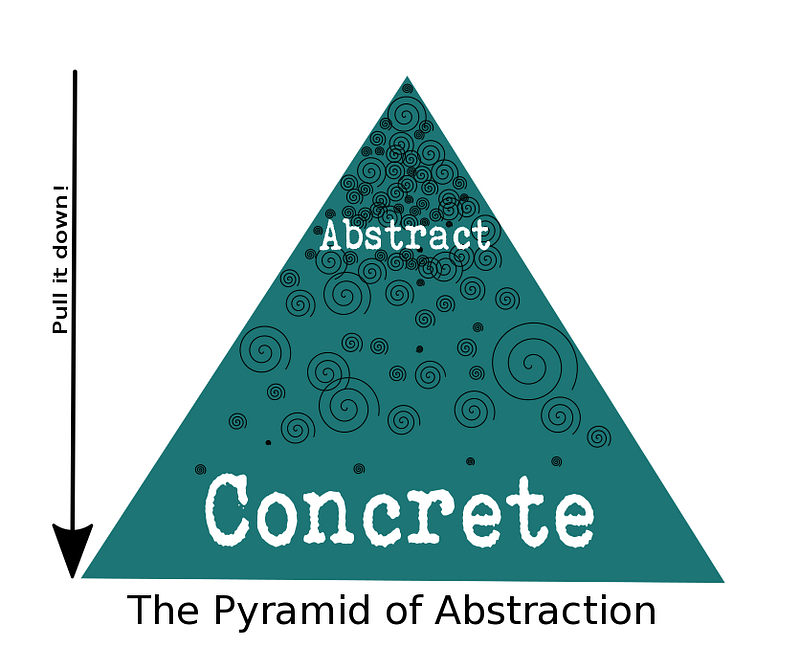
This works the following way: you think about what you want to say, and you select the right words to say it.
Your narrative needs to lay a concrete foundation about what it is and what is trying to say before you enter any abstract notions. I’ll explain.
Let’s use the word ‘road’.
Where do you think it lands on the pyramid?
Bottom?
Well, not exactly. It lands somewhere in the middle. The word ‘road’ is very abstract. If you say ‘dirt road,’ for example, it’s a little better. You get a better picture of what you are trying to say. But something like, ‘the dirt road was as smooth as the moon’s surface,’ would be way more concrete.
Take ‘highway,’ for example. That’s very concrete, and there’s very little you can add to it. So don’t.
Now let’s take a wild card and talk about pride.
Pride is incredibly abstract by its very nature. So how do you make it concrete?
You first need to lay foundations before you venture into the abstract zone. If you want to talk about pride, you first need to set the stage. You must establish the characters and the setting concretely before diving into what pride means in your story.
There are many different ways to be proud of something or someone. And you need to be sure you set enough concrete evidence before you say something like, ‘Untamed joy burst in his soul with the magnitude of a thousand suns.’
The Slippery Scarcity
Another common malpractice usually happens when the newbie writer decides to get serious about writing and starts studying. This is when they’ll come across a little, almost unassuming word called: scarcity.
When a writer first learns about scarcity, they usually slip and destroy all the progress they made going up the enlightenment slope.
This is when they’ll write a whole book and leave the good stuff for last, or even for the next instalment in the series, stuffing their narrative with filler in order to keep the reader ‘in suspense’.
This is also when the writer will usually feel an unrelenting impulse to start a story with an extended dream sequence.
Don’t get me wrong. There are examples of when it works. For instance, the new FX series, ‘The Bear’, a show with a 100% score on rotten tomatoes, starts with a brief (emphasis on brief) nightmare of the protagonist running from a bear.
Scarcity is very important, but you need to be smart about it. Too little and your book could be a pamphlet; too much and no one will ever bother to read it except, perhaps, your significant other, whom you coerced into your literary trap.
If you are writing a mystery novel, you can’t have just one mystery. You reveal the main mystery at the climax of your story, but you have to throw more into the mix from the beginning.
If you don’t start your stories with ‘the good stuff’, no one will read them.
Let me give you an example of how I started a story back in 2016:
The sand filled the spaces between his toes, which curled, digging themselves further into the fresh melancholic feelings of hope and nostalgia.
Man, I nearly fell asleep. There is so much wrong here I can’t be bothered to enumerate. And yes, it is part of a 1500work dream sequence. I wrote a whole novel from that point. 200K. Yup. I still have it. I refer to it every time I want to see how not to write something.
Here’s an example of how to properly start a story:
The water was so clear Jason could easily count all the bodies resting on the bottom.
Isn't this better? Don’t you want to know more about it? Feel free to use it as a writing prompt.
The bottom line is: If you take too long to give concrete information to your readers, you have lost them.
Please start your story with tangible, to-the-point scenes that will grip the reader’s attention.
The vague, the redundant and the stubborn
So we covered the three main monsters that lurk in writers’ inexperience. You’ll need to write through them to establish a strong voice.
You can, of course, avoid them now that you know about them. But since you are a writer, odds are you’ll disregard everything I said and plough through as you intended.
Don’t worry. You’ll come to your senses eventually.
And like many writers before us, you’ll see your work, on which you toiled endlessly, end up locked in a drawer somewhere or forgotten in a computer folder forever.
Bringing it home
Once you have written away from these scary monsters, I want you to say, ‘the hell with it,’ and write how you want to. (Within reason, of course.)
Here’s what we’ve accomplished: You gained an insight into how fluidity in writing works and that you can only achieve this by writing a lot, in different styles, and learning about the pitfalls you may encounter.
Don’t worry about what style it is. You can either choose one from an author you love, or you can do what I did and pick up the voice of whomever writer I happened to be reading at the time. Given time and effort, your voice will pop out.
I want you to consider the people you like to hang out with. Remember how each individual talks. What is it that differentiates them? Why are some more compelling than others? Are some complete opposites of one another? Are some too dramatic, and others more controlled and pragmatic? Are some stern and others funny?
There are no real boundaries to style, but you can’t brave the seas without knowing a little about sailing.
Could I have written this article more concisely and straight to the point? Sure I could. But I wouldn’t have had as much fun writing it. (Yeah, writers can be selfish pricks.)
Writing + Learning + Not giving a damn = Strong voice
Think about all the famous writers who love to disregard the rules.
If you read Stephen King, you were probably able to smell his ego through the pages.
Neil Gaiman says his favourite word is ‘fuck,’ but if you read any of his books, you know his favourite word is ‘and.’
J. K. Rowling has said several times you shouldn’t use adverbs, all the while littering her manuscripts with them.
Whaddayknow…
In the end, your voice will depend on who your influences are and who you are. That is it. Learn to avoid the above-mentioned monsters and let creativity fly.
Join me at Mute Cat Manolo, a free weekly newsletter with insights on how to improve your writing.