
Write to Be Read
6 common reasons why people stop reading and what to do about them
Why do you stop reading something?
- It’s unclear, and you can’t follow it.
- You lose interest in it.
- It’s too difficult to understand.
- It rambles and never makes its point.
- It looks too hard to read.
- There are mistakes and errors.
These reasons are the same ones our readers have for not reading our writing. It’s to our advantage as writers to be aware of them, know how to avoid them, and create articles that our readers want to read.
1. It’s Unclear
Clarity means that the document has a logical structure, it flows well, and the reader can easily follow our thoughts to the end. If your content has a logical integrity before you write, the actual writing process goes faster and less structural revision is needed.
Think of a piece of writing like a stream that the reader needs to cross using flat stones. Each stone is one piece of information that leads logically to the next piece and so on to the other side, where they understand what we have written. It makes sense.
Creating clarity is a challenge, especially if we are juggling a pile of research, interviews, notes, etc. The key is to use an orderly process.
The easy way to ensure clarity
You can use a Word document, an app, index cards, a mind map, or anything that lets you focus on one topic or idea at a time.
- Start with the subject of the article and list the subtopics that you need to cover.
- Take each subtopic and list the key points that you need to include to fully develop it.
- Eliminate any key points that aren’t necessary, combine some with others where it makes sense, and add any points that you believe are missing.
- Turn each key point into the topic sentence of a paragraph.
- Order the topic sentences into a logical sequence, like steppingstones across a stream.
- Expand each topic sentence into a paragraph comprising three to seven sentences.
- Build in transitions from one paragraph to the next and create subheads between subtopics.
When you are done, you have a clear, logical structure for the piece. You have each steppingstone needed to guide the reader to meaning.
“Clear thinking becomes clear writing; one can’t exist without the other.” — William Zinsser
2. The Reader Loses Interest
“Quality, relevant content can’t be spotted by an algorithm. You can’t subscribe to it. You need people — actual human beings — to create or curate it.” — Kristina Halvorson
A landmark study by the Nielson/Norman Group showed that 79% of study participants always scan when reading while only 16% read word by word. A more sobering study by sumo.com showed that only 20% of readers finished their articles, and the average reader only made it through 25% of an article’s content before stopping.
Q. How do we write for people who won’t read what we’ve written?
A. We eliminate anything that isn’t relevant to the reader.
What is relevance?
Relevance means that the information has value and the reader will gain something or avoid something by reading it. This is the benefit or payoff for giving you their time and attention. You focus on relevance by answering some questions before you write and while you are editing.
- Why should your reader care about this? Answer this question for every paragraph and every subtopic, to keep the reader reading.
- How can they use it to make their lives, work, relationships, and so on better? The more practical the benefit, the greater the motivation to read.
- Will it help them avoid something unpleasant, such as a tax audit, disease, job loss, and so on? Avoidance can be a stronger motivator than gain.
- What’s in it for them (WIIFM)? This is the payoff they get for reading.
If your reader isn’t going to read past the 25% mark, frontload the article by putting the most relevant messages first. This is the strongest motivating gain and/or pain.
Use an inverted pyramid style, where each successive message is less relevant than the preceding one. Even if people stop reading, they will have gotten the most important information.
3. It’s Too Hard to Understand

In addition to logically organizing a piece of writing and ensuring the content is relevant, we want the reader to comprehend our meaning. Some people will look up a few words they don’t understand. However, most people will stop reading if it becomes too challenging for them to understand the writing.
The solution is to use simple words and sentence structures. We don’t want it to be so simple that our work reads like a children’s primer. We also don’t want it to be so complex that our readers need a graduate degree to follow it. We want the sweet spot for a general reading audience, which falls between a sixth- and eighth-grade reading level.
Check readability the easy way
Tools like Grammarly and the Hemingway App give you readability statistics. You also can set your Word preferences to check for readability.
- Open a Word document.
- Go to File.
- Go to Options.
- Go to Proofing.
- Check “Show readability statistics.”
When you run spelling and grammar checks, you will get a pop-up with the readability score that shows the grade level of the document.
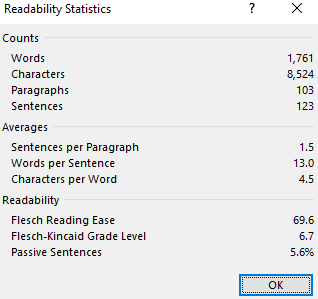
This article scored a 6.7-grade level. The number tells me I’m in the sweet spot for readability and have some wiggle room to use more complex sentences if I choose to.
If the grade level is too high, simplify complex sentence structures and use smaller, easier words where appropriate.
A good example of how this works is Harry Potter. The readability level of the books increases as Harry’s age increases. The early books are written at the seventh- to ninth-grade level. Later books increase readability, and the final books end up at eleventh grade and up.
“I notice that you use plain, simple language, short words, and brief sentences. That is the way to write English — it is the modern way and the best way. Stick to it; and don’t let the fluff and flowers and verbosity creep in.” — Mark Twain
4. It Rambles
“The most important lesson in the writing trade is that any manuscript is improved if you cut away the fat.” — Robert Heinlein
Just about everyone hates documents that ramble. How many times have you moaned, “Just get to the point!” when reading something.
The more concise our writing, the more precise it is, and the easier it reads. One of the best tools I have found to be more concise is removing 10% of the words.
Set your Word preferences to take a word count. When you run spelling and grammar checks, you’ll get a pop-up that shows the word count. Let’s say it’s 500 words. Your goal is to cut 10%, or 50 words. This forces you to look at every clause and phrase and identify what you can cut or replace.
In the example in the previous tip, the word count is 1,761. By cutting 175 words, the article is more concise and more precise.
5. It Looks Too Hard to Read
“Document formatting is one of the most important elements in readability for end users.” — connectsUsHR
How a document appears to the reader can make or break their desire to read it. Formatting is a key element in getting read our work read.
Write above the fold
What does this mean for us?
We need to write to be read when people aren’t at their computers. We need to write for the mobile reader.
Above the fold comes from newspapers, and it’s the area of the front page that you see when the paper is on a news rack. It’s prime real estate and where you find the most important information. On mobile devices, it’s the copy that appears on the display when a document is opened. This is our opportunity to grab the reader and give them a reason to keep reading.
Create white space
- Long, solid blocks of copy are intimidating. They look imposing and time-consuming. Short paragraphs, on the other hand, are attractive and look easier to read.
- Use wider margins. Long lines of text are challenging. Your eye tends to drift downward as you read. By closing up your margins, you create shorter lines, and the eye is less likely to slide.
Use subheads (this is a subhead)
Subheads are mini-headlines. They break up copy and make the piece appear easier to read. They:
- Have high readability, especially for people who scan
- Can signal the value of the content that follows and reinforce the WIIFM factor
- Help the reader know where they are in longer documents. For example, the main headline for this section is larger than the subheads. The reader automatically knows that they are in a subsection of a larger section. (This is highly important in documents like manuals.)
Grab their attention with lists
Just as with subheads, bulleted and numbered lists have high readability. People like them because they make the content seem easier to read.
There’s another important reason: They ensure that nothing will be missed. Most readers don’t remember what’s in the middle of a paragraph. If you want them to pay attention to all elements, break the points out into a list. This is extremely important when writing instructions since you don’t want readers to miss a step.
Publications often have unique style and formatting rules, especially when it comes to quotations, references, and hyperlinks. Always check a pub’s requirements before submitting a manuscript.
6. There Are Mistakes and Errors
“Fast is fine, but accuracy is everything.” — Xenophon
You ensure the accuracy of your document only after you are satisfied that it is clear, concise, relevant, and properly formatted. Now you’re ready to find and fix anything that needs correction. You are checking for and correcting:
- Formatting inconsistencies
- Grammar and punctuation mistakes
- Poor parallel construction, especially for bulleted lists
- Poor sentence structure that escaped the editing process
- The wrong words and the almost-right words
- Spelling that escaped the spell check
- All references and hyperlinks
- Phone numbers
- Anything else that could be wrong
Becoming a Better Writer
It doesn’t take a lot of effort to become a better writer, but the effort it does take is worth it. Never again worry that you will confuse your audience, write something you don’t mean, or turn away readers.
By paying attention to your writing and taking time to make it as good as possible, you will gain confidence as a writer. You can be proud of what you write, knowing it will enhance your professionalism, credibility, and your business/career.


