
Wrap Up the Year With a Personal Annual Review to Get the Most From the Upcoming One
A step-by-step guide to looking back at the past year, analyzing the lessons you learned, and setting goals for the new year

Doing personal annual reviews at the end of each year has brought forth some amazing changes for me:
- They help me understand my weaknesses.
- Annual reviews improve the way I perform self-reflection and embrace the growth I’ve seen in the year gone by.
- They clarify what I want and help me plan ways to turn my dreams into reality.
- They play an important role in setting realistic and achievable goals for the upcoming year.
In 2019, I learned a lot about myself in the annual review. The lessons were so life-changing that I decided to send out a newsletter with a list of review questions to the people subscribed to my email list. The responses I received were heartwarming. Some people said my questions helped them come to terms with some important aspects of life they had previously turned a blind eye to, while others thanked me because they were able to set better and more realistic goals for 2020.
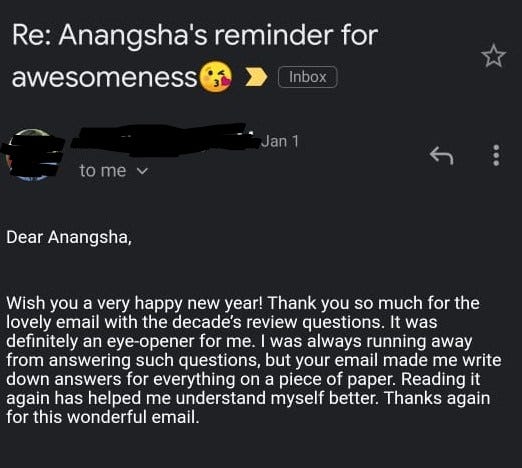
In this article, I’m going to lay out a step-by-step process of how to do your own annual review so you can make the most of all the positive changes that have happened to you in the current year. While I write out my reviews in my journal, it is possible to perform them on a computer or phone too. For those who prefer writing the reviews digitally, I’ve included a link to my Notion templates, where you can directly log in and start editing. I would also like to outline my review routines and discuss the results, in the hopes that this will be helpful for anyone looking to explore personal annual reviews as avenues for personal development.
Step One. Lay the Groundwork
Before I set about doing an annual review, I make sure I have the three important things listed below:
Pen and paper or computer/phone
I prefer writing out my annual review in my journal, but if 2020 has taught me anything, it’s this: The ability to improvise and adapt to changes can help us survive just about any disaster. That’s why I’ve started writing my daily reflections on my phone of late. This practice comes in especially handy on the days I can’t gather enough patience to sit with a notebook and paper.
Whichever option seems appealing to you, pick that one and stick to it.
A couple of hours of uninterrupted time
I take about four days to complete my annual review. I know some people from my email list perform theirs within a few hours on a single day. The time you take to answer all the questions depends on you. However, make sure that no matter how long you take, you have those hours to yourself.
Keep your phone on silent. If you live in a noisy place with several family members, you can either put some music on your headphones or take a stroll to a nearby park and do your review there. As this post in The Atlantic suggests, solitude can be a powerful tool for self-reflection.
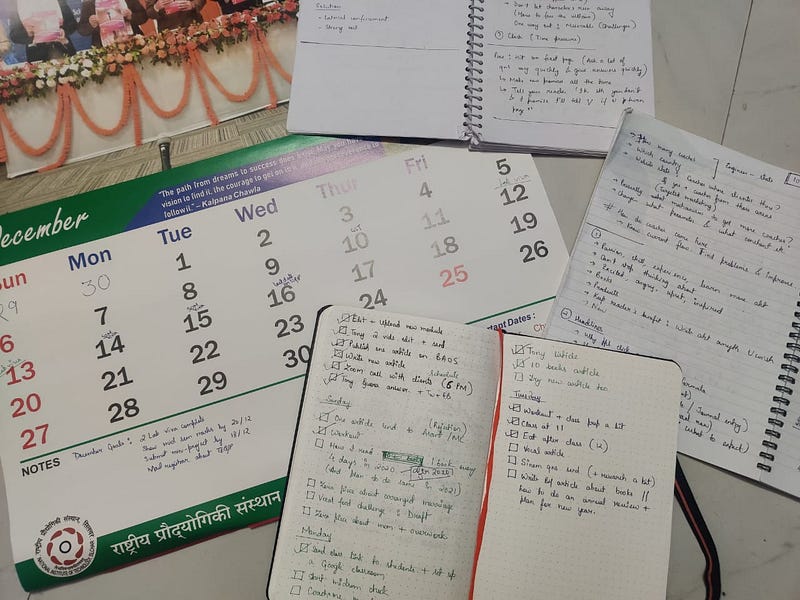
Journals, notes, diaries, and calendars of the previous year
Sure, it’s possible to perform the review based on your memory, but going through your notes of the previous year and all the saved data you have can be immensely valuable. This will make sure you don’t overlook some important event or life lesson. I usually take out every piece of recorded information I have before sitting down to write my review.
If you prefer performing your reflection digitally, keep your mobile or computer at hand. But make sure these are in flight mode so you don’t get distracted by the constantly pinging notifications.
An important point to note: Even if you haven’t maintained a journal before, you can use other records as part of your review. Just take a look at your phone’s picture gallery from the previous year — some mindful reflection can trigger enough memories to give you a solid idea of how you’ve changed.
When’s the best time to perform an annual review?
I usually perform my annual review in the last working week of the year. However, if you’ve already taken all major decisions and performed everything you’d planned to do this year, you can start your annual review earlier, too. The most important thing is to do the review after the significant changes of the year.
If something unexpected happens, you can of course look through your review notes and highlight anything that’s changed.
Step Two. Reflect on the Year Gone By
The first step towards performing a successful annual review is to take a look at all the lessons you learned in the previous year—reflection and self-examination. This lays the foundation for the next section, where you will plan for the upcoming year.
Start by being mindful of the present moment. You can take a few deep breaths and really focus on what you’re about to do next. You can also try journaling about how you’re feeling right now. This will help you get into the right mindset.
Next, start going through your notes from the current year. Look at the goals you’d made at the beginning of the year and flip through your journal pages to see how many of them you’ve accomplished, missed, or outperformed. Make note of your highlights and lowlights of the year. If you haven’t maintained a journal, you can replay a highlight reel of the year gone by from memory and try to fix on the moments that truly stand out. A look through your email history and your phone’s picture gallery can also help.
Then it’s time to address the questions that tackle your personal and professional growth. I’ve added the questions I use for myself as well as the members of my email family. You don’t need to answer them in order. You can even skip some questions if they don’t feel relevant to your goals. The important point is to really address questions about yourself that you might have otherwise refrained from introspecting over.
1. What are the three biggest hurdles you faced in the past year?
You can write about three hurdles in your professional life, the pursuit of passion, or relationships. I say biggest so you will only focus on the hurdles that broke you apart and made you feel as if it was impossible to go on.
I understand recounting the memories of some events might be traumatic or triggering for some. If that’s the case, then it’s best to seek help from a professional therapist. If you aren’t triggered, then consider this reminder of past failures as the first step towards moving on from them.
2. How did you find a way past each of these three obstacles?
No matter how hard the obstacles might have seemed at the moment, you obviously dealt with them. You wouldn’t be here today if you didn’t. To answer this question, I always think of the ways my life improved after facing those hurdles.
Sometimes this makes me realize that I hadn’t actively done anything to solve the problem. Instead, I merely waited for the issue to resolve itself. While this definitely isn’t the healthiest way to move forward, it worked for me at that time. It also gave me clarity about what remains to be done and how I can go about it. At other times, it makes me marvel at my strength and resilience, at how I managed to move past something that threatened to tear my world apart.
“Sometimes it is good to be in uncomfortable situations because it is in finding our way out of such difficulties that we learn valuable lessons.” ― Idowu Koyenikan
3. Do you see a recurring thread tying up all three in the question above? Keeping that in mind, what are the top three qualities in yourself you are proud of?
This is my favorite question because it really shines a light on my strengths. Usually, when I move mindlessly through life, I tend to focus too much on my shortcomings and never give myself enough credit for all that I accomplished. The answers to this question are like a pat on the back and a reminder that no matter how hard I’ve fallen, I’ve also managed to pull myself back together.
This question is designed to make you reflect on your strongest qualities and understand how they helped you reach where you are today. For example, was it your courage that helped? Or maybe your perseverance?
4. How did these obstacles change you as a person? Or what is the biggest lesson you learned from them?
This is another reflective question. When I feel I’ve no clue how to answer this, looking through the pages of my journal helps. I can usually see a significant shift in tone before and after these obstacles. This helps me gauge how much of an impact these issues must have had on me.
You can do the same. Reflect on how your mood has changed after these obstacles and how they have changed you as a person. You can also try and introspect on the biggest lesson you learned from this problem. This will be valuable in tackling the third step of the annual review exercise.
5. What are the top three happiest memories of the year gone by?
Of course, a review is not just about focusing on the hardships you faced or the lessons you learned. This question helps me look back on the unexpected gifts I received in the past year and count my blessings.
You can write about anything good that happened in your job or side hustle, or even in your interpersonal relationships.
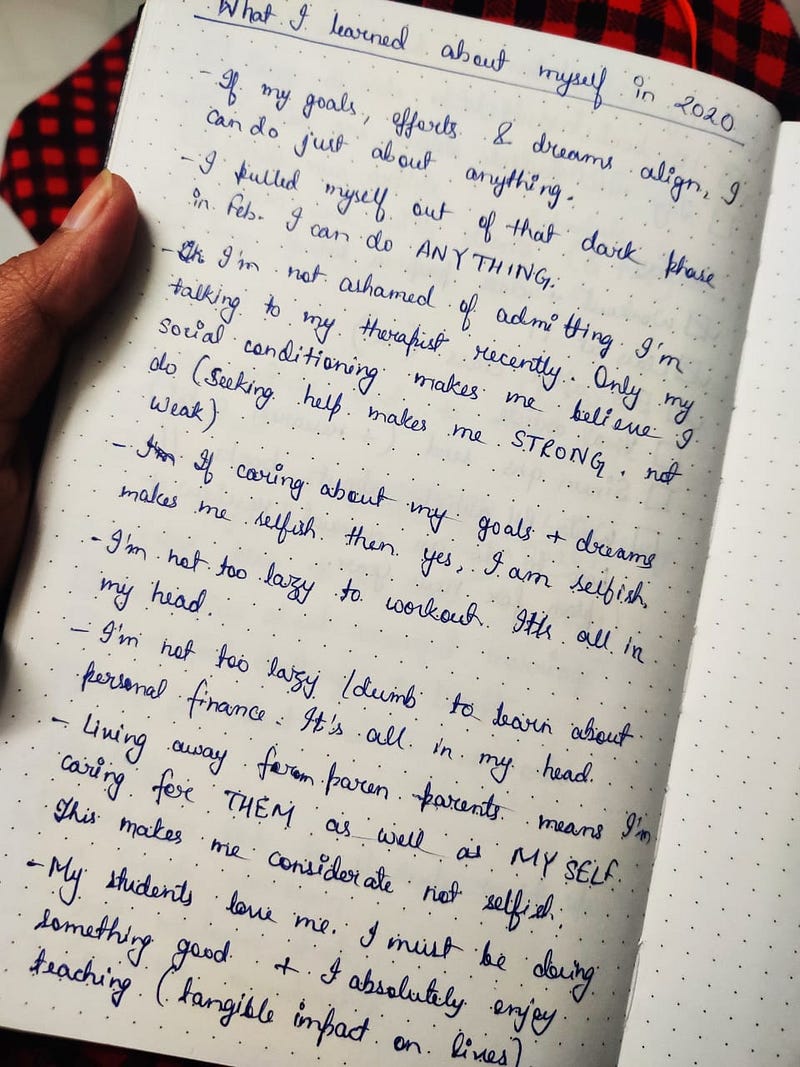
6. What’s the one thing you learned about yourself in this past year?
This is probably the hardest question in this review. What makes it even harder is sticking to just one thing I’ve learned about myself. No wonder I find myself writing down several lessons I learned. If you find yourself doing the same, it’s OK. The annual review is meant to be an exercise in self-reflection. You can’t let rules bind you.
If you have trouble coming up with multiple lessons, sticking to just one is fine — as long as it’s the biggest revelation you’ve had about yourself this year. The answers to the previous five questions should help you come to this realization easily.
7. When was the last time you tried something out of your comfort zone? How did that change you as a person?
This question is meant to focus on your growth. I love trying things out of my comfort zone, but when daily life gets too familiar, it’s not easy to push myself to try something different. However, this year I started making videos for my YouTube channel and Instagram. That was something totally new and unexpected for me.
While answering this question, take into account the small things, too. Maybe you attempted a recipe using ingredients you were terrified of using before. Or you held a puppy in your arms for the first time. Include as many new experiences here as you can find, and notice how each of these has enriched your life.
8. What’s the biggest change in yourself you see this year compared to the previous year?
The answer to this question might overlap with question 6, but this is meant to make you look back and see how far you’ve come.
I usually base my answer to this question on all the other seven I’ve written so far. This really helps me put things into perspective and reflect on my growth. Reading through my annual review of the previous year also plays a significant role in answering this question.
Step Three. Carry Forward the Lessons to the Next Year
The previous section was like a review of the year gone by. It helps me ask some important questions and learn some pertinent truths about how I’ve evolved as a person. Once that is done, I take a break and read through the answers — an exercise that really helps me appreciate the wonders of the bygone year.
The next section is about carrying these lessons forward and making the most of the upcoming year. The following questionnaire might be hard. I implore you to spend some time thinking about each question before you answer it.
1. Have you figured out what you want to do for the rest of your life?
Yes, this is a difficult question, but it helps me reflect on whether I’m in a place where I want to be for the rest of my life. It forces me to introspect on my life’s purpose and be mindful of it.
It’s not an easy question, but trust me, your subconscious knows the answer. Feel free to write the question on a fresh page of your journal and write everything that comes to your head. You’re the only person who can answer this accurately. Sure, it might change later, but for now, this answer can be the driving force for the rest of your foreseeable future.
“He who knows the ‘why’ for his existence will be able to bear almost any ‘how’.” — Viktor Frankl
2. What are the top three skills you learned in the past year that will help you in your chosen path?
This answer really puts things in perspective about how far along I am on the way towards achieving my dreams and what else needs to be done. It’s a revelation as well as an incredibly grounding experience.
Like I mentioned before, even if you’re not aware of how you want to spend your life, at some level, your heart knows where it wants to be. It is probably seeking some form of alignment of efforts, goals, and dreams. Even if you feel you haven’t figured out what you want to do yet, relax. Instead, write down the top three most useful skills you picked up over the past year. Then analyze how they can push you forward and in which direction. Also, is that a direction you’ll find fulfillment in?
3. If you keep going at your current pace, how long will it take to reach your goal (if you have one)?
This is my favorite question in this section because it helps me look at my goals and skills in terms of the time it would take me to achieve more. It’s the first step towards laying out plans for the next year.
This question is supposed to be another grounding experience. Think objectively and write your answer in terms of the years, months, or weeks you think it will take you to be where you want to be.
4. How willing are you to try something out of your comfort zone?
My first instinct to this question is to always answer with a resounding YES. However, it should be based on the response to question 7 in the previous section. Anything less than that would be colored by my biases and wouldn’t be fair to the question.
You should also carefully consider all your previous responses before tackling this question. While there’s nothing inherently right or wrong about not being willing to move out of your comfort zone, it’s believed that as your comfort zone expands, you’ll see new opportunities previously obscured by barriers of your own making.
“Real change is difficult at the beginning, but gorgeous at the end. Change begins the moment you get the courage and step outside your comfort zone; change begins at the end of your comfort zone.” ― Roy T. Bennett
5. Are you in control of your life or are you being controlled by someone else?
I take the longest answering this question because of how deep I have to look into myself so that I can write my response without lying or letting it get colored by my biases.
It’s not possible to be completely in control of your life as, no matter how meticulously you plan it, there’ll always be circumstances and situations that are out of your hands. You can never determine how other people will perceive your success, but you can do everything that’s in your power to make sure you succeed. Here are a few questions to help you ponder more on this topic:
- Are you doing your 100% to make sure you reach where you want to be?
- Have you bitten off more than you can chew and are regretting your choices?
- Are there some tasks you can drop and/or outsource?
- Are you blindly trudging on through life, or do you wake up each day with the motivation to create or work on your projects?
- Is your life fueled by curiosity and excitement, or does fear rule your thoughts?
The way you write the answers to these questions will help you understand who is directing the course of your life: you or your circumstances.
For those who prefer performing reviews in digital form, you can find a link to my Notion template here. You can either edit the template directly or convert it to a printable sheet and take it with you when you start performing your annual review.
Step Four. Set Goals and Habits
The previous two sections make this a lot easier because hindsight helps me understand where my priorities lie. Mapping answers from the two sections and laying them out in the form of goals and plans takes some time and effort, but it gives me an actionable road map for the year ahead. Here’s how I go about it:
- I chart year-long goals, where I make a list of everything I hope to achieve before the year’s done.
- I make a list of daily habits I plan to perform each day of the year.
These aren’t well-planned-out with month-wise outlines. I just write a basic outline and wing it as I go. My answer to the first question in the second section was that I want to be a full-time writer. That’s why most of my goals are directed towards achieving that purpose.
Here’s a look at the goals and habits I had set for myself at the beginning of 2020. I managed to stick to my daily habits and accomplished all the goals except the ones about travel blogging and solo trips.
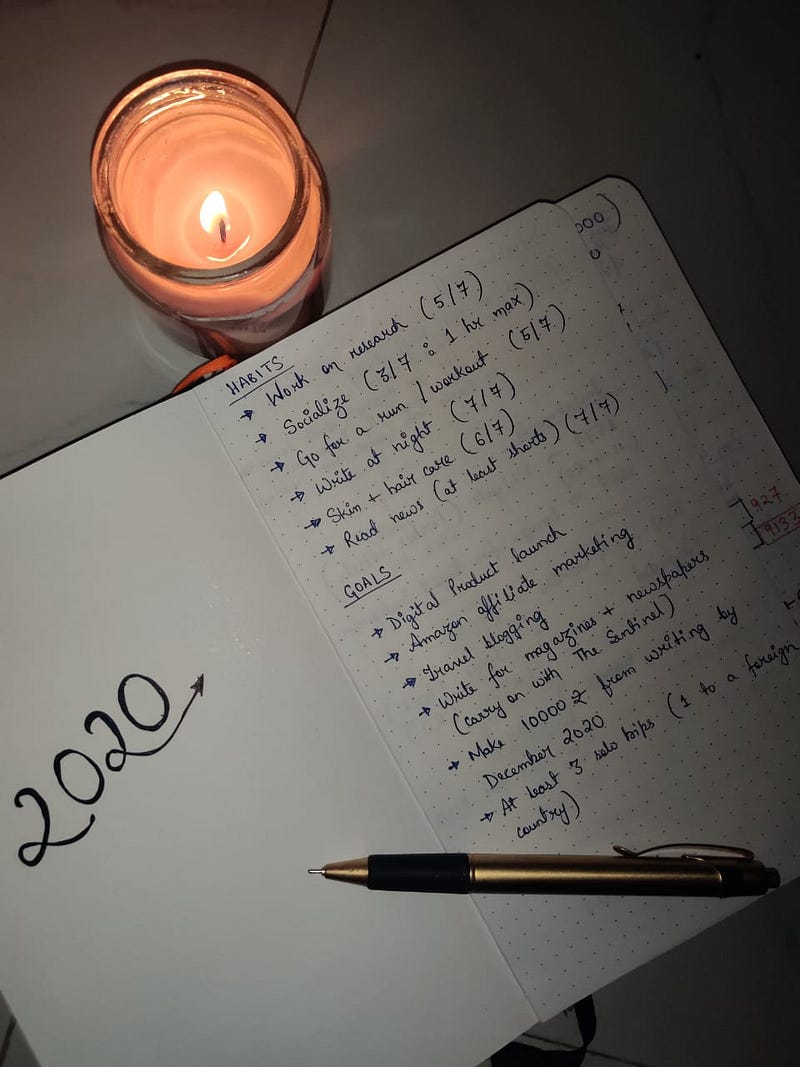
Before setting goals, take a break and read through all you’ve written so far. Answers to questions 3, 4, 6, and 8 in the first section and questions 1, 2, and 3 in the second section are meant to help in goal setting for the upcoming year. You can also set daily habits about tasks you intend to perform every single day of the year. Write these on the first page of your new journal, or print them out and stick them on a wall you can see every day.
Wrapping Up
Personal annual reviews have helped me look at the year gone by without bias and truly analyze all the highlights and lowlights of the year. They have helped me understand my strengths and weaknesses and given me a better perspective of how I can go about making things more fruitful in the upcoming year. Although I don’t obsessively make goals for the new year, the annual reviews have given me clarity about what I expect from myself and the ones around me.
Summing up, here are the four steps to performing a personal annual review to wrap up the current year and usher in the new one with hope and positivity:
- Go to a distraction-free environment and become mindful of the present by doing a few breathing exercises or reflective journaling.
- Then take out all your journals, notebooks, and calendars from the previous year and go through them to focus on the defining moments. Ask yourself questions that help you reflect on the year gone by and how it changed you as a person.
- Analyze what you expect from the upcoming year and answer a few questions that help you understand that.
- With the help of your answers, set a few goals you hope to achieve by the next year’s end. Also, make a list of daily habits you intend to perform every day of the year.
If you think this exercise is terrifying, that’s actually a good sign. The more scared you are, the better suited you’ll be to embrace the change in yourself.
If your answers to the review questions made you feel disheartened, please don’t blame yourself. This guilt is a sign that you’re willing to change. Celebrate that, and don’t let anything else dim your flame. The next year is a brand new opportunity filled with uncountable possibilities. It’s up to you to make the most of them.
Trust me, with a proper annual review and accurate goal setting, you can make the upcoming year YOUR year.


