
Wow and Whatever
And Why I’m Not Scared of AI
One of the women below is the mother to my children. The other three… AI-created portraits. I’ll tell you which one is real at the end.
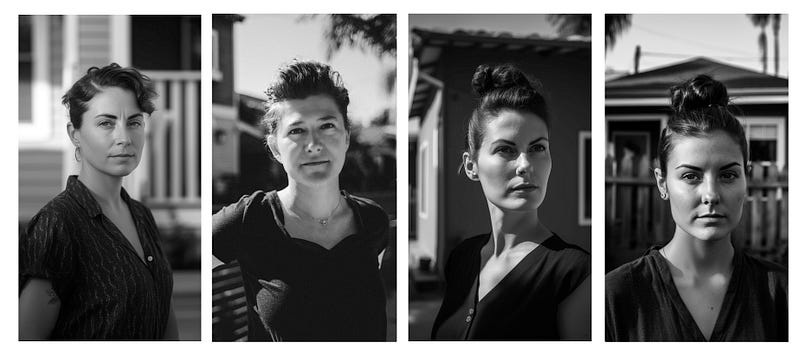
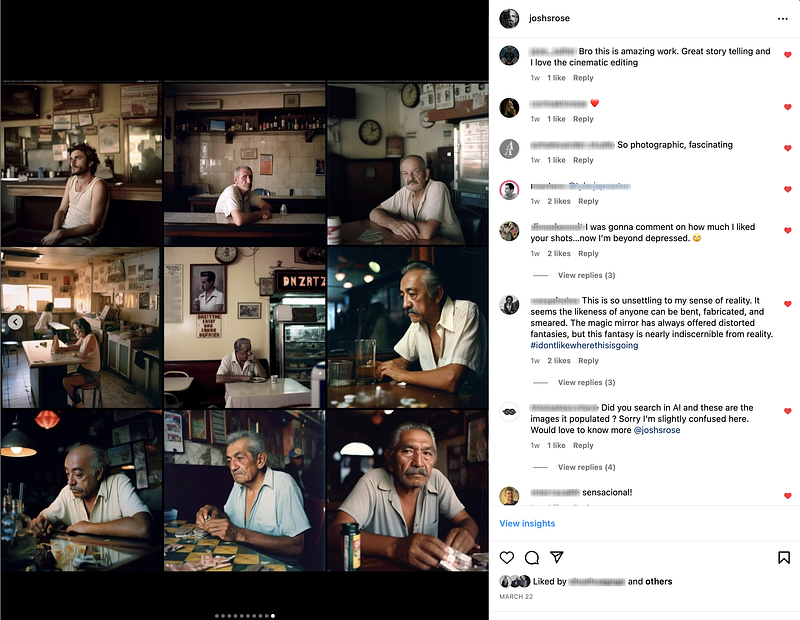
AI has been raising emotions lately on Instagram. My last few posts have used AI-created images and the response has been all over the place. There’s everything from anger to awe seeping through in the comments. One person was up-in-arms enough to comment no less than 12 times across other people’s comments. Yet another was inspired to sign up and start experimenting with MidJourney herself. The descriptors themselves are a rainbow of feelings: unsettling, amazing, fascinating, depressing, sensational, frightening, scary, sad, yikes, awesome, crazy, mind-blowing…
I get it, even if I don’t necessarily feel it.
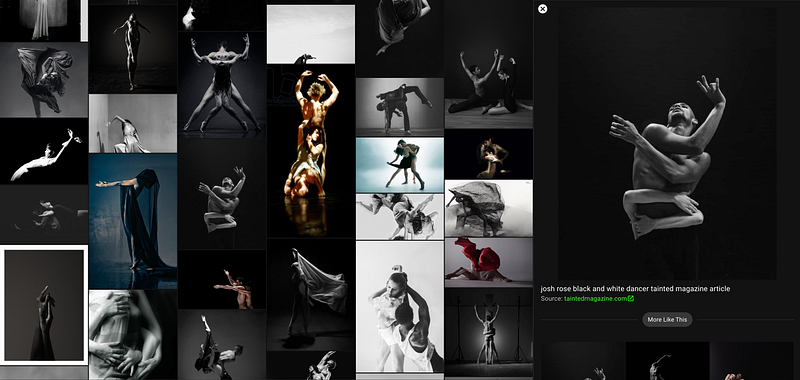
Theoretically, I have as much to lose from AI-driven imagery as anyone. As a long-time photographer whose imagery has been all over the Internet, AI was built, partly, off my hard work. And to what end if not to put my services out of business? I did a light search and quickly found an image of mine that is in the database of images that AI pulls from to create.
I’ll skip the legal and moral issues of AI for now, though I know for many it’s an impossible gap to step over. I’ve read as many articles and opinions as anyone else and I’m well-versed in the issues. But I’m just a photographer — not a lawyer or tech futurist. I have a deep sense that the issues surrounding AI will get ironed out by people far more versed in copyright law than I. Meanwhile, I don’t believe I need to sit on the sidelines while people smarter than me duke it out over right, wrong and the demise of humanity.
What I’m qualified at is tackling the quality and role of imagery as a creator. This is my area of expertise. So, for the purposes of this deep dive, I’m only looking at the quality of AI and musing on the affect it might have on our craft and our business, as creators.
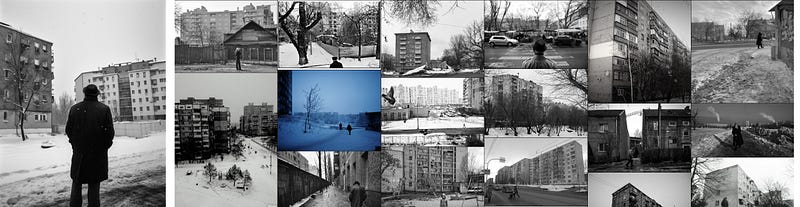
There are ways to look at the images that AI is pulling from, simply by putting an image into a search over at HaveIBeenTrained.com. This is how I found that my own photography has been used to train AI, but also how I’ve been able to take an AI-created image and see what imagery was used to create it. The results are, well, photographic. And that’s really the moment we’ve been waiting for, isn’t it. A world where we can recreate a photographic-looking image without taking a photo at all. We live in that world now.
Pausing for a moment to let that sink in.
I should feel unsettled, I know. I just don’t.
Between Wow and Whatever
I’ve spent months now working in AI and creating imagery. Most of it never goes anywhere. The process is often the same— I have an idea in my head, I go create it (which is not as easy as one might think), I get impressed by it, I save it and then… I almost never share it. Days later I look at it again and I’m simply not that impressed by it anymore. It slips into the stream of imagery I’ve made over my lifetime: drawings, designs, illustrations, photographs. Some enormous library of visuals that are nice enough, but for which only a very tiny percentage really withstand the test of time.
And this echoes my experience watching images stream through within the AI communities at large. Some constant vacillation between “wow” and “whatever.”
What happens between Wow and Whatever? How do we become so quickly inured to impressive things? This, to me, is where the discussion gets interesting. And where the true understanding of where photography is going lies.
Our Slow/Fast Evolution
Have you ever watched a film from the 60’s or 70’s that moved purposefully slow? Take a look, for example, at this 5-minute love scene from the film Play Misty For Me that came out in 1971.
In Clint Eastwood’s directorial debut, he takes a time out in a psychological thriller to slow everything down for a love stroll through Big Sur. The shots are long, the pace slow as time itself and Roberta Flack’s famous song, First Time Ever I Saw Your Face, plays out. In. Its. Entirety. I, like many, have this scene burned into my psyche for all eternity. It’s a seminal film sequence that, for anyone who was alive at the time, came to define larger notions of romance and the beauty of nature. But it’s slowwwwww.
Slow creates indelibleness.
Filmmaking changed after this. From the 80’s forward, everything became about quick cuts, cross cuts and fast-paced editing.
How does this relate to where we are with AI?
Because it’s a short walk from the fast-paced cuts of MTV videos to the constant scroll of social media and YouTube, where we glean only small drips of impressiveness and move on to the next one, ad infinitum. The scrolling is the entertainment. The entertainment… its entire job is to last 20 seconds and disappear.
A 5-minute stroll just doesn’t play with today’s algorithm.
AI is the end result of all of this. Because the entire role of imagery in our lives has changed. In the 1980’s, National Geographic Magazine boasted a readership of around 16 million. Like others, I would sit with the magazine and stare for long periods of time at beautiful spreads of worldly things. Today National Geographic’s readership is under 3 million. For no other reason than we now have more and more access, more and more imagery… and less and less attention. To the point where the beauty and impressiveness of a single image has no value anymore.
The ease of creating imagery was born of having less reverence for it.
Consider the Instagram photographer who has circumvented the years of training that most professional photographers before them had to go through — posting photo after photo of their travels, their friends, models, street photography, food, everything, in an attempt to draw attention and pave their own path to photography success. All this with a blind eye toward the idea that these constant look-how-amazing-I-am images were headed off into the Internet unknowns, for free. What was the transaction if not personal success over the value and protection of those images? Of photography itself? AI wasn’t developed on the backs of artists, but on the backs of would-be commercial artists.
In the world of commercialization, there is always a price.
AI is the price we paid for social media.
Photography is Dead. Long Live Photography.
New eras are brought about by death and renewal. From kingdoms to family-run businesses, the hallmark of life is that old ways die and new ways are born.
If you’re good with a camera, it’s time to look at how photography moves on from the death of whatever it was before. I’ll tell you my approach:
I’ve become ever more interested in family, behind-the-scenes, dance and event photography. And ever less interested in landscape, street, model and drone photography. Photography rooted in self-absorption — i.e. the transaction of beauty — is now a commodity. The goings on of real, everyday undertakings and the unpredictable human choreographies are the stuff of life for me.
Of the four images at the head of this article, the second one is my life partner. The real difference between that image and all the others is that it’s the only image that makes me feel anything.


