
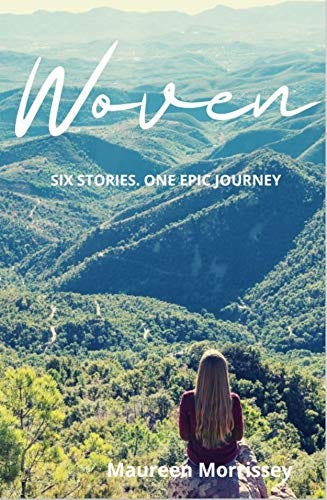
Woven: Six Stories, One Epic Journey
Excerpt 1
Glen’s Story
Padraig stood, filthy felt hat in his bony hand, about halfway back in the line from the door. The line moved a few meters, and he took unsteady steps, almost falling over his little brother who was crouched in front of him, with his head on his knees.
“C’mon, will ya, the line is moving,” he said, but his voice was weak and Darragh did not hear him.
Padraig stepped around him and heard him scrabbling behind. There were hundreds of people in the queue, but the only noise to be heard was the low sound of listlessly shuffling feet. The humid air was rank with the odor of unwashed infectious, diseased bodies and rotting teeth, but no one paid it any mind. It was all they could do to hold on to the tin plates or small woven baskets as they waited.
The afternoon sun beat relentlessly on their heads. Just ahead of them, an elderly woman wobbled, leaned heavily on the stone building and slid to the ground, her small tin making a muted thump as it hit the dirt and rolled a meter away. The others trudged around her emaciated and dirty bare legs without a glance. A tiny girl fetched the tin and got back in line without a word.
When the boys finally stepped inside the dim low rectory building, the overpowering reek of corn stew almost made them retch. The nuns in their black habits with large metal crosses hanging on their chests, stood in a row behind black iron pots. As the line moved through, they placed a steaming scoop of mush in each of the proffered pans, intoning, “God bless you.”
The boys walked outside, carefully carrying the laden tins to the rocks by the river. Darragh scooped up a small handful in his grimy fist, shoved it into his mouth and swallowed. As soon as the first gulp was down, he did it again, and then again. The first solid food to hit his stomach in days came back up and out onto the ground.
“Slow down, Da,” Padraig told him. “Do it like me,” and he took a pinch between shaky fingers, chewed it a few times and swallowed. Then he waited to make sure it stayed down and took another pinch.
As soon as his tin was empty, the smaller boy put his face in the water to get a drink, but his brother poked him in the shoulder.
“Wait a minute for the grub to settle, Darragh,” and, as always, he listened to Padraig.
The warm food in their bellies gave their mood a little lift. The setting sun stretched shadows over them, a relief from the heat of the day, and they took off their dilapidated hobnail boots to splash filthy toes in the water. They even played for a while, throwing rocks into the river.
The boys had been wandering Galway for days. The narrow cobblestone streets were filled with stinking garbage, rotting dog carcasses and hundreds of hungry people all searching for food.
Padraig and Darragh had left home after their father died, bent over and crying, by the last rotting potato plants on his plot of land. His heart and spirit had broken after loading a second son onto the death cart in just under nine months. After a year of fighting the blight that killed his potato crop and was slowly but steadily killing his family, Eamon Ó Cealláchain, the large man with the largest laugh in the county, had lost the battle of wills. Darragh, eight years old, had found him there.
“Go fetch your Pa, Darragh,” his mother had said, looking down at the baby in her arms with worry lines creasing her forehead. “The wee one is not getting enough to eat. She can barely open her eyes. He will have to go back into town straightaway and see what he can find. You and Paddy go with him. Check the church and maybe the docks at the harbor. There has to be something.”
Her lips were desiccated and cracked as she added wretchedly, “We can’t lose another one.”
She sent him off without looking up.
It had taken the little boy a while, but finally he spotted his father far out in the field and moved toward him as fast as his underfed legs could go. Now he stood staring at his father’s unruly dark curls matted around the large head. The gaunt face was blackened with dirt and streaked with his last tears. His shirt was unbuttoned to the waist and ripped at both sleeves.
Darragh remained still for a moment, staring at his father’s unflinching gaze, waiting for him to move; wanting him to jump up, grab the boy and throw him in the air and let out a loud guffaw like he always had, before.
“Pa?” he said, just once.
He waited another moment and when the man did not respond, the boy went to find his brother Padraig. It took some time, but he finally found Paddy dozing in the shade of their broken-down wagon and nudged him awake with his foot.
“Somethin’s wrong with our da’, Paddy. You better come see.”
They walked back to the field where their father lay in the blazing haze of hottest noon, kicking up dust and dirt with their ragged shoes. Standing together over the motionless body, they stared at him for a moment. Padraig, older than Darragh by less than two years, was not much taller than him; but he radiated an assured confidence that came with being the oldest in the family.
“What do you think, is he dead, Paddy?”
Padraig crouched down, looked into the open unresponsive eyes, shooed away a pair of black flies, and shook his father’s arm gently. When there was no reaction, he touched his father’s hand. In the sweltering heat of the day, the skin he held was stiff, papery, cool.
“Dead, Darragh,” he said, standing up.
Padraig hitched his pants over his bony hips and turned to his little brother. Darragh looked down at the ground, tears streaking his grimy thin face. The older brother felt his own eyes begin to fill, but he blinked rapidly to fight it before his brother could notice.
“First the little boys, and now Pa. And Mam says the baby is not getting enough to eat. What will happen to all of us? What are we gonna do now, Paddy?” the smaller boy sniffled, wiping his eyes with his ragged shirt.
“We better start by telling Mam,” Padraig replied, and put his arm over his brother’s shoulders as they walked to the shack.
They found her sitting on the floor with the top of her tattered dress down around her waist, struggling to nurse the infant she was holding to her flabby, empty breast. Two small girls lay on threadbare potato sacks on the bare ground, eyes closed. They looked to the boys like they were sleeping, but it was hard to really tell.
The two remaining sons of the family stood in the open doorway of the crumbling shanty for a moment, taking it in. The furnishings, as poor as they had been, had been sold long ago; and the empty room was dark, humid, close. The boys often slept outside at night, despite the ravaging mosquitos that plagued them; at least they had an occasional breeze to keep them cooler. The large black iron kettle still held water from the pump and a few corn stalks that had been boiled to a pulp days ago. It was all they had had to eat in so long, their stomachs ached constantly with emptiness. Their mother gently wept as she crooned to the thin babe she held; an infant girl whose soft bleating was almost too faint to hear.
“Mam,” Darragh said.
She did not look up, did not seem to have heard. She had been so kind, attentive, warm and fun in the time before. Their evenings had been full of music, dancing and laughter, Pa playing fiddle as the aroma of stew wafted through the small and poor but happy home. Even as the crop began to fail, their stores of grain were enough to carry them for a long while. Worry had crept in gradually, but Eamon and Cara had been able to keep up a charade of happiness for a while beyond that.
When hunger moved in, like an ill-disposed guest, the laughter had given way to querulous children clamoring for something to eat; and then, too quickly, to starvation and death. Eamon and Cara’s souls became withered and beaten down. At night, Padraig and Darragh heard the sounds of quiet whispers of comfort between them, and that made it seem like all might still be okay.
The birth of their newest sister, on the floor of the shack with their mother’s screams echoing off the walls and out through the open door, had come nine months before. Padraig took all of the others on a walk to hunt for a gift to welcome the new babe; wildflowers or pretty rocks or even a discarded piece of leather strap that could be braided into a bracelet. Padraig carried his slingshot in case they spotted a pheasant, grouse or ptarmigan. He was a good shot, and had often brought home some game for the cooking pot; but the birds had been decimated by the starving families and it was rare to find one these days.
Now they stood in the doorway waiting to tell their mother more bad news, very bad news, the worst news.
“Mam,” Darragh tried again, tears sliding down his cheeks and neck.
When she still did not look up, the boys went to her, one on each side, and lay their heads on her bony bare shoulders. She leaned her head to the left and then to the right, gently touching their matted red hair with her own, now streaked with premature gray.
“Me big boys,” she said, her voice low and weak. They wanted to stay there forever.
And then, “Darragh, did you find your Pa?”
Padraig turned to look into the haggard face, trying to find the young fresh one hiding just beneath. It was gone; and in his ten-year-old mind, he knew this news would bury it forever.
“Mam, we found him in the field. He was…”
He did not need to finish the sentence. Her eyes squinched shut, the crow’s feet deepening to trenches; her mouth opened a bit wider and her shoulders shook. She cried almost silently, no tears wetting her slack cheeks. Both of the boys cried with her.
When she was able to contain the grief, gradually boxing it in with the already overwhelming hopelessness and fear, she let herself look up at the small children lying still on thin potato sacks, at the baby lying still in her arms, at her oldest sons, thin in the extreme but somehow still full of life.
“Paddy. Darragh.”
She forced herself to say words no mother should have to utter to her children.
“I want you to go. Leave here and go to town. If you stay here, you will die, like…” she paused, searching for strength to continue. “Like your little brothers, and like your dad. You are old enough and strong enough still to find food and shelter there. If you stay here much longer, you might not be.”
Padraig, head down as he listened, whispered, “What about you, Mam? What about the baby and these other two? We can’t leave you here. I’m the man of the house now, I have to take care of you.”
“I’m still the mother, Paddy, my love. I will get the girls to the poorhouse; at least there we will have shelter. The British and their king might suddenly decide to help fix this mess they made. Her tone turned bitter for a brief moment as she spat out the curse. Go dtuitfeadh an tigh;” May your house fall upon you.
“The poorhouse will be the first to get any help from them, and so we will go and take our chances there. At least then we would have a coffin to be buried in, instead of a paupers’ pit.”
At this both boys began to cry again, shoulders shaking with their sobs.
“This hell that we are in cannot go on forever, boys. You are the ones who will carry this family forward now. That is what a man of the house does, Paddy.”
She put the baby down and gathered the boys in her gaunt, skeletal arms and hugged them with the last of her strength. The boys clung to her until she pushed them away.
Padraig and Darragh stood then and walked to the open doorway. For the last time, they turned and took in the sight of their mother and what was left of their family. Eyes blinded by tears; they waited for her to change her mind. When she did not look up again, they left the hut without another word.
They began walking the six kilometers into the city. In better days, they had often ridden with their Pa in the horse and cart to market and knew the way well. On the side of the road, they passed barren potato fields, dilapidated shacks resembling their own, and abandoned wooden carts, one still attached to the bloated and rotting carcass of a mule. A few other people were shambling in the same direction, carrying cloth sacks of belongings over their shoulders. A family, father and mother and four children, asked them for food or money as they walked by.
It took them most of the day to reach the outskirts of Galway, and they immediately began their search for something to eat.
The day they arrived in the city, they found an ear of corn with the kernels already eaten and chewed on it as best they could.
That afternoon, they passed a darkened storefront with a broken plate glass window, and went inside. Padraig spotted a cubby tucked back high over their heads. He crouched down so that Darragh could stand on his shoulders. As weak as he was, he struggled to hold his brother’s legs long enough for him to reach inside. They were rewarded with a quarter bag of oatmeal which they mixed with water from a pump on the street and drank down.
They had lucked out two days ago with a small loaf of black bread they found behind some rubbish bins. Darragh had watched Padraig scrape off the blue mold and very carefully split the loaf in exactly half to share.
Nights, they dozed in alleys or along the banks of the river, keeping watch for roving thieves, kidnappers, murderers. Padraig kept his slingshot tucked into a ragged pocket in his pants, along with some small but sharp stones; ready if needed.
They had wandered past the poorhouse; shadowy, sinister and bleak. Living skeletons squatted outside, shivering in spite of the blazing sun, half naked, slack-jawed with sunken black eyes. They all looked ancient, even the smallest and youngest of them; like the characters from a book about deepest Hades their mother used to read to them late at night by the eerie glow of the warm fire.
The delicious sensations of delighted fear they had felt then echoed hollowly in the face of this real-life hell; where their mother was hoping to find aid.
They looked away and continued their quest to survive.
***To be continued…Excerpt 2 will be published on Friday***
Thank you for reading this excerpt of my novel, Woven: Six Stories, One Epic Journey! Find the book in paperback at any bookstore, and in paperback or kindle here: https://www.amazon.com/Woven-SIX-STORIES-EPIC-JOURNEY-ebook/dp/B08NCPHYZY
Synopsis: When the world as you know it is rent into shreds, you either survive or you die. When your friends, your neighbors, members of your own family starve to death in front of your young eyes, only a steel drive to live will rescue you. If your government turns on you, killing everyone in your community, only foresight and the guts to listen to it will help you. When widespread poverty and lack of hope destroy the fabric of reality, only fortune can save you.
When you survive any or all of these traumatic events, you live to create the next generation. Cam and Tessa are the next generation.
Raised by Holocaust survivors and refugees in New York City in the 1970’s, Tessa battles not only her own demons but those her family faced. She takes nothing for granted and relies only on herself as she navigates a dangerous and dark period of time in the city. Cam needs to escape the Midwestern upbringing that began with his mother’s journey from somewhere in Eastern Europe to an orphanage in Iowa and with his great grandfather’s early life in Ireland; and ends with his father’s spiraling and destructive behavior. Directionless and lost, Cam takes a risk to find his way.
At a chance meeting, they discover that they are kindred spirits; and against the push from both sides, they clasp hands and decide to face whatever may come together.
Woven dives deeply into events you learned about in history class and makes them personal. Written as a series of novellas, this book weaves the lives of four very different families into one story, showing that out of overwhelming adversity can come strength, hope, and a future no one predicted.


