
Would You Write A Memoir?
Considerations abound.
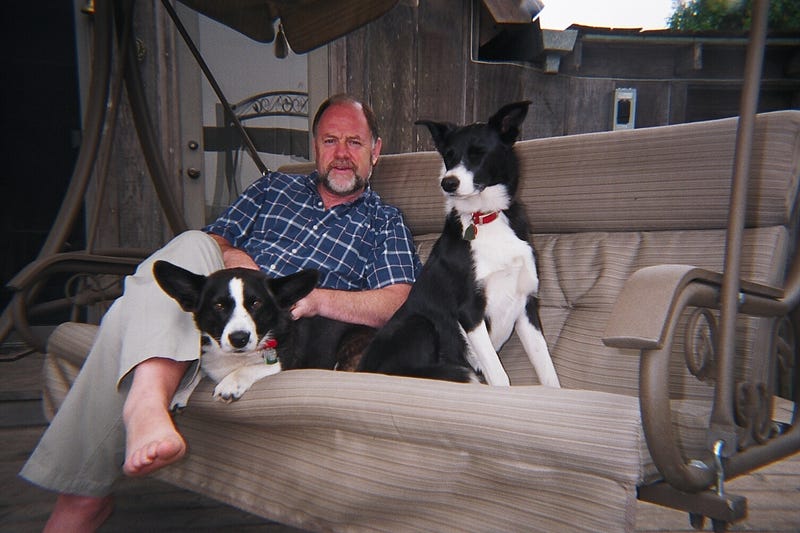
I am considering writing a memoir, the period between birth and my fiftieth birthday. That said, I worry about the fortunes of my grandchildren. I cannot write my early life’s saga and leave out the whole intolerable truth; it’s violence, savagery, beauty, and immensity. It’s love, deception, romance, and despair. It is a story uniquely disturbing, as it is interesting. A life fallen short of once ambitious goals.
My grandchildren, two boys, were born within three months of each other; the eldest, now a year old, is incredibly beautiful and, of course, innocent of everything. They will grow into their early years loving me.
My intention, during this time, is to spoil the heck out of them both. However, it is possible that if longevity favors me, I will be around in their teen years and into my eighties. A time when they will be susceptible to rumor, opinion, and lies about their grandfather. They will have questions.
Over the last seventy-three years, people have learned a different side to my nature, or perhaps they knew my real personality, and in old age, I’m showing another side.
Then, well, there’s my adult son, who suffered through the torment of being raised by a father out of control, hell-bent on causing trouble. Today I’m forgiven and loved. Does he need to relive the whole thing again through a memoir? The broken body at the breakfast table, the scars, the death of his mother and younger brother, the activist, the black priest, a man taken under the wings of music promotion, a world of slammed doors, when songs rewrote themselves, transvestites’, drugs, scooters, and Dusty Springfield.
Every story begins with a first sentence, and of course, this is true whether we are writing a novel or reading one. However, a writer can start a story in many places and, whether consciously or not, come upon the beginning nearer to the end.
Life doesn’t begin with a sentence, nor end with one. It starts with a first breath and ends with a last. Everything between those two extremes lies a story waiting to be told. It is wrong to write a memoir using ideas. Nor can a memoir cover every day of the writer’s life. However, using all the craft’s elements, it can be a memoir that will entertain and capture the reader’s interest.
Writing a memoir will relieve me of creating a protagonist. That said, I cannot help but turn my creative observations toward people who have contributed, influenced, and attempted to kill me on more than one occasion. The first occasion being that of my birth. From that day, they are all, somehow, poured into the mix. As a result, every character is more accurate than I want them to be.
So, as to the question should I write a memoir? My answer is one of genuine concern. Whether it will free me from a lifetime of demons, or release them from where they lurk. Consciously or unconsciously, that’s a fear I alone can face. Some of these demons aren’t characters, but each is as real and tangible as spit blood.
I wasn’t born to a literary ambition or the many choices such an undertaking presents. It would have been wrong, as fantastically wrong as anything could be.
I was encouraged to abandon my first real ambition by my father, that of becoming a deep-sea fisherman. Trawling for fish was his profession, and I wanted to be like him. Being adopted, I didn’t have his genes, and it was he who told me to think higher than the surface of the ocean. There was nothing for me if I couldn’t be like my father. There’s your first clue on my life falling far short of ambitious goals.
There were many good years, ones I’ll be happy to write down. The meeting of the mother of my two boys. Then the sadness of losing her and my youngest child when she was forty-four.
We fell in love immediately and began a passionate affair that lasted until her death. Sure, there were many turbulent quarrels and crises, but the passion in our relationship overcame everything. Should any man but I write about our relationship, I can only imagine the distortions, the quoting of angry letters, the times apart, her disappointments, mine, because only we correctly understood the sensitivity between us. I loved her completely and never once wavered in my feelings. Up to the point of losing her, my memoir is as easy to write now as it was to love her then.
After the first romance was gone, bitterness ensued. I entered into several prisons, went through a court-martial, was confined to cells in Norway, Japan, and Ukraine, assaulted a transvestite, to my bitter shame. I killed people I never met, and put all those hesitations, silences, shifts, inside songs. None of which were challenging to write.
A memoir will be.
The most uncomfortable, the one imprisonment impossible to escape from, was the prison into which only one person ever entered; that person was me.
To some extent, the attitudes and ideas revealed in such a memoir must be checked and rechecked. I can overdramatize events because I grew up hearing father recite passages from Shakespeare. Mother and father were used to expressing themselves theatrically. When they were apart, it came naturally to mother to write letters, which she would read to him upon his return. In a dark but visible universe, under a light that never fell on land or ocean, father crossed his own haunted and desolate seas, the solitary passenger of spectral ships. I remember he wrote there were horns blowing underwater. It was common for him to note that he had voyaged enough.
When I returned home from my sojourning, I was again able to enjoy time with them. On my leaving the military service, my father wrote me many declarations of love.
I’m in doubt whether the story will hold to its violence or the many times the angel of death sang close by. During the Falkland War, I was that angel. Words don’t bury people. Death doesn’t bury people. Instead, life’s venom, the destruction of wishes, fears, and lost feelings of warmth, bury people.
It’s hard to remember and write about Cambodia in the late eighties, why I was there, and not supporting my son. Such a memoir will be full of poor judgment, standing in wrong places, chapters full of tribal conflict between the man I was and the man I’ve become.
Perhaps it will be the tyranny of tying it all to what an artist might say about his own life, to give it the weight of the real, switch off the creative imagination, so that headlines and text matter. If someone responds and says, I suffered those losses, too, then they are the serious ones, the people that matter.
I can live happily mistrusted by the world, if my grandchildren know the truth.