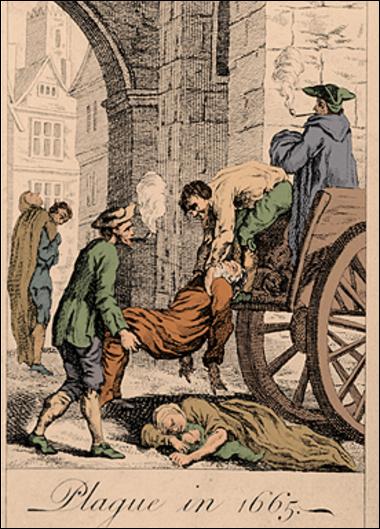
Would You Have Survived The Black Death?
A hypothetical scenario based on fact.

It began with a look of horror on the faces of dock workers. A line of sailors on the ship across from them was covered in sores. They were gaunt. Many of them were coughing.
The port manager ordered the workers back. He came forward and argued with the fleet captain. Word had long arrived that a disease was ravaging Asia. These ships weren’t welcome here.
The fleet left but it was too late. Several dock workers were already infected.
Thus began the Black Death, a cataclysmic pandemic, caused by the bubonic plague. The infection brought a kind of unchecked ferocity that hasn’t been replicated since.
By the end of it, 75 to 200 million would die, including ~50% of Europe’s population.¹ More than 200 years would pass before the world population replenished.
It was, quite possibly, the deadliest event in human history.
But could you have survived it?
The Hypothetical Scenario
Let’s say your time machine broke. You are suddenly stranded in Europe in late 1346. It’s the absolute worst time to arrive. It will make COVID-19 look like a cakewalk.
The disease is diffusing through Europe via trade routes from various directions. It is hitting fast and hard.
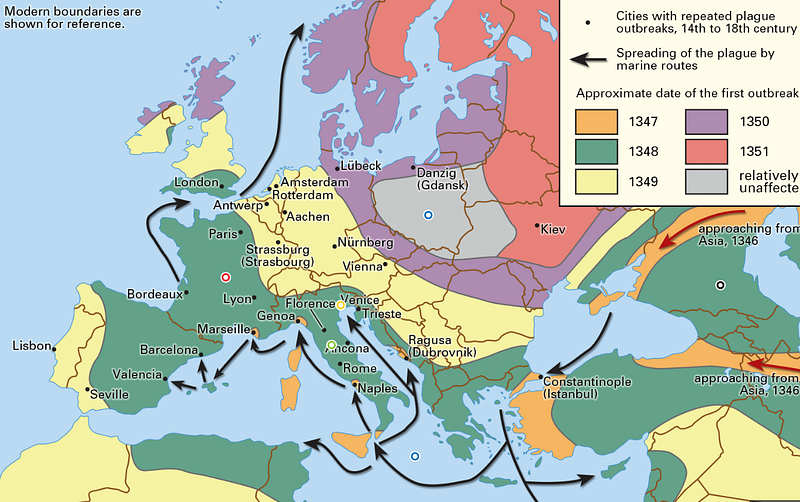
Survival would be very difficult. Let’s see if we can get you through this.
Signs of sickness (what to avoid)
As you travel across Europe, be wary of swelling in your neck. That’s often the beginning of the end.
Swelling leads to fever and sores. Fever and sores leads to an early grave.
Symptoms start three to five days after exposure. Death is usually another three to five days after symptoms arrive. If infected, survival will be, more or less, a coin toss.
The name “black death” comes from the blackened sores that develop in the end stage of this disease.
The key challenge. These are different times. There isn’t refrigeration and instant clean water. You can’t just wall yourself off for quarantine. You also won’t be able to just wander off to survive in the woods (Unless you are Bear Gillis).
Here’s what you should do.
Decide your location based on your risk appetite
Survival will largely be shaped by where you go. You’ll need to balance several competing concerns.
If you suck at survival and need food and shelter, go to larger cities in Europe. The caveat: it will be a full coin toss for your life, give or take 10%.
That mortality rate is certainly terrifying. But it beats starving to death. You are hundreds of years removed from food stamps and charitable meals.
Know what cities to avoid
Mediterranean port cities are death traps. The disease travels via fleas on rats.
Port rats are masters in survival. They can swim to shore, live in sewers, and linger free from first world luxuries like pest control. Combine this with the fact that a rat can have seven litters of a dozen rats per year? And you have the definition of infestation.
When those rats die, their fleas scatter and look for new hosts. This is why so many seaside towns were eviscerated. But, contrary to what most think, the Black Plague eventually traveled via people. Rats were merely the spark to the fire.
If you’d prefer to just die, go stay in Florence. They’re a bit like my hometown here in Florida. People are throwing parties, attending festivals, hanging out, doing whatever.
Consequently, and seemingly overnight, it will become one of the deadliest places in all of Europe. More than 80% of the population will die within a few years.³
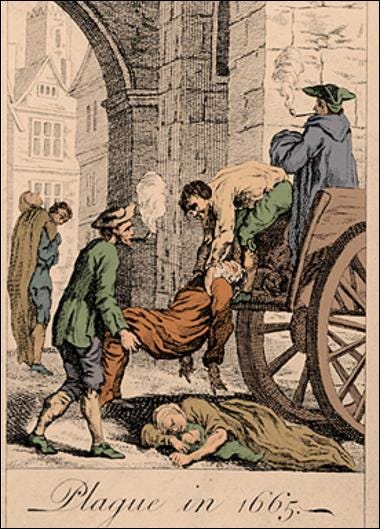
Few places will be more horrifying than Florence at the peak of this pandemic. The streets and roads will be filled with bodies they’ll unable to remove. I’ll spare you the remaining details.
Cities to go to
Milan is a great option — but still risky. Their dictator has taken drastic measures to squash the disease. He will wall entire families into their homes if even one of them shows signs of infection.
If you don’t get buried alive, you’ll have a good shot. The mortality rates in Milan are among the lowest at 15%.⁴ (You know things are bad when you should be excited about a 15% death rate.)
London is above average, with more sophisticated development. They’ll “only” lose 25% of their population. However, like many other cities, the entire medical community has fled (but that is likely a good thing, as I’ll soon explain).
Venice is a decent bet, but not at first. Their first wave will hit hard. Then, they’ll institute forty-day holds on incoming ships and people.
This practice is referred to as quarantino. It comes from quaranta, which is Italian for forty. This is where the word quarantine originates.
Look for strict, locked-down, landlocked towns. Many cities in Italy will have martial law, allowing only known locals within their walls. You might have to beg to come inside. Once inside, find a host family and offer to help with their business, in exchange for food and shelter. Show them your iPhone to impress them.
If it were me?
I’d find a self-sufficient town that’s far removed from big populous cities. A remote town in the countryside of Germany is a great choice.

Many of then will go completely unscathed.
Saunter on over and chum it up with the locals. Maybe try to fall in love with a German handmaiden (or stable boy, er stable man).
Don’t assume this is perfect protection though. Some of these towns will be deleted, and you could be the cause if you aren't careful.
The ultimate red flag? Fields full of dead animals. The disease kills them too. And those bugs will need a new host.
If you are a great survivalist, the ultimate escape will be the north. The bubonic plague often dies down during winter. Fleas don’t like the cold, be it on humans or rats. Pack a coat and go as north as you can.
One minor complication, warm clothes will be hard to come by. There’s a massive wool shortage because all the sheep died of infection. I told you this wouldn’t be easy.
A final checklist of things to avoid
Some of you will die because you think you’re awesome at survival. You’ll end up getting too cold, too hungry, and other stuff will kill you.
Malnutrition and exhaustion will solidify your death sentence if you are infected. Even people with optimum health had double-digit percentage death rates.
Avoid doctors. Medicine is a completely bastardized version of what it is now. They’re literally making stuff up as they go. They are about as capable as they look.
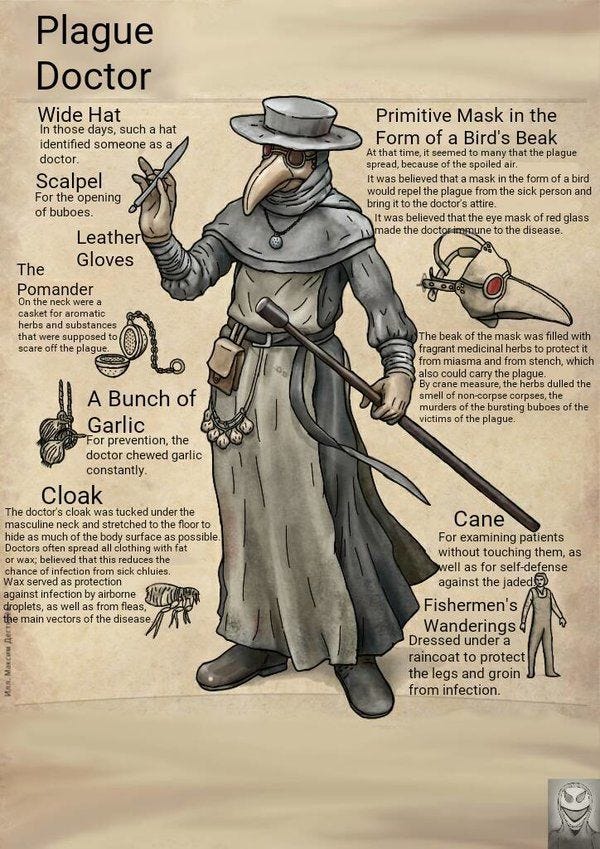
They’ll resort to bloodletting and lancing sores. Sanitation is terrible. So you’ll end up with a bunch of other complications.
Some doctors will even make you sick on purpose (with pills and herbs) thinking that a good fever will cleanse you. (Spoiler alert: it will do the opposite.) So if a doctor comes near you, just tell him, “I’m good for now”.
Comparable suicide missions will include political rallies, parades, church, synagogue, and any form of religious gatherings. If you see Christians whipping themselves bloody, get the hell off the scene. All of these events were shockingly common despite the epidemic.
If you own a time machine, I’d generally advise against using it. But if you are so compelled, definitely avoid 1340s and 1350s Europe. The bubonic plague was unstoppable. The suffering was unprecedented. It was perceived as an apocalypse: people literally thought the world was ending. It wasn’t without merit. Just imagine a disease sweeping through society while having a 50% mortality rate.
Today, we are surely in troubled times. But we should still be grateful for modern medicine: the Black Death could have been stopped with a mere round of antibiotics.
Things are bad. But they could be far more terrible. As soon as I fix this time machine, I’ll prove it to you.
Sources
1. George Gould. 1896. Historic Epidemics — Anomalies and Curiosities of Medicine.
2. Boydell. 2004. The Black Death, 1346–1353. The Complete History
3. Michael Clouse. 2002. The Black Death Transformed: Disease and Culture in Early Renaissance Europe. Samuel K Cohn Jr. London
4. Geoffrey Marks. 1971. The Medieval Plague; the Black Death of the Middle Ages.