
EXOTIC FOODS
Would You Eat a Cheese Loaded With Live Maggots?
It’s a Sardinian delicacy that many claim is delicious
Two dear friends are hopping a plane this week for a two-week trip to Barcelona. Then, over to Sardinia, they’ll explore the Bronze Age ruins and archaeology, and enjoy the majestic scenery and local cuisine.
Both are foodies, and have taken cooking classes while in France and have toured a variety of European wineries on previous trips.
Although generally experimental in sampling what diners have to offer, there is one temptation both travelers have vowed to eschew.
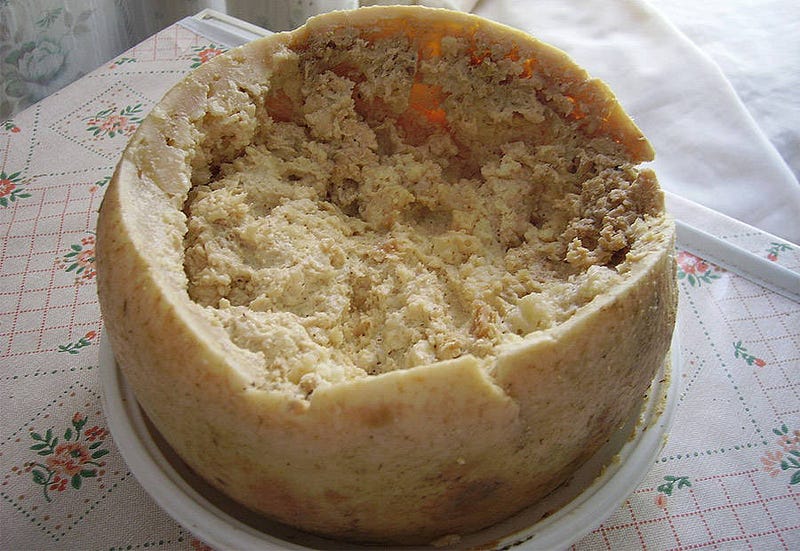
It’s a cheese called casu marzu, and dates back to the Roman Empire. It’s also referred to as “the forbidden cheese,” “maggot cheese,” and even “the world’s most dangerous cheese.”
This Sardinian delicacy is regarded as a vital part of Sardinia’s culinary heritage but you won’t find the maggot-infested casu marzu sold in many shops.
It’s been banned by the European Food Safety Authority — which means it’s illegal to buy or sell within the EU.
Did you say maggot-infested?
Casu marzu (literally “rotten cheese”) is a traditional Sardinian pecorino made with sheep’s milk — and filled with live maggots.
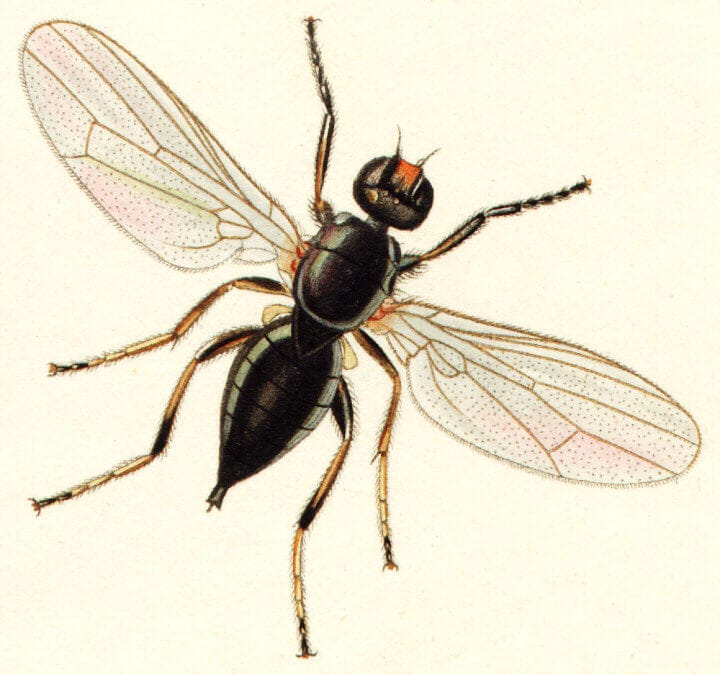
To prepare it, the milk is heated and then let sit for three weeks to curdle. By that time, a nice crust will have formed. The crust is then removed, making the milky concoction inviting for “skipper flies” (Piophila casei) to enter and lay their eggs in cracks that form within the cheese.
Next, it’s left in a dark room for two to three months during which time fly eggs hatch into larvae — or maggots — and begin to “worm” through the cheese and eat its proteins. The live maggots then decompose the cheese.
Simply put, the live maggots eat the cheese, digest it, and then expel an acid excretion that causes the hard cheese to break down and become spreadable.
Cheesemongers will tell you these excretions passing through the maggots are essential to the process, as they are what gives the cheese its creamy texture and distinctly pungent flavor.
The cheese is described as peppery, sharp, spicy, and intense. Others say it reminds them of a ripe Gorgonzola.
But bottom line, just know that spiciness you’re tasting is larvae shit.
Close your eyes and enjoy
Locals enjoy casu marzu with a freshly-baked moistened flatbread, melon and maybe a bit of prosciutto. It also pairs well with a glass of Cannonau, an intense red wine that matches the cheese’s aromatic robustness.
When tasting the cheese, diners are advised to either close their eyes, wear glasses or at least to place their hand under their nose to prevent the wriggling larvae from diving into one’s eye socket or nasal cavity.
The live larvae in the cheese can, when disturbed, can jump up to half a foot.
First-timers are encouraged to refrain from swallowing the cheese too quickly. Each bite should be thoroughly chewed, as there’s a risk the living larvae can travel into the stomach and bore holes through the intestines.
This can lead to a condition called pseudomyiasis, — the ingestion of eggs or larvae of flies.
Most people eat up to two pounds of bugs each year — and survive
You may be wondering how many people die from having their intestines eaten out by these unsavory critters.
Ironically, this island is noted for its high rate of longevity with nearly nearly ten times more centenarians per capita than the U.S. It’s considered one of the world’s healthiest populations.
According to Scientific American, most people on average unintentionally consume up to two pounds of bugs each year.
Tiny pantry bugs such as beetles, moths, weevils, moths, maggots and worms can live undetected in stored flour, pasta, rice, crackers, dried grains, spices, cereal products, and powdered foods.
Outlawed in almost every country
Casu marzu is banned in almost every country in the world. And at one time was even outlawed in Sardinia. It’s banned throughout the entire European Union and is illegal within the United States.
Eventually a shift in classification allowed casu marzu to be considered a “traditional food” in Sardinia, but it’s still mostly sold under the counter by locals or made at home.
In Italy, it’s been illegal to sell casu marzu since 1962. And according to Italian law, anyone who sells it can be fined up to 50,000 euros (U.S. $53,000).
Casu marzu’s dubious recognition
Back in 2009, as reported by CNN, it was declared the world’s “most dangerous cheese” by the Guinness World Records.
Casu marzu ranks third on the list of the most dangerous foods in the world according to Insider.
And in December of 2018, casu marzu was finally inaugurated into the Disgusting Food Museum in Los Angeles, California.
Not feeling this dish? For my friends, it’s a hard pass, too.


