
Would It Hurt to Acknowledge the Man on the Street?
Civil Inattention in a society of millions
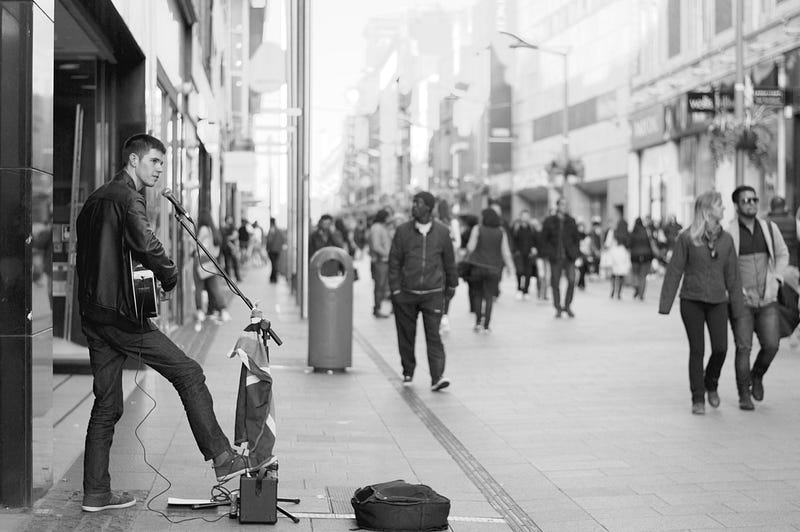
It was not the first time my wife and I had walked past him. He was there, just like every other day, at exactly the same spot, his guitar case open for those who might want to spare him a coin or two. As always, his choice would be a popular song. Today, that song was an acoustic rendition of Eric Clapton’s Tears in Heaven. He sang soulfully, smiling at those who walked past him, but no one paid him any heed. Like what I do every other day. People walked by, eyes cast ahead as if he was a figment of their imagination.
For some strange reason today, I hesitated as I passed him, and dug into my pockets for some spare change. It was unfortunate that I had left my coins at home, and for that reason, my wife and I went on our way, feeling a little disappointed that we could do nothing for him.
Why was it I felt this urge to help this man? I have walked past him many times in the past five months since we’ve moved here. Perhaps I felt bad for him. But not because of his plight. After all, I knew nothing of the man and did not feel the need to take it upon myself to presume what he was going through. What I really felt bad about was the fact that so many of us walked right past him, yet no one seemed to have considered even helping the man. And that I was one of them.
Did people really not notice his presence? The man was singing, after all.
It was easy to wonder about the effect this experience had on him. If everyone had walked by him without acknowledging him, would he have gone home hungry and feeling very much alone in a city of millions?
This brings to mind a theory by sociologist Erving Goffman called Civil Inattention. Civil Inattention can be seen as a kind of social norm or ritual aimed at mutually helping each other self-distance (how convenient in the time of social distancing!). As with all social norms, these are things we are socialised from a young age to believe. You sometimes experience this in your everyday life, where you glance at a stranger and quickly look away, with the thought that it is “rude to stare” or that you ought to “mind your own business”.
As a social norm, Civil Inattention has its place in our modern experience. It allows society to function at a level where everyone would be accorded his/her own right to privacy. It also acts as a kind of sociological (and psychological) defence mechanism against the million things that fight for our attention as we go about our daily lives. It is easy to see that most people would then require a criterion to differentiate between people who do not, and who require attention from us. In a world where interaction itself can be a social currency, people who demand attention from us are those whose interactions bring some kind of benefit. The benefit might not be material — it could be as self-satisfaction or even peace of mind.
However, would Civil Inattention lead to some kind of collective callousness? A kind society operating on a self-serving decision-making mechanism that makes us take part only if we have something to gain or lose personally from the interaction.
Would a society that functions on such a norm result in a state of loneliness experienced by those who need help, yet have no one to turn to, the “stranger-in-a-crowded-room” feeling we often spend our lives trying to avoid?
So if Goffman was right, we did in fact notice the man, just like how he probably would have noticed us. Perhaps we wanted him to be a stranger so that we could go on with our lives with as little fuss and external interference as possible. We had judged any interaction with him not worth our time. Had any of us made eye contact with the man, we would have acknowledged each other’s presence, which may lead to more interaction (perhaps a little too much for our liking) with one another.
Implicit in the decision-making mechanism is the assumption that we can make quick assessments of situations and people. Did we, as collective members of society who knew nothing about the man’s situation, make the right decision in deciding to walk right by him? Until we choose to acknowledge his very presence, we have given up our right to know.
I sometimes wonder if his choice of Tears in Heaven was a silent message to all of us about how he felt that day.
Would we know his name, if we saw him in heaven?