Worrying About My Brown Children
Reflections of a white mother of mixed race kids
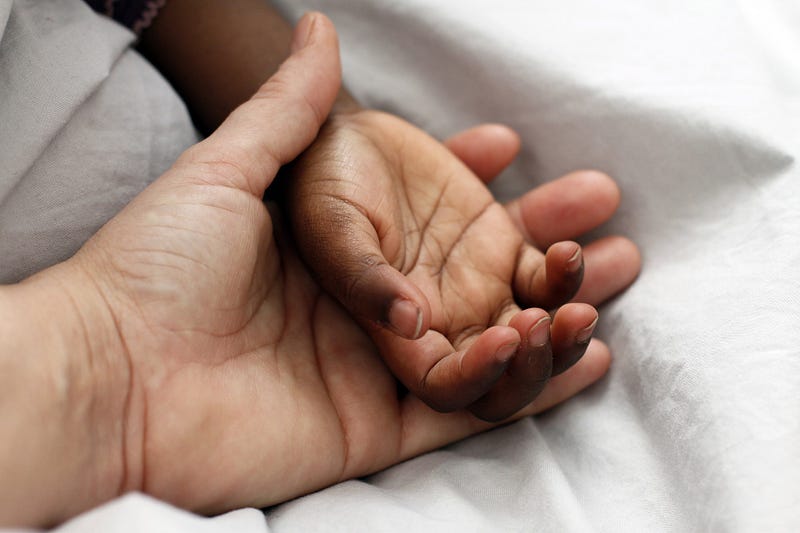
I’m a single mother by choice. That means that I had my children without the help of a parenting partner, and with the help of donated sperm and a fertility clinic. In Australia, where I’m from, it’s illegal to purchase sperm and I didn’t have the funds to travel abroad, so donations were my only chance.
And may I just shout out to the amazingly generous men out there, and the women who donate their eggs as well, who are willing to do this for others to fulfill their dreams of raising a family. You are truly saints on earth.
When I chose my donor, there were three possible options: two were Anglo-Saxon, with red hair and blue eyes — like my family. And one was Indian, with black hair, brown eyes, and brown skin. Definitely not like my family.
How to choose?
Each anonymous donor provided an A4 page of bullet points about themselves. I knew their:
- Coloring
- Ethnicity
- Education level
- Job category
- Relationship status
- Medical history and
- Reason for donating
It wasn’t much to go on. But it was all I had. I recruited an informal committee consisting of friends and family. Who would they choose, and why? Here were some of the factors we considered:
The two Anglo-Saxons were both single. The Indian was married with one child.
The two Anglo-Saxons both had histories of either depression or anxiety, plus one had a history of allergies. The Indian had an ‘excellent’ medical history, with no other details provided.
The two Anglo-Saxons both stated as reasons for donating: ‘to pass on my DNA’. The Indian stated ‘to help someone else have a family.’
All three were happy for their sperm to go to a single woman (not a guarantee).
My family is mostly pale-skinned and red-headed. My family also has mental illness in the form of anxiety and depression and possibly bipolar disorder, plus a strong history of allergies, asthma, and eczema.
Decisions, decisions
My family and friends were divided. Some advocated for one or other of the Anglo-Saxons, ‘so the baby will look like you.’ But, despite my father, brothers, and sisters all having red hair and blue eyes, I take after my mother with dark brown hair and grey eyes. So, although it was definitely true that the child/ren would look like they belonged in my extended family, it didn’t follow that they would resemble me in coloring.
Ultimately, it was my sister and I who found ourselves in complete agreement.
‘You don’t want to introduce more mental health issues into the family. It’s a no-brainer. Go for the one with the excellent medical history.’
And so, that’s what I did.
I chose an Indian donor. But first, I wanted to find out what that might mean for my kids in the future.
At the time, I was living in Western Australia, a very multicultural part of the country. I worked and socialized with people from a diverse range of cultures and felt confident that my kids would fit in nicely with their society.
But my family is from Tasmania, in the south of the country. It is still very, very white, and not very diverse, though things have improved in the last two decades. I knew that if I ever found myself back there, things would not be quite the same for my kids. It was a wise thought: two years after the birth of my first child, and pregnant with my second, ill-health forced me back to my little country Tasmanian town, and we’ve lived here ever since.
Getting the low-down
While I was still deciding, I spoke to a good friend of mine, who was from Fiji. She had married a Vietnamese man, and her children were half Fijian and half Vietnamese. I asked her if they had ever experienced any racism or discomfort with their ethnicity, or if she herself had.
She said something that really resonated with my world-view.
‘It’s about your self-confidence and your deep understanding of who you are in the world. If you are confident in who you are and in your right to exist and be just as you are, doing what you’re doing, then it gives others confidence in your position as well. It gives them permission to accept you as you are. But if you lack confidence in yourself and your place in the world, people can feel it, and it makes them question you, just as you are questioning yourself.’
This helped me. It is how I have always lived my life.
And yet, I hear you cry, you are a white person in a white culture. You don’t know the first thing about systemic racism.
You are correct. I don’t know. And that’s what worried me.
In Australia, racism is everywhere. Most white Australians, including members of my own family, would beg to differ. ‘There’s no racism here. Or sexism. Everyone is equal. We’re the lucky country’.
That’s why little has changed despite various movements for over 100 years. The people in power don’t see it, and so, don’t act on it.
As we slowly get more diverse representation in parliament, this is gradually changing and will, I hope, continue to change, though the pace seems glacial, complete with frequent slides backward. Still, more of us privileged white Australians are trying and learning and educating ourselves and our children. This also will help.
But for now, racism is everywhere. Since COVID-19, Chinese and other Asian citizens have been attacked and their businesses boycotted. Asians and non-white Australians have been the victims of hate since modern Australia came into existence, often from the government down. First people have been horrifically oppressed and mistreated since 1788, with little improvement. I have current friends who are studying at the university with me from Malaysia, Vietnam, China, Ukraine, and Africa. Every one of them has experienced racism from everyday citizens in my own home town. I was shocked when they shared their stories with me, but I shouldn’t have been. It’s a living part of modern Australia.
What would all of this mean for my kids?
In the end, I went with the Indian donor. His good health and generosity of spirit, embodied in his reason for donating, ‘to help others have a family’, put him at the top of the pack with ease. I was grateful to have such a good option — I was grateful to have an option at all, what with the scarcity of donor sperm in my country.
My daughter was born with deep brown hair, storm-cloud eyes, and beautiful caramel skin, and she looked exactly like me as a child. My son was equally a mixture of myself and his unknown father, with the Morgan chubby cheeks and cheeky grin, brown wavy hair, and deep brown eyes. They are the most beautiful children in the world, of course.
As youngsters, all was well. They were simply my kids. They are simply my kids. I see only them. Sometimes I look at the expression on one of their faces or a particular behavioral quirk and I wonder, am I looking at their father? Or their paternal grandmother? Which bits would I recognize, if we knew that side of the family?
But mostly, I see me, or my brother, or my father, or my grandmother in them. I marvel at how genes perpetuate through the generations and I rejoice in the knowledge that much-beloved ancestors are still alive in my children.
It’s not so glorious for them
My daughter is eight now, and children seem to grow up so fast these days. She’s still a little girl in many ways. She plays with teddies and make-believe games. She wants to be with me all the time. She loves to dress up.
But she is also becoming more aware of her environment, and her place in it. Her friendship group is strong, thank goodness. But she goes to a little country school in a little country town. There are probably no more than 10 non-white children in a cohort of 200 or more, almost all of whom have light brown or blond hair and pale skin.
And she feels it.
She doesn’t like to stand out. She never has. We’re currently working on some positive psychology concepts with her to help her with her mild anxiety. Her physical difference wasn’t a factor in this anxiety until recently. But now, it is definitely a factor.
Being tall, and the only person in her grade walking out of the school each afternoon with dark brown hair, she knows she stands out. In vain, I point to some of the other non-white kids, but they don’t register with her. They’re mostly younger, anyway. She’s also the only girl in her class with chin-length hair rather than long hair. But here’s the thing: that’s completely her decision. Every haircut, I give her the option to grow her hair. She always refuses, disliking the feeling of having it tied back or plaited. She wants it short, and she has it short, despite the difference in appearance.
Glimmers of hope
It’s a small thing, but it gives me hope. She remains strong in her own needs and wants. As yet, she does not push these down in order to ‘fit in’ with the group. She has a strong core of self, which I can only try to nourish and nurture; ultimately it will be she who decides who she becomes.
Her strong friendships are another piece of good in this anxious parent’s thinking. She has ups and downs like every girl, but so far there’s been no painful moments of girlhood relationship breakdowns. There’s a long way to go, but I have to remain positive.
As for my son, so far he dances through life in a bubble of self-absorption and satisfaction. He loves life, is confident, and has no problem with who or what he is. It remains to be seen how things develop, but I feel much less worried about that little guy.
Did I make the right choice, nine years ago?
Both my kids have suffered from allergies, eczema or asthma. My daughter has mild anxiety. Perhaps the health records of the Anglo-Saxon donors really wouldn’t have factored in. Or perhaps things would be worse for my kids. I have no way of knowing.
As far as I know, my kids have never experienced racism. They are very light-skinned compared with some half-Indian children I’ve seen, and that no doubt helps, though it shames me to admit that skin color is still such a divider of privilege in this day and age. Not knowing their origins, my kids could be mistaken for Eastern European or Asian descent, and so perhaps they have some immunity from racism due to their lack of distinguishing features. Or perhaps they simply haven’t encountered a racist yet…
Right now, my kids are generally happy and healthy. They are snuggled into a loving extended family that adores them for being them, not for being the product of anything or anyone else. Regardless of their origin, they are now in the world and forging their own way. It’s likely that my work will eventually take me away from small-town Tasmania and hopefully into a more diverse society where my kids can develop that side of their heritage more fully, and learn to embrace difference.
I guess, like every parent, I must keep on doing my best, and see what happens.


