
World-schooling with a Twist!
Curated Travel As a Way to Educate (and to Survive Parenting)
In February 2019, my husband and I both quit our jobs, pulled our daughters out of school and left on a journey which we had never imagined.
All of us love getting to know a new place, participating in local experiences, trying out a variety of cuisines and most importantly, discovering a little bit more about ourselves by deviating from our routines, don’t we? Shashank Nigam and I have lived in over ten cities and travelled to nearly 70 countries between the two of us. Boston is his favourite city, and London is mine (soon to be dethroned by Whistler, I believe). Perhaps, our shared wanderlust is the reason why we became such good friends. “Slow travel” is our thing.
And now we were living the millennial family’s dream, until…
The parenting treadmill
…we became parents (again). Truth be told, both our children have been a delight. They were always easy babies (relatively, speaking), except for their demand for our undivided attention.
And yet, the logistics of parenting two under three years was exhausting. Our days were a series of routines — morning routine, school routine, work routine, back-from-school routine, mealtime routine and finally bedtime routine. Simply renaming the routines to rituals made it sound better, but not for long.
At some point, after our second daughter was born, an extreme case of impostor syndrome set in where no matter how much we did as parents, we did not seem to get it right. It was partly our perfectionism, and partly the rebellious streak that all young parents carry. Whatever it was, our first few years as parents of two were exhausting and full of self-doubt. We were on the verge of concluding that we were not cut out to be decent parents.
Our questioning minds could not help but think — Did this have to be this way? And if generations before us have come out of this with flying colours, what was it about us that made us so much worse at it?
What our conscious minds did not know then was that several little observations and sparks of restlessness were simmering in our subconscious. Eventually, all of them crystallised and came to the surface as one idea —
Do we have to be on the parenting treadmill to raise our family well?
The answer was a resounding NO. But if not this, then what? We had been under a self-imposed travel embargo for nearly 2.5 years. It took even seasoned travellers like us that long to be able to raise our heads above the day-to-day treadmill of kids-careers-chores-sleep-rinse and repeat, and develop the confidence of travelling internationally with two little ones and more so, the confidence to parent differently than the norm.
World-schooling, but with a twist!
Several things came together at the subconscious level for us to take a tandem sabbatical out of our careers, pull our daughters out of school and pre-school and start their around-the-world education in February 2019.
The traditional parenting model of settling down in a big house with a yard was not working for us and our kids. It hasn’t been working for most millennial parents we know, either. This pandemic has only accelerated the much needed and much overdue rethink of how we educate our kids, how we raise our families and how we ourselves grow on a day-to-day basis.
We had heard of a few world-schooling families. However, the driving factor for most of them seemed to be a desire to see and live in many different places and cultures. The learning part would be incidental. Their adventures are spectacular, and yet, we differed fundamentally from these world-schoolers, in why we were doing this.
Wonder-led learning is the most effective form of learning, especially in early childhood. While children absorb tremendously from traveling, such travel may or may not cater to their specific curiosities. We wanted to harness the power and potential of our daughters’ curiosity right from the start, and make these fundamental to our travel-education year. We wanted to put the things that our daughters were already curious about at the centre of our excursion. We love learning ourselves, and we were not satisfied to let our kids learn incidentally while we traveled with them. Instead, we curated our travel in a way that we could explore what piqued at their inquisitive minds.
An example would be this Genovese pesto sauce available only in Costco, which our daughters insisted to have their their ravioli lathered with, and would have loved it for all three meals a day. So when that opportunity arose, we decided to visit Genoa, the birthplace of the original Italian basil pesto to learn how to make this pesto sauce and the accompanying pastas by hand. Along the way, the girls absorbed countless other culinary, cultural, social and touristic nuggets of experience simply by being in Italy. Yet, the anchor of all these “travel” experiences was to find out where their beloved pesto sauce comes from.
Our guides
We also differed from most other millennial parents in our approach to parenting and learning. Most working parents must become strategic optimisers, who recognise that their competence lies in their professions and it would serve their kids better if they were to hire high-quality caregivers to educate and care for them. We acknowledged this truth from the start, too. Yet, somehow we were unable to make the psychological leap that is necessary to overlook minor lapses for the big picture.
Perhaps, our thinking was deeply influenced by Dr. Stanley Greenspan’s book “Growth of the Mind” and Dr. Shefali Tsabary’s “Conscious Parenting”. Reading them were light-bulb moments for us. Dr. Greenspan shares the obvious yet elusive truth that the level of intelligence a child develops is directly determined by how loving, secure and responsive a child’s relationship is with their primary caregivers in early childhood. No way were we going to leave such an important task to anyone but us, no matter how difficult!
Dr. Tsabary’s premise is that we are not raising our children; our task is to raise ourselves so that we can be present with our children as they fulfil their intrinsic purpose. No way were we going to miss out on the single greatest opportunity for psychological and spiritual growth for us, by entrusting (or outsourcing, if you will) the care of our gurus, our children to the daycare and kindergarten system. There is nothing they needed to learn at that age that can only be taught inside a classroom. But everything we needed to learn was best learnt by being fully present with them in our collective journey together.
Parenting and educating our daughters was no longer an activity; it became a cause. So, we married our cause and our passion. Parenting, educating and traveling. All at once.
An approach to un-parenting and un-schooling
An experiment for curating educational travel was born. First came a curated five-week-long, thematic trip. The overarching idea was to travel so they could interact with a wide variety of wildlife, flora and fauna in its natural habitat. The themes we chose were based on what already interested our daughters at that point. For example, Tahiti was a search for the real Moana and her grandmother, who swam with stingrays. Melbourne and Phillip Island were a quest for the fabled “black” sheep who sings baa-baa and whose wool keeps us warm in the Canadian winters. They watched the origin of our gloves by taking part in sheep shearing. From those five, slow weeks spent leisurely in and around the Pacific Ocean, emerged lots of learnings and a framework that we would put to use in each of our travel-schooling excursions thereafter.
A framework emerges
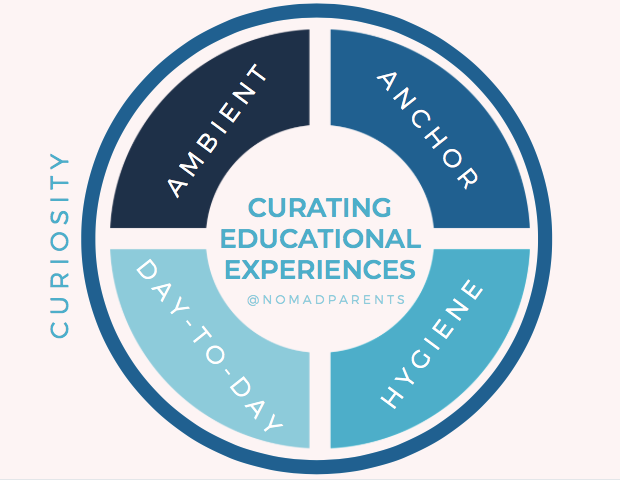
We started curating experiences for Sanaa and Samaa in locations unique to their fascinations— Tahiti, Phillip Island, Auckland, Genoa, driving through the US from Toronto to Vancouver, Yellowstone National Park, New York City, Princeton, NJ, Chiang Mai, Mae Sot on the border of Thailand and Myanmar, Bali, Himalayan foothills of Mussoorie, India. Everywhere, we looked for four types of experiences — anchor, hygiene, day-to-day and ambient. Most importantly, the cornerstone for all of these was a single question — what are our girls curious about at this point in time?
Some themes and ground rules
There have been a few common themes as to what makes an outstanding learning experience for the kids. Our overarching theme was to take them to visit wildlife in its natural habitat. Architecture, scenery and so on did not interest toddlers and preschoolers, so we left those experiences out and stayed as close to our mission as possible.
We did not aim to budget-travel. While we did not always splurge, we were particular about the quality of our lives on the road. The quality of accommodation and the quality of food we consumed (no McDonald’s was a mantra!) was a priority. However, we did figure out some very cool hacks which almost anyone can benefit from — more on that in the section on financing travel education.
We quickly learnt to let go of our rigid plans and go with the flow. Detours became windows to learning. We watched out for them and proactively followed an interesting rabbit hole if it piqued at their curiosity even if it was not part of the original plans or looked mundane to us. Sometimes we even let go of some bucket list experiences.
And yes, so we steered clear of any bucket list destinations my husband and I would have liked to visit. We did not want to dilute the purpose of this trip — education.
We made meeting people a priority. For example, both the girls spent considerable amounts of time with grandparents and great grandparents this year, which resulted in solid language immersion. They already spoke our mother-tongues, but now they can pass off as natives! Sometimes, we also serendipitously bumped into other world-schoolers with kids of similar ages. We made sure to follow up with playdates etc.
Anchor experiences
Anchors are activities or encounters that are unique to the place we visit and those that can’t be done elsewhere. In the context of travel schooling, these would include learning how to make fresh pasta and pesto sauce in Genoa, Italy.
If you homeschool, this could take the form of visiting the nearest national park, a famous museum or a historical site in your town. You would be surprised how many things you could find about your local town that could never be experienced elsewhere. A black sand beach with access only by walking through small sunflower fields, a fully functional village inside a formidable medieval naval fort, a community of Indo-Portuguese descendants who speak a language unique to this town — these are all experiences you could have only in my little known hometown in Western India. Anchor experiences are everywhere; we just have to find them. We decided to travel out to the other side of the world because in those days we could. With the pandemic, we may all have the opportunity to educate our kids with anchor experiences right next door!
The key to making anchors leave an impression on the child’s mind is through reinforcement. It is the repeated revisiting through repeat visits, pictures and souvenirs that helps the kids internalize the experience. For example, we bought storybooks from each major anchor. Or we called everything dirty that one of them was about to touch “Koala poo”. The reinforcement is needed because anchor experiences are so unique that it is rare for them to be repeated. Koalas are only found in Australia. Only Ubud has an entire forest full of monkeys. And tuk-tuks are an exclusively Thai and Indian mode of transport.
Ambient experiences
Another category of experiences is ambient. For instance, when we travelled to Genoa because it has an ancient port with a long (and dark) maritime history, elements of the maritime life had made their way into everything from the architecture of buildings, to the names of shops and even the souvenirs that were sold in them. Everything had to do with sailing, exploration and Columbus. None of these is things that we were looking for. However, these elements create a vibe that results in activities and environments built around that vibe. This is true of the largest of cities and the tiniest of towns. Moreover, this is a holistic educational experience for the kids because they can now observe first hand the local life of a place, a maritime culture and how that culture shapes the preferences, lifestyle and day to day activities of the people who live in these towns.
It is important to make the trip a little longer than it needs to be. Let boredom in. Only when our schedule is not packed with activities, do their minds become aware of such ambient experiences. Like the ringing of church bells, the chirping of birds, the waves crashing on the pier, the gentle cool morning breeze as I write this while watching the sunrise over the last slivers of snow on the mountain tops. The ambient experiences are those you don’t proactively seek, that you can’t consciously seek. They are more than just the vibe of a place. Rather they are interwoven in the fabric of the place. They come to our children and us by being present in a certain place, inhabited by certain people.
Hyperlocal experiences
The next category of experiences is hyperlocal experiences. These are things that are part of everyday life for the local residents but a big departure from our lives in Canada — for example, taking a few hundred steps to get to the port in Camogli, or taking the bus and the MRT trains in Singapore, or even walking along Jalan Sugriva and Jalan Hanuman in Bali to get to our dance classes, yoga classes or local bookshops in Bali. These show the kids that there are different ways to live and thrive.
These experiences may seem difficult to pick if you are the local resident. However, experiencing life as another demographic in your own city can be fascinating. Taking a route different than your usual one to get to school. Or trying out a new mode of transport every once in a while can add so much flavour to their thinking.
Hygiene experiences
Finally, hygiene experiences are those that make the kids feel at-home, no matter where they are. For our girls, we took the effort to find a playground and play structures in every city we went to. Be it an indoor playground filled with plastic balls in Panama City, or a charming playground with wooden structures and a massive splash pad of fountains in Nice, or even a playground constructed purely out of bamboo and sand in the heart of Chiang Mai. Where there were no playgrounds available, we took them to open spaces for hours of open-ended play. Visits to the neighbourhood playground were a regular part of our life back in Toronto. Having a semblance of the same activities in a foreign city made our girls feel anchored and comfortable. In the absence of such experiences, the girls would feel a sense of loss of the things they love to do. The uprooting would make the transition too harsh for their sensitive minds.
Bringing the experiences together
Not every place offers all four types of experiences. With the exception of anchor experiences (which were the very reason for curating a city), most places offered at least three of the four experiences enough for satisfying their curiosity, experiential learning and yet feeling anchored.
The unexpected, and where we are now
After sending three months under lock own in India at grandparents’, we took a repatriation flight back to Canada in May 2020. Covid19 may have been unexpected, but not so much that it would shake the conviction we have developed in our approach to unschooling and unparenting. We have once again done the unexpected by not returning to Toronto where our home was before we started our journey. We have now moved to Whistler, BC and are living in this small ski resort of 12,000 residents. Moving to such an unlikely place, living in the mountains for the very first time and sending our children to the Waldorf school here are all very much part of unschooling and unparenting. We are looking forward to skiing, making friends from scratch in this new community. Once again, the anchor here has been the Whistler Waldorf School, the ambient experiences will come from the mountains and the outdoor/sporty lifestyle, the day-to-day experiences will come from things such as forest exploration (our girls have been going to a forest school here since we moved) and biking, and the hygiene experience is going to be our “home”.
Education in a post-pandemic world
For parents who do not like travelling that much especially with their kids, or love doing something else they’d rather combine parenting with such as sports, permaculture, cooking and so on — that’s absolutely possible too. Travel is an obvious choice as it happens to lend itself to a rich experience naturally. However, it is the focus on un-schooling and curiosity-led learning that is fundamental. Likewise, it is the idea of un-parenting that matters. Our educational framework can be applied by any millennial parent, any unschooler — travelling or not.
Terrific Resources to get you thinking about your own Questbased Learning™ journey:
Read about our journey — Our Worldschooling Journey, With A Twist
Subscribe to Medium, follow us on Instagram and read about our newest adventures at our Linktree page.
Book a FREE consultation call with us to explore a Questbased™ approach to your family’s learning!


