[World Spotlight] The Impact of the Israel-Hamas War & Global Commodities Markets on World Affairs
Follow Areas & Producers for content about World Affairs

Wars are taking the headlines by storm! Even though it was a big week for the global mining industry, it doesen’t seem to be as important as the Russian threat to Moldova or the international outcry for Palestinians in Gaza. Not to mention the increasingly powerful coalition made up of the UK, US, France and Germany naval forces in the Red Sea.
I want to keep this focused on the situation in the Gaza Strip for now. Because I got into a little scuffle with another Medium writer about his story entitled “Why Hamas Doesn’t Want a Ceasefire During Ramadan”
I overall agree with the perspective shared by Mookie Spitz that both sides of the war are not taking the international sentinment for a cease-fire seriously. The writer elegantly takes Ramadan as an example to explain his reasoning. I, however, did not see eye-to-eye about some his views on the US strategy and historical context of the Middle East region. For example, see what I highlighted in his story below:
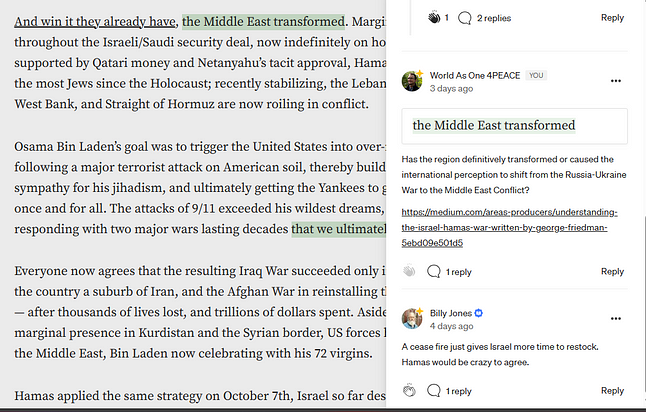
I do not agree that the Middle East has transformed as a result of the Oct 7 attack and Israeli’s response to them. Here’s what the author wrote back to me:
“I think people can walk and chew gum at the same time:
Yes, perception has shifted from Ukraine to the Middle East
And yes, the Middle East is transformed because the marginalized Palestinians are now front and center.”
Not bad. This response I will take as true. But I could not stop there. When I came to the part of this story where the author referred to “two major wars [in the Middle East]” and that the US had been the losing side to those wars, I could not help myself but to be bold. Look at my comment below:
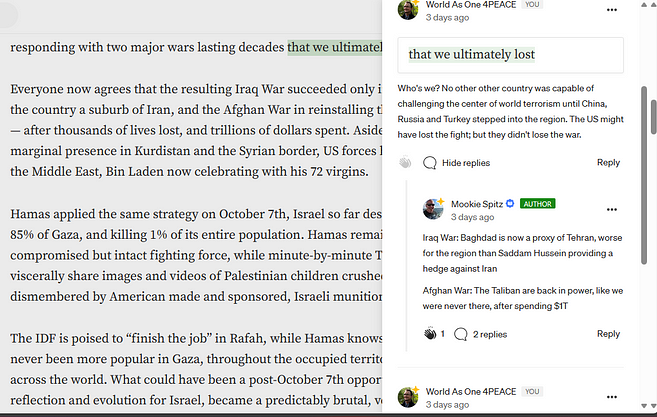
As expected, the author gave a fierce response to my comments. I only sought to defend the US position. It is indeed part of the US grand strategy to withdrawal its military resources from the Middle East and focus more on the country’s geopolitical objectives to deter China’s rise in the Indo-Pacific. This has allowed Iran to gain a stronger foothold in the Middle East, but this doesn’t necessarily mean defeat for the US military’s past wars there.
Go to the story in the link above to read more about it. Explore more content about the impact of the Israel-Hamas War & Global Commodities Markets on World Affairs in the publication Areas & Producers below.
George Friedman is founder of Geopolitical Futures and author of many books on geopolitics. This latest writing by Friedman about the outcomes and historical context of the Israel-Hamas War is insightful and a little controversial. Have a look at it here.
Now, here are my thoughts about the article.
“No Arab or Islamic country or movement was prepared to ally militarily with Hamas. The group thought that while a direct, combined attack on Israel would not succeed, it was still possible to force Israel into an untenable position. We now know that this was the line of thinking because Hamas did indeed attack Israel and, in doing so, isolated it from other potential allies. This decision shows Oct. 7 was more complex and, to an extent, more successful than initially thought.”
In hindsight the attack on October 7 was successful in getting the world’s attention; in other words, shifting the international perception from the Russia-Ukraine War to the Middle East Conflict. Using foresight will tell a completely different story about the big picture in International Relations. My meaning is that I do not think Hamas will survive to see a Palestinian state, because the group’s future depends on strengthening cooperation with state-actors that can supply arms. And, as Friedman pointed out here, the attack has made the group less attractive on the international stage.
The Houthis have succeeded where Hamas has ultimately failed — the Houthi rebels are organized around an area where they hold a major advantage. And that, my friends, is maritime warfare. There isn’t a NATO of the Red Sea, nor any other type of nascent coalition like the Quad in the Indo-Pacific, that can be present near the Houthis at all times. State-actors like Iran know this, and by supporting the Houthi rebels, it ensures that US and UK interests in the Red Sea and Persian Gulf do not go unchallenged by Tehran’s own geopolitical objectives.
“Wars are political affairs, and the Israeli Cabinet had to decide to attack from the air to calm the situation and mollify the growing hostility to the government. Israel hoped that airstrikes and special operations would break Hamas. But Hamas was fighting urban warfare on its own terrain — a terrain where disengagement and sudden counterattacks were practical choices.”
Friedman’s words are said like a true political geographer. Talking about political affairs, air attacks, urban warfare and terrain, is another way of saying that we are witnessing global modern warfare at its finest. This makes me think of the video game Call of Duty: Modern Warfare (it was very popular version of the Call of Duty series). I wonder if all those gamers realize that what they are playing is actually being carried out in real-life scenarios like Israel and the Gaza Strip. Psst, I seriously doubt it!
Anyways, Friedman indicates that we should be thinking of this Israel-Hamas war in terms of geographical terms. The initial attack on October 7 was a surprise element, one which was poorly defended and has made Israel appear at its most insecure position since the contemporary era. Israel might have the military advantage, but its political will is constantly being tested as it carries out increasingly more severe attacks on Hamas and innocent civilians in the Gaza Strip. The Israeli political will is not as strong as its military might, and the Houthis are likely to step up attacks from maritime areas until this is proven true.
“Israel is now caught in a war in northern Gaza with a rigid Cabinet that won’t accept a strategic retreat and a media ecosystem criticizing its approach…At this point, Israel’s military options are limited, thanks in no small part to the shift in public opinion in its most important ally, the United States. The possibility of a successful assault on Hamas is dwindling, and even Israeli citizens are demonstrating for a deal to be made for the remaining Israeli hostages.”
The US wants a solution to this Israel-Hamas war — asap. The US cannot appear to be too conciliatory to the Israeli enemy, while it also cannot sit idly by as Israel pummels innocent civilians and infrastructure into oblivion. I think, what the US really wants to do, is wait for the right moment to step in as peacemaker to this conflict. However, that role isn’t going to be prioritized during the month of China’s National People’s Congress (NPC) and the Australia-ASEAN 50th anniversary.
The US knows that it must play a leading role in the Indo-Pacific strategy. But that doesn’t mean that it will continue to play a leading role in the world. As everyone following current affairs should know by now, the US is slowly disengaging from the role as world peace diplomat. This makes certain countries happy (like Iran) but displeases others (like China) who do not want to become the targeted attention of a US military strategy (like Russia).

Live from Toronto this week was the Prospectors & Developers Association of Canada (PDAC) convention — a rock star event for the global mining industry!
This event is a must-have on the calendar for any students, investors, strategists or futurists who have an interest in staying up to date on what’s happening across the mining industry. Here are some of the main highlights from this year’s PDAC:
- PDAC 2024 Convention welcomes the world to the Premier Mineral Exploration and Mining Event in Toronto
- “Metals Matter” Keynote Speech by Jakob Stausholm of Rio Tinto at PDAC 2024
Rio Tinto CEO Jakob Stausholm delivered his keynote speech entitled “In a World in Transition, Metals Matter” at the kick-off of the PDAC 2024 this week.
The CEO of one of the world’s largest mining companies, Stausholm outlined his speech according to six main points about the future of the global economy and mining industry: Decarbonization at the Core; New Opportunities — Lithium and Scandium; Diversification and Traceability of Supply Chains; Investment in Innovation; Engagement and Collaboration; and Financial Resilience.
CEO Stausholm stepped away from the PDAC 2024 convention to speak with Bloomberg BNN reporters about the global mining industry.
Here’s what he said about China’s near-term demand for global commodities:
“Look, everybody says that it is a very difficult world that we are living in, and certainly there’s a lot of geopolitical uncertainties, but the world is growing. And when you look at China, they grew around five percent last year…what we see is that there’s a lot of infrastructure being built…all those things requires steel, requires copper, requires aluminum.”
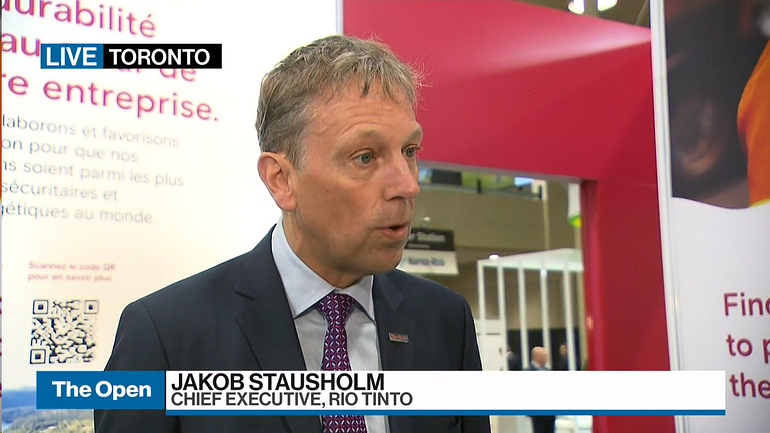
There’s been a lot of talk about China’s demand for global commodities since 2023. The results have been more than disappointing; in fact, many of the miners who were betting on a strong recovery from China’s economy in 2023 were hit hard by a lack of demand for their resources in the China market. Industrial demand from China has been particularly lackluster.
Meanwhile, the surge in demand for electric vehicles (EVs) has not been the same story. China’s BYD reported higher earnings than Tesla last year, becoming the top EVs seller in the global market. This story largely revolves around China’s comparative advantage in battery materials resources and technology.
Here’s what CEO Stausholm said about the mining outlook for EVs demand in China:
“What we have seen over the last few years is that the LFP [lithium-iron phosphate] batteries has grown a lot. In fact, two-thirds of the batteries produced in China are now LFP. LFP has got lithium — but no nickel, no cobalt — so it’s unclear about the role of the elements here. But we feel quite comfortable about lithium.”
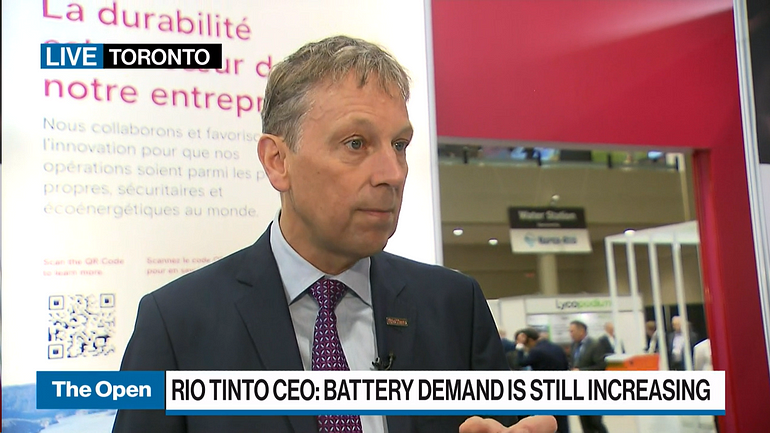
LFP batteries were once a buzzword that have now, evidently, turned into a stark reality in China’s comparative advantage to produce the high-quality batteries needed to meet the rising global demand for EVs.
It’s clearly not just about lithium, cobalt or nickel, anymore, as the chemistry for battery materials is getting more complex — a testament to its demand in spite of limited natural resource potential and global mining projects for the critical minerals.
The world’s largest miners, particularly Rio Tinto, are pushing a narrative that in order for the world to truly decarbonize, that the need for those critical minerals is going to explode. Copper is one of the most significant global commodities under this energy transition narrative. For example, gold and copper miner Newmont, based in Colorado of the United States, made a deal to acquire Newcrest which will give the company a significant global reach in copper production capacity in the near-term.
One of the reasons why this deal is so critical to the global mining industry is due to the key issues that the industry is facing with copper supply and demand in the future. Newmont says that copper should be viewed as one of the critical minerals in the United States, Canada and Australia.
Follow Areas & Producers for content about World Affairs.