
Religion + Social Justice
World Religions Working Together for Justice
Why I’m attending the 2023 Parliament of the World’s Religions
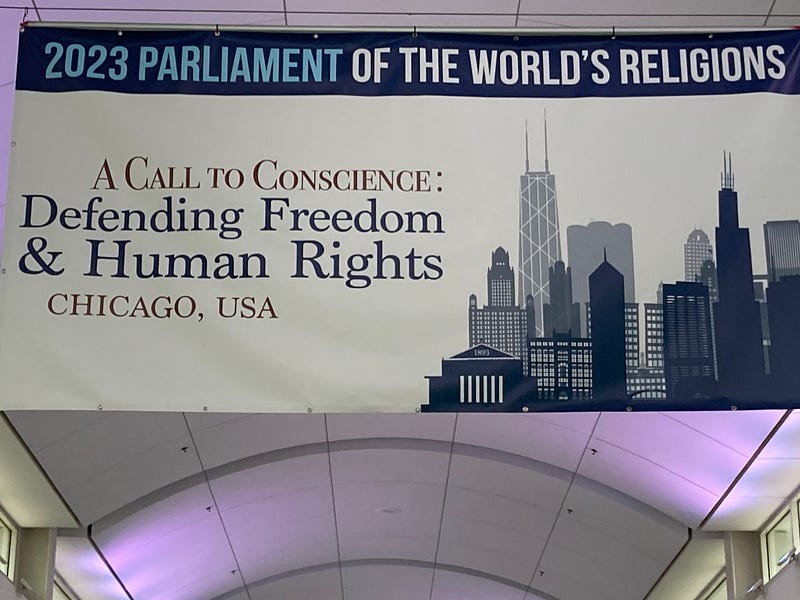
Discovering the PoW[e]R of Religions
If you’re like most people, you’ve probably never heard of the Parliament of the World’s Religions (PoWR). I’m a professor of religion and I only recently learned about the Parliament. PoWR is the world’s premier interfaith convening of civic, spiritual, and grassroots change-makers. According to their website:
The organization was founded on a mission to cultivate harmony among the world’s religious and spiritual communities and to foster their engagement with the world and its guiding institutions to address the critical issues of our time.
PoWR dates back to the 1893 World’s Columbian Exposition in Chicago, where the historic first convening of the World’s Parliament of Religions created a global platform to engage the world’s religions.
The Parliament reconvened in Chicago in 1993 to celebrate 100 years. Since 1993, PoWR has attracted participants from more than 200 diverse religious, indigenous, and secular beliefs and more than 80 nations to its international gatherings. Since the 1993 convening, the Parliament has convened seven times around the world.
Parliament convenings are the world’s oldest, largest, and most inclusive gatherings of the global interfaith movement. Nearly 60,000 people worldwide have convened in an enduring commitment to justice, peace, and sustainability. This year marks the seventh convening since 1993, and the 9th convening overall. The Parliament has returned to its birthplace in Chicago to celebrate 130 years.
I am currently in Chicago for the beginning of the 2023 Convening. According to its promotional literature, PoWR is committed to creating a just, peaceful, and sustainable world. It seeks to create such a world by addressing the critical issues facing the human community and the earth. The work of PoWR is articulated as follows in its founding document, A Call to Our Guiding Institutions:
The realities of the world situation set the critical issues of our time in stark relief: disintegrating community; declining resources; injustice; divisions into rich and poor; spiritual indirection. However, if we address these issues from the perspective of shared moral principles and a “global ethic,” we find hope [in]…building community…commitment to sustainability…striving for justice…solidarity and service…seeking spiritual grounding.
The theme of this year’s convening is A Call to Conscience: Defending Freedom & Human Rights. I’m excited to be attending my first PoWR convening. I’m also honored to be participating on a panel entitled Religious Perspectives on Approaching Interfaith Dialogue. I will be exploring the topic, “Working Towards an Interfaith Liberation Theology.”
Religion as a source of liberation
Many (if not most) religions emphasize some notion of “salvation.” While salvation is essentially a state of being saved or delivered from harm or a dire situation, many religions frame this “deliverance” within a spiritual or even metaphysical context rather than a physical context. Many religions even present concerns regarding the physical realm as a source of spiritual bondage from which human beings need to be delivered.
This focus often leads to an understanding of religions as “otherworldly” and detached from the inequities and injustices of this world. The soul and/or spirit gets prioritized over the body. This results in injustices like racism, sexism, classism, ableism, or any form of oppression based on bodily and/or social identifiers such as sexual identity and/or orientation or ethnicity getting minimized or ignored.
Liberation theology, however, presents “salvation” as liberation from all forms of social, political, and economic oppression. Salvation is about this world not some distant future world.
While “liberation theology” may have developed within Christian theology, I’m interested in exploring contributions made by liberation thinkers from multiple religious traditions and exploring resources found within various religious traditions that contribute to the promotion of equity, equality, and justice by recognizing the inherent worth and value of all life.
While I have long been interested in liberation theology, I developed an interfaith interest immediately after the 2020 police killing of George Floyd. While the killing of George Floyd produced international outrage, I was disappointed by what I considered to be the relative silence of major religious leaders from various religious traditions.
It seemed to me that the teachings and tenants of most world religions should have provided religious adherents with resources to vehemently condemn and speak out against the killing of George Floyd. While I and a few black religious leaders I knew were appealing to our religious tradition to condemn the killing of George Floyd, the lack of any “official” condemnation and the silence from most world religious leaders was deafening.
As a result, I started grappling with the idea of promoting interfaith understanding, cooperation, and collaboration that can enable leaders and adherents of various religious traditions to work collectively and constructively toward the creation of interfaith liberative theologies that can unite us and push us beyond the doctrinal differences and limitations of our particular religious traditions to think about and advocate for human and planetary liberation in new and universal ways.
I’m hoping my time here at the Parliament of the World’s Religions can provide me with conversation partners to explore this idea in more depth.
More ongoing discoveries and reflections to come
As I stated, this is my first PoWR convening. I’m not quite sure what to expect. If you are reading this article and have previous experiences with the Parliament of the World’s Religions, I would love to read any responses you might wish to share about your experiences. I’m also sure other readers might enjoy reading such responses and learning more about PoWR as well.
While I imagine my time will be fully occupied attending several of the hundreds of sessions being offered at this year’s convening, I’m hoping to find time to chronicle my experiences here on Medium. I’ve never attempted to write a “series” of stories so this will be a new experience as well. If anyone has experience with writing a series on Medium and has any suggestions, I would welcome that feedback as well.
While I’m greatly inspired by the origin, history, vision, and purpose articulated by PoWR, there’s a part of me that wonders how transformative the work has actually been. I can’t help but wonder, “Why have I just learned about PoWR when it has been around for 130 years?” I’m hoping it’s because positive news/work often tends to garner less publicity and attention than negative news/work. If that is the case, I hope my writings here will help bring much-deserved attention to the transformative work being done by PoWR.
While there’s so much running through my mind at the moment and so much more that I feel I should write, as I look through the 300-page program book I realize I need to devise a game plan for scheduling the various sessions I want to attend and for identify the people I want to meet over the next five days.
I hope to share more soon!
If you appreciate this article, I’d love to share my articles with you directly. Please click here to receive an email whenever I publish a new article.
Thanks for reading and (hopefully responding with claps and a comment) I look forward to sharing more with you and hearing from you.
Learn more about Guy Nave here
See all my Medium articles here
Follow me on Twitter: @guynave2